 ETB
 KES - Kenya
 UGX - Uganda
 TZS - Tanzania
 RWF - Rwanda
 NGN - Nigeria
 ZAR - South Africa
 USD - Zimbabwe
 GHS - Ghana
 ZMW - Zambia
 USD - International

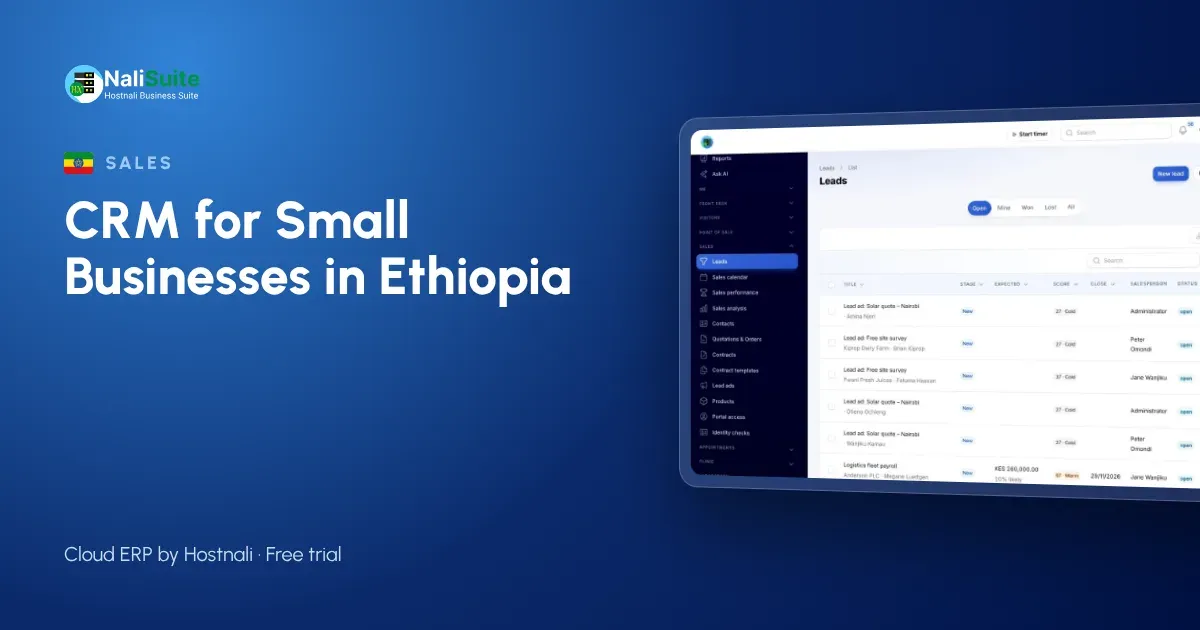
Whether you sell tours from Addis Ababa or industrial supplies in Adama, your customers expect quick, personal answers. A CRM helps a small team give them, without losing track of anyone.
This guide shows how Ethiopian businesses can get started.
Why small businesses lose deals
Ask yourself honestly whether any of the following is true in your business:
- More than one person handles enquiries.
- Follow-ups depend on memory.
- You do not know your conversion rate.
- Customer details live in several places that disagree.
A CRM (customer relationship management system) is one place for every lead and customer: who they are, what they asked about, every call and message, every quotation and what happens next. Its job is simple: make sure no promising conversation is forgotten.
Example: a tour operator in Addis Ababa
Think of an example tour operator in Addis Ababa selling trips to Lalibela, Gondar and the Simien Mountains. Enquiries come by email from abroad, through the website and on messaging apps. Different staff answered different channels, and some travellers received two different prices.
With a CRM, every enquiry is a lead with travel dates and group size. One person owns each lead, quotations are sent from the system and tracked, and reminders prompt follow-ups before the traveller books elsewhere. The manager sees which trips sell and which sources bring real bookings.
Five habits a CRM builds
1. One record per customer
Start with clean contacts. Import your existing customer list from Excel into Contacts, merge duplicates, and from then on add every new person once. The CRM, invoicing and helpdesk all use the same record.
2. Every lead in the pipeline
Leads come from many places: website forms, WhatsApp, Facebook and Instagram ads, phone calls and walk-ins. The more of them land in the CRM automatically, the less typing your team does. In NaliSuite, website forms and Facebook and Instagram lead ads create leads by themselves, and WhatsApp conversations can become leads too.
3. A next step for every lead
Follow-ups slip when they live in someone’s head. In a CRM, every lead has an owner and a next activity with a date. Each morning, salespeople open their list of today’s follow-ups and work through it.
4. Quotations from the same system
When a lead is ready, send the quotation from the CRM rather than a separate document. In NaliSuite, Sales and Quotations builds a branded quotation from your price list, the customer accepts it online, and it becomes an order and an invoice without retyping.
5. A weekly look at the numbers
| Measure | What it tells you |
|---|---|
| Leads by source | Which channels are worth your money |
| Conversion rate | How many leads become customers |
| Time to close | How long a typical sale takes |
| Lost reasons | Why customers say no |
Quotes, invoices and payment
When a customer accepts a quotation, it becomes an invoice with a pay link for card or bank transfer. See online payments in NaliSuite.
Getting the team to use it
In many Ethiopian businesses, several people share the same enquiries. Decide who owns each lead, and let the CRM show it, so customers deal with one person and receive one price.
Keep stages simple and use the reminders. Agree how quickly new enquiries are answered, and review open quotations every week.
Record why deals are lost. Over a season, the reasons show you whether prices, timing or the offer need to change.
Choosing a CRM that fits
Three questions decide most CRM choices. Will the team use it on their phones? Does it capture leads from WhatsApp, forms and ads without copying? Does it connect to quotations, invoicing and payments, or will someone retype every sale? A CRM that answers yes to all three pays for itself quickly; a clever one that nobody opens does not.
Customer data and Ethiopian law
Ethiopia’s Personal Data Protection Proclamation No. 1321/2024 sets rules for handling personal data. Collect what you need, keep it secure and use it only for the purposes you have explained to customers.
A CRM with access by role keeps customer data in one protected place instead of scattered across inboxes and phones.
Frequently asked questions
Can I use a CRM for customers abroad?
Yes. Leads from anywhere go into the same pipeline, and quotations can be sent in the currency you agree.
Does Ethiopian law cover CRM data?
Yes. Personal data in a CRM falls under the Personal Data Protection Proclamation No. 1321/2024. Keep it secure and use it only as explained.
Should I build my own CRM in a spreadsheet?
It works for a handful of leads, but reminders, sharing and history quickly outgrow a spreadsheet.
Can I import my existing contacts?
Yes. Upload an Excel or CSV file and match the columns to fields such as name, phone and email.
Try NaliSuite
NaliSuite includes a CRM, quotations, invoicing and contacts in every plan, from ₵25 a month with a free trial. See plans.