 ETB
 KES - Kenya
 UGX - Uganda
 TZS - Tanzania
 RWF - Rwanda
 NGN - Nigeria
 ZAR - South Africa
 USD - Zimbabwe
 GHS - Ghana
 ZMW - Zambia
 USD - International

Ask an Ethiopian business owner how they market to customers and the answer is often Telegram channels, Facebook pages and word of mouth. Email rarely comes up. Yet for businesses that sell to other businesses, NGOs, embassies and international clients, email is often where buying decisions are actually made.
This guide is organised around the questions Ethiopian business owners ask when they consider email marketing, with direct answers and the steps that follow from them.
“Who will actually read my emails?”
Email works best with people who already use it for work:
- Companies and NGOs in Addis Ababa that buy supplies, services or training;
- Hotels, lodges and tour operators dealing with travel agents abroad;
- Exporters of coffee, leather, textiles or flowers who stay in touch with buyers;
- Professional services such as consultancies, IT firms and clinics with corporate clients;
- Diaspora customers who buy services for family at home.
If your customers are mainly walk-in buyers who rarely check email, Telegram or SMS reminders may matter more. Many businesses use both.
“Where do I get email addresses?”
From people who want to hear from you. Good sources:
- Existing customers. Your invoices and orders already contain email addresses. Ask these customers, once, whether they would like news and offers, and add only those who agree.
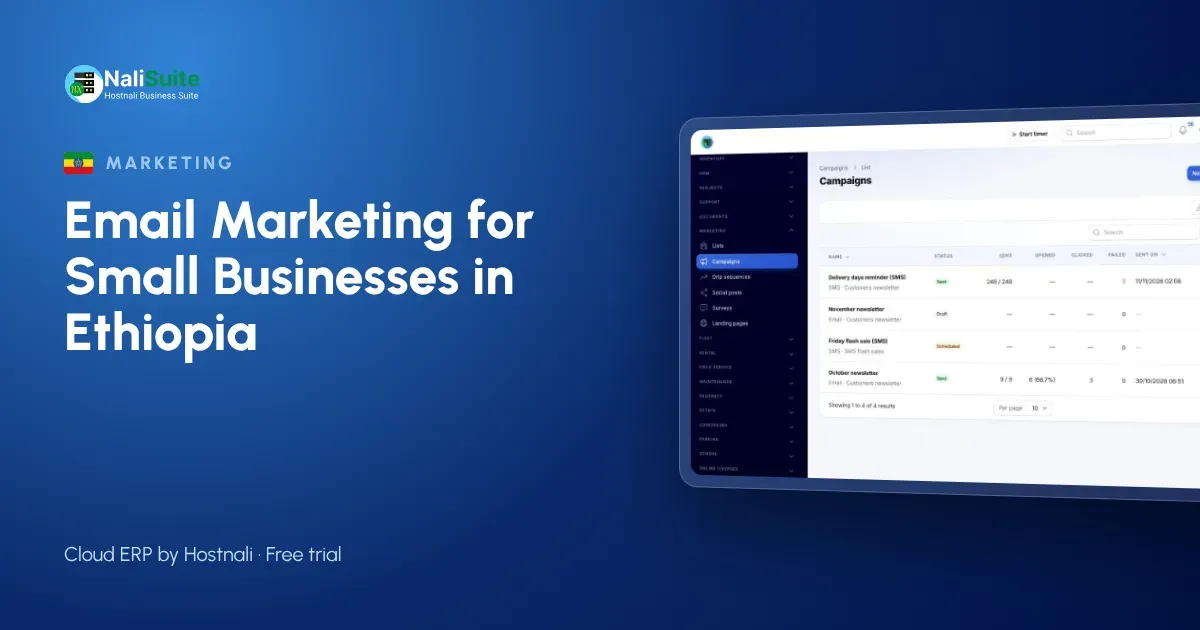
- A sign-up form on your website. The NaliSuite marketing app includes subscribe forms and landing pages that feed your lists directly.
- Events and trade fairs. A QR code on your stand, linking to the form.
- Your Telegram channel or Facebook page. A pinned post inviting followers to join for detailed updates.
Do not buy lists. They damage your sender reputation and contain people who never agreed to hear from you.
All your contacts can sit in one place, the NaliSuite contacts app, with tags showing who opted in to marketing.
“What should I write about?”
Write about what your customers care about, not what you want to say. Ideas for an Ethiopian small business:
- New products or services, with clear prices or “from” prices in birr.
- Seasonal needs: preparations before Meskel or Enkutatash, end-of-year procurement for NGOs, or the busy tourism months.
- Practical tips: how to choose a product, maintain equipment or plan a project.
- Case stories of work you did, with the client’s permission.
- Company news that affects customers: a new branch in Hawassa, new opening hours, a new service.
Keep each email to one main message and one button.
“How do I stop my emails going to spam?”
A few habits make a big difference:
- Send from your own domain, for example [email protected], not a free webmail address. Hostnali’s email hosting gives you mailboxes on your domain.
- Set up authentication records (SPF, DKIM and DMARC) on the domain. Our support team can help.
- Email only people who opted in, so complaints stay low.
- Make leaving easy. NaliSuite puts an unsubscribe link in every campaign email and skips opted-out contacts.
- Remove addresses that bounce.
“Which language should I use?”
Use the language your customers use for business. Some businesses send English emails to international and corporate clients and Amharic messages to local customers. You can keep separate lists or segments for each, so nobody receives an email they cannot read.
“How will I know if it is working?”
Decide before you send what success looks like. For a supplier, it may be quotation requests; for a hotel, bookings; for a training centre, registrations. Then look at:
- opens, as a rough sign that the subject line worked;
- clicks, to see which offers interest people;
- replies and enquiries;
- sales or bookings that followed, which you can see when marketing, CRM and sales share the same customer records.
Compare your campaigns with each other and keep what works.
“Can it run without me?”
Partly. Drip sequences send a series of emails automatically when someone joins a list. A three-email welcome series, written once, introduces every new subscriber to your business: a welcome, your main product or service, and answers to common questions.
“What do the rules say?”
Ethiopia’s Personal Data Protection Proclamation No. 1321/2024 sets out rules for collecting and using personal data, which includes email addresses and names on a marketing list. Collect addresses with clear consent, explain what you will send, give an easy way to opt out and respect opt-outs. As the law is recent, check current guidance on what it requires of businesses like yours.
A first-month plan
| Week | Task |
|---|---|
| 1 | Ask existing customers to opt in; add a website sign-up form |
| 2 | Write a three-email welcome series |
| 3 | Write and test your first campaign on a phone |
| 4 | Send it, then review clicks, replies and sales |
Frequently asked questions
How often should I send emails?
Once or twice a month is a good start for a small business.
Can I send SMS as well as email?
Yes. With a supported SMS provider connected, the marketing app sends SMS campaigns too.
Can I survey my customers?
Yes. The marketing app runs NPS and multi-question surveys.
Is the marketing app an extra cost?
No. It is one of the built-in apps on every NaliSuite plan, from ₵25 a month.
Try NaliSuite
Start email marketing with the customers you already have. See the NaliSuite plans and start a free trial.