 ETB
 KES - Kenya
 UGX - Uganda
 TZS - Tanzania
 RWF - Rwanda
 NGN - Nigeria
 ZAR - South Africa
 USD - Zimbabwe
 GHS - Ghana
 ZMW - Zambia
 USD - International

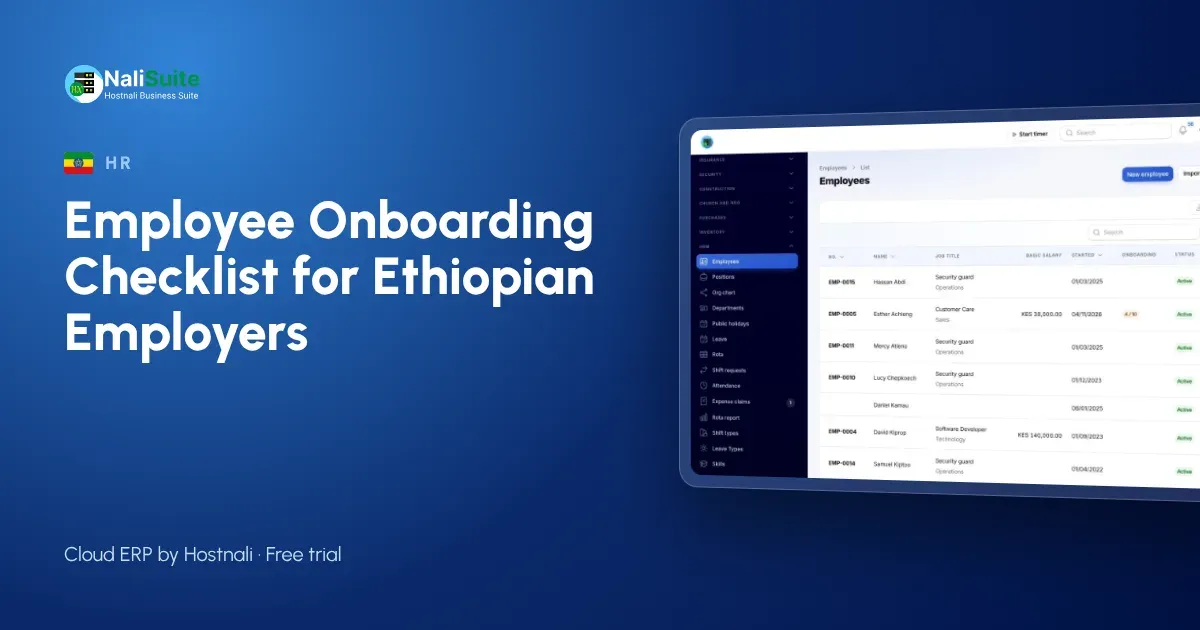
In many Ethiopian companies, a new employee’s first day starts with a signature on a contract and ends with “start tomorrow”. What happens in between depends on how busy the supervisor is.
That is fixable without a big HR department. This guide sets out five questions every employer should answer before a new person starts, a simple first-week plan, and how to set up payroll records properly, using an example from a coffee exporter in Addis Ababa.
Five questions to answer before the start date
1. What exactly will this person do in their first month?
Write three to five tasks they should be able to do by day 30. If you cannot list them, the new hire will not know them either.
2. Who is responsible for them?
Name the supervisor and a colleague who will help with daily questions. One person cannot be “everyone’s”.
3. What do they need on day one?
Tools, a uniform, a workstation, a login, keys. List them and assign each item to someone.
4. What records must be complete before the first salary?
The signed contract, a copy of the employee’s ID, their TIN, the bank account for salary, the agreed salary and allowances, and the start date.
5. How will we know onboarding worked?
Agree a review at 30 days and a decision at the end of probation, with notes kept on file.
A first-week plan that works
Day 1. Welcome, introductions and a tour. Explain working hours, breaks, how to report absence and how leave is requested. Hand over equipment and record what was issued.
Day 2. Shadow an experienced colleague doing the core tasks.
Days 3–4. Do the tasks with that colleague watching. Short feedback at the end of each day.
Day 5. Sit down with the supervisor: what went well, what is still unclear, what the next three weeks look like.
Keep it this simple. The aim is a new person who knows what to do and whom to ask. For roles with shifts, such as warehouse or security work, repeat the plan for each shift pattern the person will work.
Payroll records for Ethiopia
NaliSuite does not ship a statutory payroll pack for Ethiopia. Instead you set up your own earnings and deductions in the payroll settings: income tax, pension and anything else that applies to your staff. That keeps you in control, because your accountant can enter the rates they use, and update them when the rules change.
Before the first run:
- Enter the employee’s TIN and ID number on their record.
- Set the salary, allowances and the deductions that apply.
- Pro-rate the first month if they started part way through.
- Check current rules with the Ministry of Revenues for tax and with the relevant body for pension contributions.
The payroll app then produces payslips from the same records every month, and the employee can see them in the staff app.
Example: a coffee exporter in Addis Ababa
A coffee exporter in Addis Ababa added eight warehouse staff ahead of the harvest season: sorters, a store keeper and two drivers. Previously, each person’s details were in a paper file and the salary sheet was an Excel workbook that only one accountant could open.
This season, each hire was added to the HR app on the day they signed. An onboarding checklist started automatically with tasks for HR (contract, ID copy, TIN), the warehouse manager (safety briefing, first-week schedule) and finance (salary and deductions). Staff check in with their phones at the warehouse, which is set up as a geofenced location, so attendance for the first month was on record when payroll ran.
Let staff help themselves
New staff have many small questions: how many leave days do I have, when is payday, where is my payslip? With employee self-service, they find the answers on their phone. The app installs from the browser, so it works on the phones staff already have.
For teams spread over a warehouse, an office and the road, Team chat keeps work messages in one place instead of personal messaging apps.
Keep staff data safe
Onboarding collects ID numbers, bank details and family contacts. Ethiopia’s Personal Data Protection Proclamation No. 1321/2024 sets rules for handling personal data. Collect only what you need, keep contracts and ID copies on the employee record in Documents, and give access by role. In NaliSuite each user only sees what their role allows.
A note on probation
Probation works best when both sides know what is being judged. At the 30-day review, write down three or four concrete goals, such as running the store keeper’s stock count without help, and record them on the employee’s file. At the end of probation, the conversation is then about those goals and the evidence, not about general impressions. Check the current rules on probation periods with the Ministry of Labour and Skills.
Frequently asked questions
Does NaliSuite calculate Ethiopian income tax automatically?
There is no statutory pack for Ethiopia. You set up your own deductions and rates in payroll settings, and NaliSuite applies them every month.
Can staff without laptops use the system?
Yes. The employee app runs on any smartphone and installs from the browser.
When should the probation review happen?
Hold a first review at about 30 days and the decision at the end of probation, with notes kept on the employee record.
Try NaliSuite
Ethiopian employers can keep HR records, onboarding checklists, payroll and the staff app together, from ₵25 a month after a free trial. See the plans.