 ETB
 KES - Kenya
 UGX - Uganda
 TZS - Tanzania
 RWF - Rwanda
 NGN - Nigeria
 ZAR - South Africa
 USD - Zimbabwe
 GHS - Ghana
 ZMW - Zambia
 USD - International

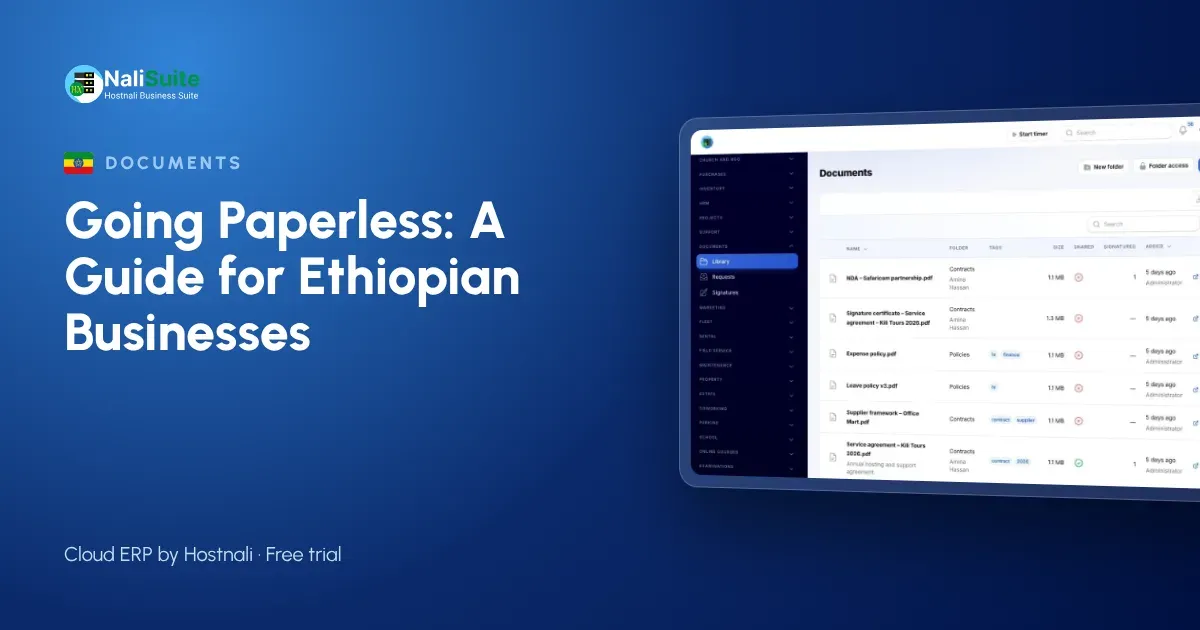
In a trading business, a single order can produce a dozen pieces of paper: a proforma from the supplier, a purchase order, a contract, a supplier invoice, payment slips, a delivery note, a sales invoice to the customer and a receipt. Multiply that by hundreds of orders a year and the filing cabinets fill up fast, while the one document you need is always somewhere else.
The clearest way to understand going paperless is to follow one order from start to finish. Our example is a trading company in Addis Ababa that imports and distributes building materials.
The example: a trading company in Merkato
The company has a shop and warehouse near Merkato, Addis Ababa, and sells tiles, sanitary ware and fittings to contractors and retailers in Addis, Adama and Hawassa. It has twelve staff. Until recently, every order lived in a paper folder, and the accounts clerk spent the end of each month matching slips to orders.
Step 1: the purchase order
On paper: a handwritten purchase order, photocopied, one copy filed and one sent to the supplier.
Paperless: the order is raised in NaliSuite Purchases and emailed to the supplier from the system. It has a number, a status and a record of what was ordered, so later documents can be matched to it.
Step 2: the contract
On paper: for a large order, a contract is printed, signed by the owner, sent to the supplier or customer, signed and returned days later.
Paperless: the contract is sent for e-signature from NaliSuite Documents. Both parties sign online, and the company receives a stamped PDF with an audit certificate showing who signed, when and from where. The signed copy is filed automatically in the order’s folder.
Each signature is recorded with that certificate, which supports its validity. Some documents, particularly those involving government offices, banks or customs, may still need originals or a particular form of signature. Check the rules for your type of document in Ethiopia and keep originals where they are required.
Step 3: the supplier invoice
On paper: the supplier’s invoice arrives with the goods and goes into a tray to be entered later.
Paperless: the invoice is photographed or forwarded, and the Document AI add-on reads it and turns it into a bill for the accounts clerk to check against the purchase order. Document AI uses the company’s own Anthropic API key, so it controls the data and the cost.
Step 4: receiving the goods
On paper: a delivery note signed at the warehouse door and filed separately.
Paperless: goods are received into NaliSuite Inventory against the purchase order, so stock levels update and the order shows what has arrived. The delivery note, if the supplier still sends paper, is photographed and stored in the order’s folder.
Step 5: selling to the customer
On paper: a sales invoice from a duplicate book, a receipt from another book, and copies for the customer, the file and the accountant.
Paperless: the sales invoice is created in NaliSuite Invoicing and sent by email or message. Customers can pay through online payments, using the methods your payment provider supports, or by bank transfer, and each payment is recorded against the invoice. Keep your invoices and records in line with what the Ministry of Revenues requires of your business.
Step 6: finding it all again
On paper: months later, a contractor disputes a delivery. Someone spends an afternoon in the storeroom.
Paperless: the order’s folder holds the purchase order, the signed contract, the supplier invoice, the delivery note and the sales invoice. Tags and search find it in seconds, and every version of every document is kept. If the customer needs a copy, it is shared through a secure link or the customer portal.
Organising the folders
The Merkato company agreed on a simple structure:
- Suppliers, with a folder per supplier and per year.
- Customers, with a folder per customer, holding contracts and shared documents.
- Company, for licences, policies and staff documents, with tight access.
Tags such as proforma, contract, invoice, delivery and receipt make searching easy. Access is set by role and person, so warehouse staff see deliveries but not contracts.
Staff paperwork
Staff records can live in NaliSuite HR, with contracts stored in Documents and signed online. New staff upload copies of their documents through a document request instead of bringing photocopies.
Personal data
Staff files, customer contacts and IDs are personal data under Ethiopia’s Personal Data Protection Proclamation No. 1321/2024. Digital records with access control are easier to protect than open cabinets, so give each person access only to the folders they need.
Branches outside Addis
Customers in Adama and Hawassa used to wait for paperwork to be sent from Merkato. Now staff at any location can find an order’s documents and share them through a secure link the same day. When the company opens a new outlet, the folder structure is already there, so the new team files documents the same way from the start.
Frequently asked questions
Do we have to stop using paper completely?
No. Start with new orders, and scan or photograph paper that still arrives from suppliers.
Can suppliers and customers sign online?
Yes. Send documents for signature; they sign online and you receive a stamped PDF with an audit certificate.
Can customers get copies without calling us?
Yes. Share documents through a secure link or the customer portal.
Try NaliSuite
Documents, Purchases, Inventory and Invoicing are part of every NaliSuite plan, from ₵25 a month. See the plans and follow your next order through it during the free trial.