 ETB
 KES - Kenya
 UGX - Uganda
 TZS - Tanzania
 RWF - Rwanda
 NGN - Nigeria
 ZAR - South Africa
 USD - Zimbabwe
 GHS - Ghana
 ZMW - Zambia
 USD - International

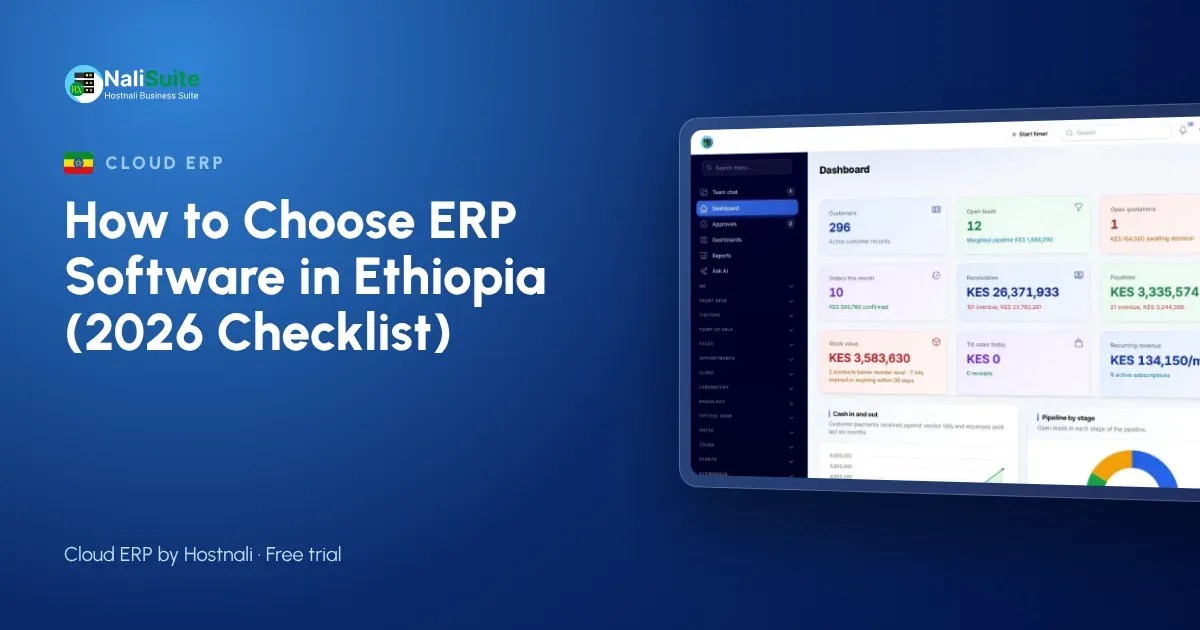
An ERP sounds like something only big companies buy. In practice, many small and medium businesses in Ethiopia need one long before they think they do. Below is a checklist built around the problems a garment factory in Adama with a showroom in Addis Ababa ran into, and the questions worth asking before you sign up. The companies named here are examples, but their situations are common.
What an ERP replaces
For most businesses in Ethiopia, an ERP replaces a mix of a till, an invoice template, a stock sheet, a payroll spreadsheet and a separate accounting package. Everything shares the same customers, products and staff, so reports agree with each other. For the garment maker, that meant one customer list instead of four.
Signs you have outgrown spreadsheets
If two or more of these sound familiar, an ERP will pay for itself:
- the stock count never matches the sales record
- month-end takes days because figures come from different places
- nobody knows exactly who owes what without phoning around
- payroll is a spreadsheet only one person understands
- a second branch or warehouse is on the way
At the garment maker, the last straw was a stock count that differed from the sales record for the third month running.
Check the payment side carefully
Ask how a card or bank payment from a customer in Ethiopia reaches the books. The answer should be: automatically, against the right invoice. NaliSuite connects to your own provider account; see online payments. Selam at the garment maker tested this first, before looking at any other feature.
Tax in Ethiopia
Your ERP should work out VAT per line, show your TIN on every invoice and give you the totals for returns to the Ministry of Revenues. Rates change, so pick a system where you set and update the rates yourself. For quick checks, use the free VAT calculator. The garment maker checked how the tax settings work before importing a single product.
Do not forget payroll
Payroll should let you set up the deductions that apply to your business in Ethiopia, work them out on every pay run and send payslips by email or WhatsApp. See the NaliSuite payroll app. Moving payroll into the same system meant the garment maker no longer depended on one spreadsheet and one person.
Offline and mobile matter more than features lists
A beautiful dashboard is useless if the till freezes when the network goes down. Check that sales continue offline and sync later; NaliSuite’s offline POS does exactly that. For the garment maker, a till that kept selling during an outage was worth more than any report.
How the garment maker made its choice
Selam started by listing what went wrong at the garment maker in a normal month: stock that did not match between Addis Ababa and Hawassa, customers paying by card or bank transfer with no clear record, and payroll that took two days. Each problem became a test for a trial. The garment maker entered a week of real sales, ran one pay run and moved stock between two locations before deciding. The trial answered more questions than any sales call, and Selam chose the system that passed all three tests rather than the one with the longest feature list.
Count the full cost
Compare the monthly fee with what you pay today for separate tools, plus the hours spent moving figures between them. NaliSuite starts from ₵25 a month with every built-in app; see the plans. When Selam added up what the garment maker paid for separate tools, the comparison was easy.
How to switch without chaos
Import your lists first, set opening balances, then run the old and new systems together for one month before you stop the old one. For QuickBooks, Xero, Sage or Tally users there is a step-by-step switching guide. The garment maker moved its customer and product lists first and kept the old books for one more month.
Local points in Ethiopia
For Ethiopian businesses, bank transfer payments, birr pricing, your own VAT and payroll settings and a till that copes with network interruptions are the features to check first.
Quick checklist
| Need | What to check |
|---|---|
| Payments | card or bank transfer recorded automatically |
| Tax | your own rates, TIN on invoices |
| Payroll | deductions for your country or your own |
| Offline | the till sells without internet |
| Growth | branches, users and stock per location |
The garment maker used a list like this to compare three options side by side.
Frequently asked questions
What should a Ethiopian business check first?
Local payments (card or bank transfer), tax handling and payroll. Without those, the rest does not matter.
Can I keep using Excel for some things?
Yes, especially during the switch. Import and export to Excel or CSV is normal.
Do I have to use every app?
No. Switch on the apps you need and leave the rest off until you are ready.
Who helps with setup?
Our team can help with the first import and the basic set-up.
Try NaliSuite
See whether NaliSuite fits Ethiopian businesses like yours: look through the 17 built-in apps, pick a plan from ₵25 a month and test it with your own data.