 ETB
 KES - Kenya
 UGX - Uganda
 TZS - Tanzania
 RWF - Rwanda
 NGN - Nigeria
 ZAR - South Africa
 USD - Zimbabwe
 GHS - Ghana
 ZMW - Zambia
 USD - International

Ethiopian businesses plan around more uncertainty than most: import costs that move with the exchange rate, supplier prices that change between orders, and customers who may pay weeks after delivery. That is exactly why a budget is worth having. It will not remove the uncertainty, but it shows you early where the risks are and how much room you have.
This guide explains how to put together a practical twelve-month budget for a small or growing business in Ethiopia.
What a budget is, and what it is not
A budget is your best estimate of income and spending for the year ahead, month by month. It is not a promise and it is not fixed. Think of it as a map: you set the route, check where you are every month, and change direction when the road changes.
A good small-business budget answers four questions:
- How much do we expect to sell?
- What will it cost us to make those sales?
- What do we need to spend to keep the business running?
- How much will be left, and when?
Forecast sales realistically
Use last year’s sales as a starting point, if you have them. Then adjust for what you know:
- new products, branches or contracts,
- price changes you plan to make,
- seasons, such as holidays and festivals, the rainy season or the end of the fiscal year,
- customers you may lose.
If you sell on credit, note when the money will arrive, not only when you invoice. A large order in Hamle that is paid in Meskerem helps your profit in one month and your cash in another.
Plan the cost of what you sell
For a trading business, the biggest cost is usually the goods themselves. For imports, include the full landed cost: supplier price, freight, insurance, customs duty, clearing, port charges and transport inland. Because these costs can change with the exchange rate, plan them with some room for movement rather than at the last price you paid.
For a service business, the main cost may be staff time and subcontractors. For a manufacturer, it is raw materials, labour and power.
List your overheads
Overheads are the costs you pay whether or not you sell:
| Overhead | Monthly or yearly |
|---|---|
| Rent | Monthly or prepaid for the year |
| Salaries and benefits | Monthly |
| Power, water and generator fuel | Monthly |
| Internet and phones | Monthly |
| Licences and renewals | Yearly |
| Insurance | Yearly |
| Vehicle running costs | Monthly |
Spread yearly costs across the months, or put them in the month they are paid if you are planning cash.
Set aside tax
If your business is registered for VAT, the standard rate in Ethiopia is 15%. VAT you charge customers belongs to the tax authority; plan to pay it out rather than treating it as income. Income tax and any other taxes that apply to your business need their own lines. Check the current rules and payment dates with the Ministry of Revenues or your tax office.
Staff deductions should be budgeted with salaries. NaliSuite does not claim a statutory payroll calculation for Ethiopia, but you can set up your own deductions in payroll so each payslip and the budget line use the same figures.
Build two versions
With so many moving costs, one budget is rarely enough. Prepare:
- A likely case, using your best estimates.
- A cautious case, with lower sales and higher import costs.
Keep your fixed costs within what the cautious case can carry. If the cautious case shows months with too little cash, plan a reserve or reduce commitments now.
A sample month
A sample importer of kitchen appliances in Addis Ababa plans an average month, in plain numbers:
- Sales: 1,500,000.
- Landed cost of goods (62% of sales): 930,000.
- Salaries: 220,000.
- Rent and utilities: 120,000.
- Transport, phones and other running costs: 60,000.
- Planned surplus before tax: 170,000.
In the cautious case, the owner plans sales 15% lower and import costs 10% higher. The surplus almost disappears, so the owner decides to keep a reserve and delay opening a second showroom until the likely case is confirmed.
Review every month
At the end of each month, compare actual results with your budget. Look at the largest differences first and ask why they happened. Then update the forecast for the rest of the year.
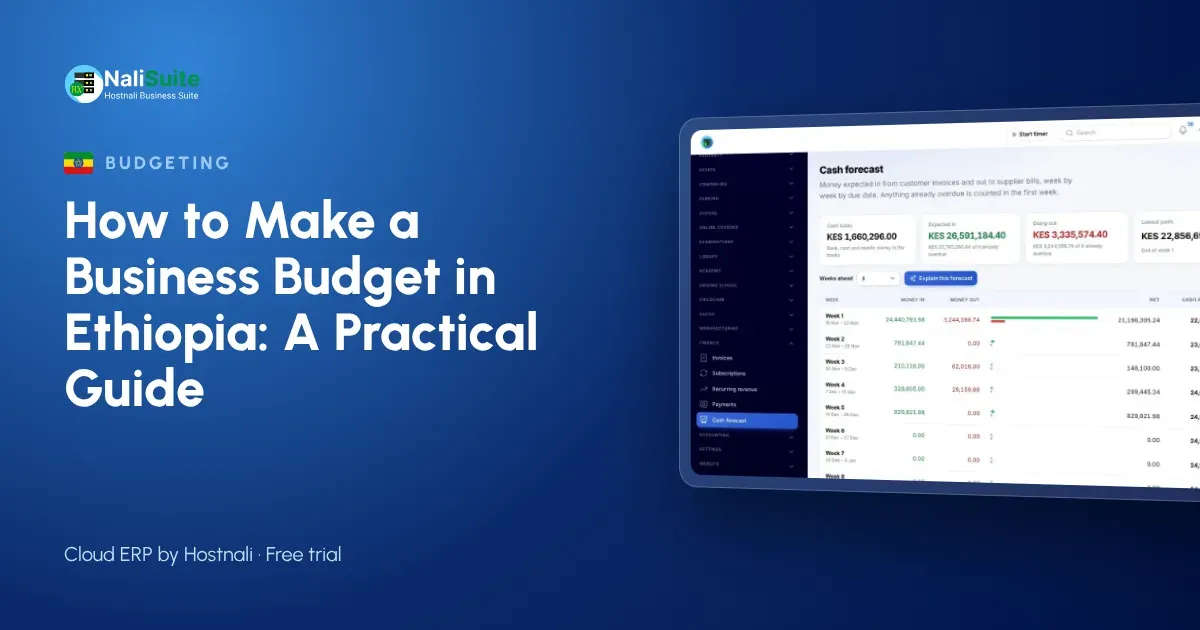
NaliSuite accounting holds budgets by account, department or project and compares them with actual figures whenever you need. Bills and invoices post themselves to the books, inventory records landed costs for each shipment, and bank reconciliation keeps your actuals in line with your statements.
Frequently asked questions
Should I budget in birr or in foreign currency?
Budget in birr, but note which costs are paid in foreign currency so you can see the effect of exchange-rate changes.
How often should I update the budget?
Compare actuals monthly, and update the rest of the year whenever something important changes.
Is a budget useful for a very small business?
Yes. Even a one-page budget shows whether you can afford rent, stock and wages in slow months.
Try NaliSuite
NaliSuite keeps budgets, books, stock and payments together, so you can see how the year is going at any time. Plans start at ₵25 a month, shown in birr, with a free trial. See the plans.