 ETB
 KES - Kenya
 UGX - Uganda
 TZS - Tanzania
 RWF - Rwanda
 NGN - Nigeria
 ZAR - South Africa
 USD - Zimbabwe
 GHS - Ghana
 ZMW - Zambia
 USD - International

Selam opened a café and bakery in Hawassa three years ago. Each year her accountant prepares the financial statements for her tax filing, and each year she signs them after a quick look. This year she wants to open a second café near the university, and her question is simple: is the first one profitable enough to pay for it?
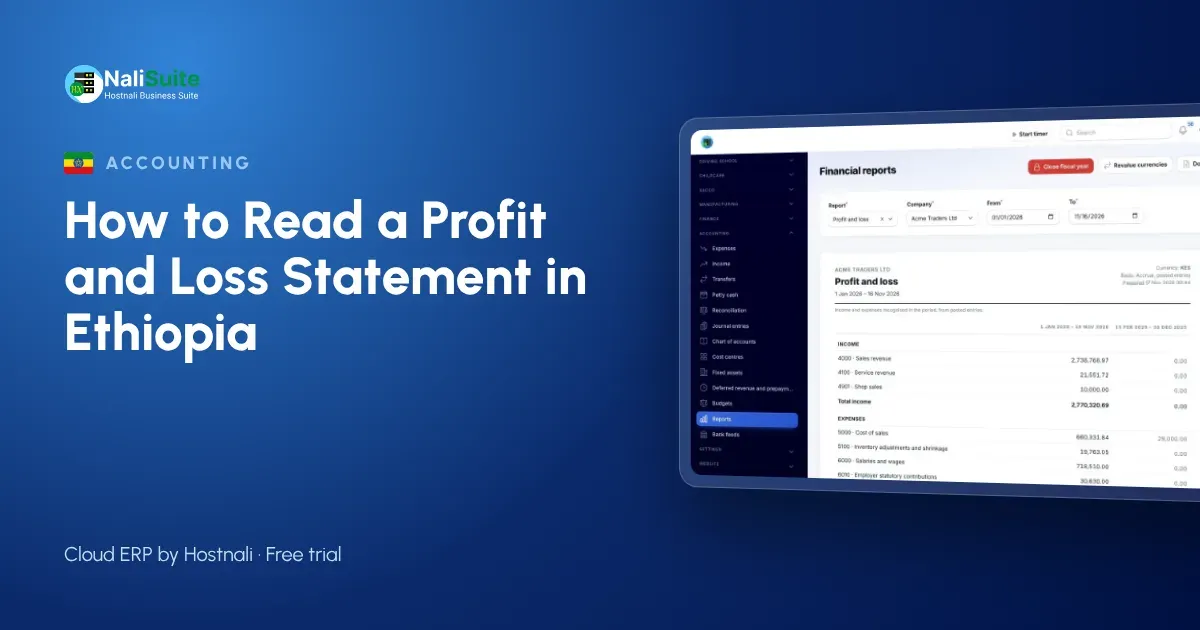
The answer is in her profit and loss statement. This guide gives you the handful of terms you need, a method for reading the statement from the bottom up, and an example based on a business like Selam’s.
The terms you need
| Term | Meaning |
|---|---|
| Revenue | Sales for the period, excluding VAT or turnover tax collected for the government |
| Cost of sales | Direct cost of what you sold: ingredients, packaging, goods for resale |
| Gross profit | Revenue minus cost of sales |
| Operating expenses | Costs of running the business: wages, rent, utilities, transport, repairs |
| Depreciation | The cost of equipment, such as an espresso machine or oven, spread over its working life |
| Operating profit | Gross profit minus operating expenses |
| Finance costs | Interest on loans and overdrafts |
| Net profit | What is left after all costs and the income tax charge |
Two ideas sit behind every line. Sales are counted when they are made, not when the customer pays. Costs are counted when they are used, not when you hand over the birr. This is why the profit and loss statement can tell a different story from your bank balance, and why we cover cash separately in our cash flow guide for Ethiopian businesses.
Read it from the bottom up
Most owners start at the top and lose interest halfway. Try the opposite.
Step 1: Net profit
Is it positive? Is it higher or lower than the same period last year? If it is lower, the rest of the statement explains why.
Step 2: Finance costs and tax
Did a new loan add interest that was not there last year? Has the tax charge changed? Your accountant works out the tax figure; check current requirements with the Ministry of Revenues, as rules and rates change.
Step 3: Operating profit
If operating profit fell but finance costs did not change, the problem is in trading. Move up.
Step 4: Operating expenses
Compare each large expense with the same period last year as a share of revenue. Wages, rent and utilities are usually the biggest. Watch also for generator fuel during power interruptions, transport, and bank charges.
Step 5: Gross profit and gross margin
Divide gross profit by revenue. If that percentage has dropped, either your input costs rose faster than your prices or something is going missing between the store room and the counter.
Step 6: Revenue
Finally, look at sales themselves. Are they growing? Is growth coming from more customers or only from higher prices?
Selam’s café, read from the bottom up
Selam’s figures for the last six months, compared with the same six months a year earlier, show:
- Net profit: down, although she felt busier than ever.
- Finance costs: unchanged.
- Operating expenses: wages up as a share of revenue after she added an evening shift; rent unchanged.
- Gross margin: down from 58% to 49%. Flour, sugar, coffee and milk all cost more, and she raised menu prices only once.
- Revenue: up 14%.
So the café is busier but each sale earns less. Before opening a second café, she needs a menu price review and a check on whether the evening shift pays for itself. If the first café cannot reach its old margin, a second one with the same menu will repeat the problem.
What makes the statement unreliable
The method only works if the numbers are right. Look out for:
- Cash sales that are not recorded. They make the business look less profitable, and that hurts when you apply for a loan.
- Personal expenses paid by the business. Household shopping bought with the café’s money inflates costs. See our guide on separating business and personal money in Ethiopia.
- No stock count. Ingredients and goods on hand at the end of the period must be counted, or cost of sales is a guess.
- Equipment recorded as a single expense. A new oven should be depreciated over its life, not counted in one month.
A monthly routine that takes an hour
- Close the month: make sure every sale, bill and payroll entry is recorded.
- Count stock.
- Read the statement bottom up and note anything that moved by more than a few percentage points.
- Decide on one action for the coming month.
Let the statement build itself
NaliSuite Accounting posts each sale, supplier bill and payroll run to the books as you work, so the profit and loss statement, balance sheet and cash flow statement are always up to date, with the previous period shown for comparison. Sales from the Point of Sale till are recorded even when the internet drops, supplier bills come in through Purchases, and bank reconciliation matches your bank statement lines to the books. Fixed assets such as ovens and coffee machines are depreciated automatically.
Frequently asked questions
Why do I need a monthly profit and loss statement if my accountant prepares one each year?
The yearly one is for tax and compliance. A monthly one lets you see problems while you can still fix them.
Is VAT part of my revenue?
No. If you are registered for VAT, the VAT you charge is collected for the government. Check which tax applies to your business with the Ministry of Revenues or your accountant.
What is a good gross margin for a café?
It varies with location, menu and prices. Track your own margin over time and investigate every drop.
Can I see the P&L for each branch?
Yes, if your accounting tracks each branch as its own cost centre or company.
Try NaliSuite
Read your profit and loss statement every month without spreadsheets. NaliSuite starts at ₵25 a month with a free trial. See the plans.