 ETB
 KES - Kenya
 UGX - Uganda
 TZS - Tanzania
 RWF - Rwanda
 NGN - Nigeria
 ZAR - South Africa
 USD - Zimbabwe
 GHS - Ghana
 ZMW - Zambia
 USD - International

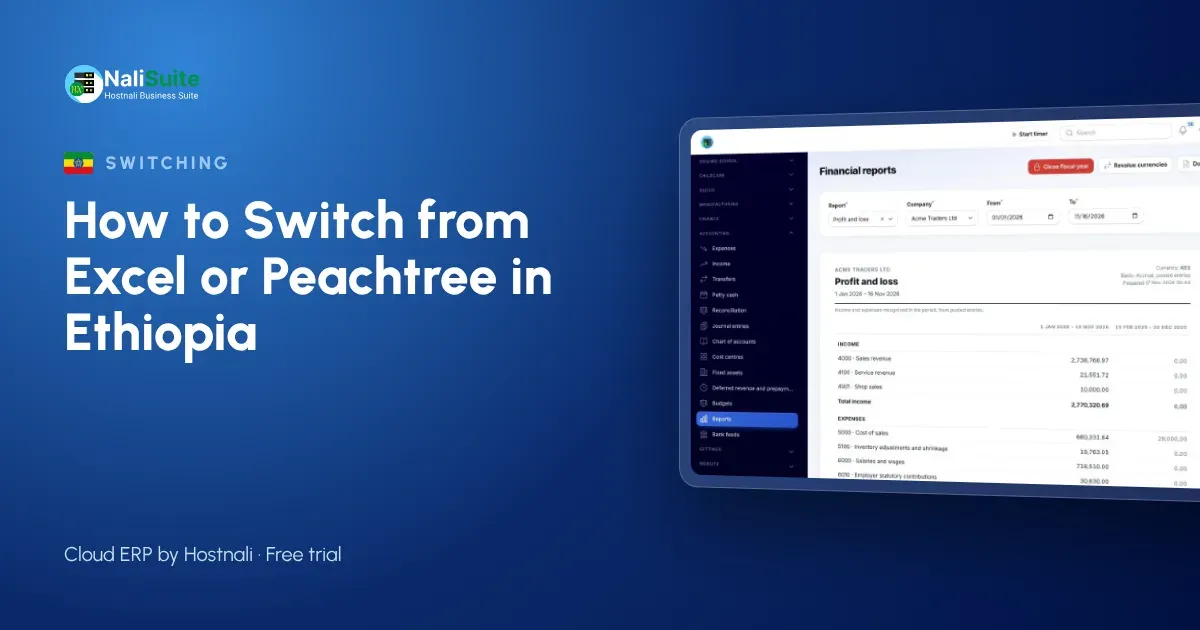
Many Ethiopian businesses still keep their books in Excel or an old Peachtree install. A switch to a cloud ERP brings sales, stock and payroll together, but it works best when the data is cleaned up first.
What you gain
QuickBooks, Xero and Sage keep your books. NaliSuite keeps your books and runs the rest of the business: CRM, quotations, accounting, invoicing with online payments, stock, the till, HR and payroll, on one login. See the full comparison on the switch from QuickBooks page.
Questions to answer before you start
- What is your go-live date, and is your accountant happy with it?
- Which reports does your accountant need from you each month in Ethiopia?
- Will your accountant work in NaliSuite, or should you keep a QuickBooks or Xero sync?
- How many branches, tills and warehouses need setting up?
- Are there old invoices to write off before you import?
- Does payroll move now, or after the ledger?
An example from Ethiopia
A construction supplier in Adama kept accounts in Peachtree and stock in Excel, with the owner reconciling both by hand. Quotations were typed in Word. After the move, quotations become orders and invoices in one flow, stock follows every sale, and the owner sees debtors in birr on his phone.
Step 1: export what you need
From QuickBooks, Xero, Sage or Excel, export:
- customers and suppliers, with contact details and tax numbers;
- products and services, with prices and, for stock items, quantities on hand;
- the chart of accounts;
- a trial balance report at your go-live date;
- open invoices and bills (what customers owe you and what you owe suppliers);
- employees, if payroll moves too.
Clean your data before you import
An import is only as good as the Excel file behind it. Before you upload:
- merge duplicate customers (the same company entered twice with different spellings);
- delete suppliers you have not used in years;
- make sure every product has a code, a unit and a price;
- check that tax numbers are in the right column and format;
- write off old invoices you know will never be paid, with your accountant’s agreement.
The import sequence
Load reference data first and money last. Accounts, then contacts, then products, then the opening trial balance report, then unpaid invoices and bills, then opening stock. If you import an invoice before its customer exists, it has nowhere to go, so this order saves a lot of re-work.
Check before you let go
Before you switch the previous software off, reconcile the bank in NaliSuite for the first month and compare debtors and creditors with your last report from the previous software. Once those three agree, you can trust the new books.
Ethiopia-specific details
Ethiopian businesses should import customers’ and suppliers’ TINs, set up VAT where registered and keep invoice numbering continuous from the old system. Bank transfers and card payments through your own payment provider are matched to invoices automatically.
Moving the rest of the business
Once the ledger are across, bring the other Excel files in one at a time: stock counts into Inventory, customer follow-ups into CRM, and team members into HR. If payroll moves too, add employees with their contracts; NaliSuite Payroll applies the deductions you set up from the first pay run.
Your first month after the switch
In the first month after the switch in Ethiopia: send every new invoice from NaliSuite with its pay link; connect card and bank payments through your own accounts; reconcile the bank weekly; count stock once at the month’s close and compare; and run payroll in NaliSuite if it moved too. By the end of the month, your team should not need the previous software for anything but history.
Three things that cause most problems
Missing starting balances, duplicate customers and a parallel run that never ends. Agree the opening trial balance report with your accountant, clean the contact list before importing and set a firm date to stop using the previous software.
Keeping a sync instead of a hard switch
You do not have to switch everything at once. With the QuickBooks and Xero Sync add-on, NaliSuite handles sales, stock and payroll while QuickBooks or Xero stays your accountant’s ledger. Many businesses run like this for a year before moving fully.
Coming from Tally or Odoo
The Tally and Odoo migration add-on brings ledgers, items and parties across from Tally and Odoo, so you do not have to rebuild them by hand.
What it costs
NaliSuite plans start at ₵25 a month, with all 17 built-in apps on every plan, so you are not paying separately for accounting, invoicing, stock and payroll. Compare that with what you spend today on licences and add-ons, and on the hours spent re-keying data between them.
Frequently asked questions
Can we keep our invoice numbers?
Yes. Set the next number in the sequence so numbering continues from your old system.
Does it work in birr?
Yes. The company currency is set to ETB and every document uses it.
How long does a switch take?
A small business can import its lists and balances in a day or two. Plan a month of comparison before you retire the old system.
Try NaliSuite
Every NaliSuite plan includes accounting, invoicing, stock, POS, HR and payroll, from ₵25 a month. Start a free trial, import your lists and see your own numbers in it, or compare the plans.