 ETB
 KES - Kenya
 UGX - Uganda
 TZS - Tanzania
 RWF - Rwanda
 NGN - Nigeria
 ZAR - South Africa
 USD - Zimbabwe
 GHS - Ghana
 ZMW - Zambia
 USD - International

In Ethiopia, many purchases by companies, NGOs and public bodies start with a request for quotations. Buyers collect several offers, compare them line by line and choose. If your quotation is unclear, incomplete or late, it may not even make the comparison sheet.
This guide sets out the parts every Ethiopian quotation should have, explains how to price and present it and shows how to send it faster.
Start with the request
Before you write anything, read the customer’s request carefully. Note:
- the exact items or services, quantities and specifications;
- the delivery place and date;
- the deadline for quotes and how they must be submitted (email, sealed envelope, a form);
- any documents they ask for, such as a trade licence, TIN certificate or VAT registration.
A quotation that answers a different question from the one asked is usually set aside.
The essential parts
Business identity
Business name, address in the city and sub-city, phone, email and TIN. If you are VAT-registered, include your VAT registration number. Buyers check these.
Addressed to
The organisation, department and contact person, and their reference number if they gave one.
Number, date and validity
Give the quotation a number and date. State how long it is valid, for example 15 or 30 days. Where you import goods or prices move quickly, keep the validity short and say so plainly.
Description and specification
Describe each item precisely: brand or equivalent, model, size and quantity. For services, describe what will be delivered and how the work will be measured.
Prices in birr
Show the unit price, quantity and total for each line, in birr. If a price depends on the exchange rate, say so in the terms rather than leaving it to be discovered later.
VAT
If you are VAT-registered, add VAT at 15% as a separate line and show the total including VAT. Buyers comparing offers need to see whether each one includes VAT. The free VAT calculator helps work out VAT-inclusive and exclusive figures. Check invoicing and receipt rules with the Ministry of Revenues.
Delivery and payment terms
State delivery time and place, and payment terms: for example, payment within 30 days of delivery by bank transfer. If you need an advance, say how much as a percentage and what it covers.
Signature and stamp
Many Ethiopian organisations still expect a signed and stamped quotation. Even if you send it electronically, include the name and position of the person signing.
A layout that works
| Part | What to write |
|---|---|
| Top | Business name, TIN, VAT number, contacts |
| Title | “Quotation” with number and date |
| To | Organisation, contact, their reference |
| Validity | “Valid for 30 days from the date of this quotation” |
| Table | Item, specification, quantity, unit price, total |
| Totals | Subtotal, VAT 15%, grand total in birr |
| Terms | Delivery time and place, payment terms, warranty |
| Sign-off | Name, position, signature, stamp |
Winning on more than price
The lowest price does not always win. Buyers also weigh:
- Completeness. Did you quote every item asked for?
- Clarity. Can they compare your offer easily?
- Delivery. Can you deliver on their date?
- Reliability. Have you supplied them before, on time?
Add a short note with any relevant experience, but keep it to a few lines.
From quotation to invoice without retyping
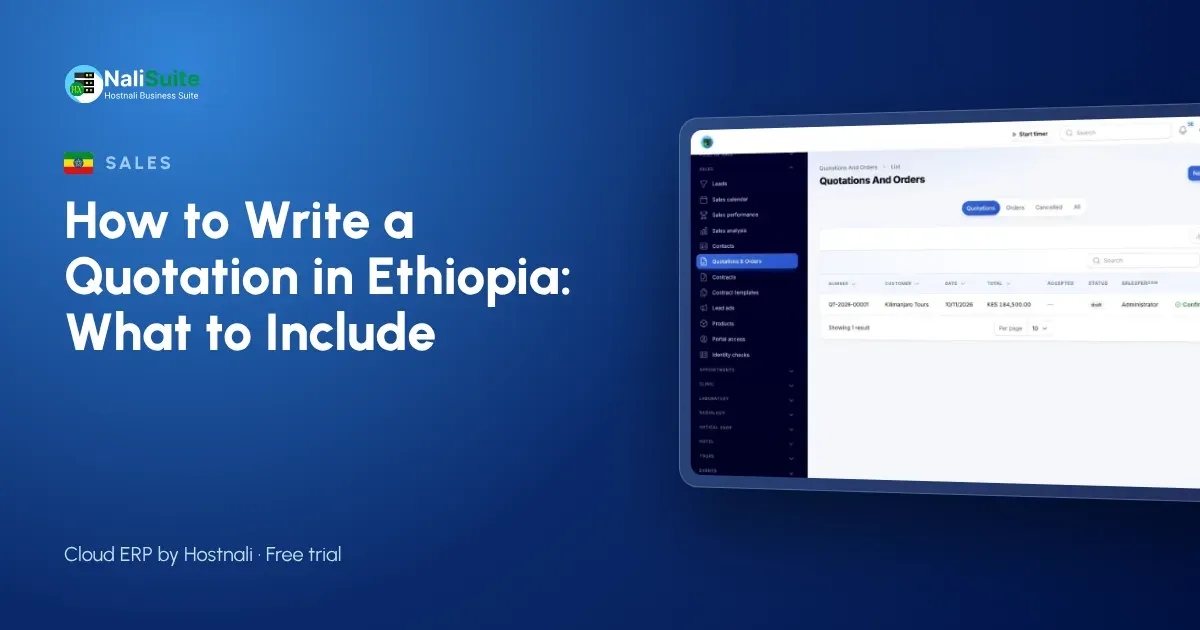
A spreadsheet or word processor works, but every quote is retyped and every invoice retyped again. NaliSuite Sales and Quotations builds a quotation from your product list with prices and VAT filled in, and sends it as a branded PDF by email or WhatsApp. Customers can accept it online through a secure link.
Accepted quotations become sales orders and then invoices in NaliSuite Invoicing. If you take payments online, customers can pay through the provider you connect; see online payments. Your customer records stay in one contacts list, so their details are right every time.
After you submit
- Confirm the buyer received your quotation.
- Note the decision date in your calendar.
- If you lose, ask politely why. The answer helps you price the next one.
- If you win, confirm the order in writing before buying stock.
Pricing for longer delivery times
Some Ethiopian orders take weeks to fulfil, especially when goods must be imported or made to order. If your own costs could rise before delivery, say how you will handle it: a short validity, a deposit that lets you buy materials straight away, or a clause allowing a revised price if the buyer delays the order. Buyers prefer to know this before they accept rather than discover it at invoice time. Keep a note of the supplier prices you used, and the date you checked them, so you can explain any revision clearly.
Frequently asked questions
Should my quotation include VAT?
If you are VAT-registered, show VAT separately and the total including VAT. If not, do not add VAT, and do not imply that your price includes it.
How long should a quotation be valid?
Long enough for the buyer to decide, usually 15 to 30 days. Use a shorter period if your costs change often, and say why.
Can I send quotations by email instead of paper?
Often yes, but follow the buyer’s instructions. Some tenders still require sealed paper submissions.
What if the buyer asks for a lower price?
Change the scope, quantities or terms rather than just cutting the price, and issue a revised quotation with a new number.
Try NaliSuite
NaliSuite lets Ethiopian businesses prepare quotations in birr, track them and turn accepted ones into invoices in one system. Plans start at ₵25 a month with a free trial; see the plans or learn about NaliSuite.