 ETB
 KES - Kenya
 UGX - Uganda
 TZS - Tanzania
 RWF - Rwanda
 NGN - Nigeria
 ZAR - South Africa
 USD - Zimbabwe
 GHS - Ghana
 ZMW - Zambia
 USD - International

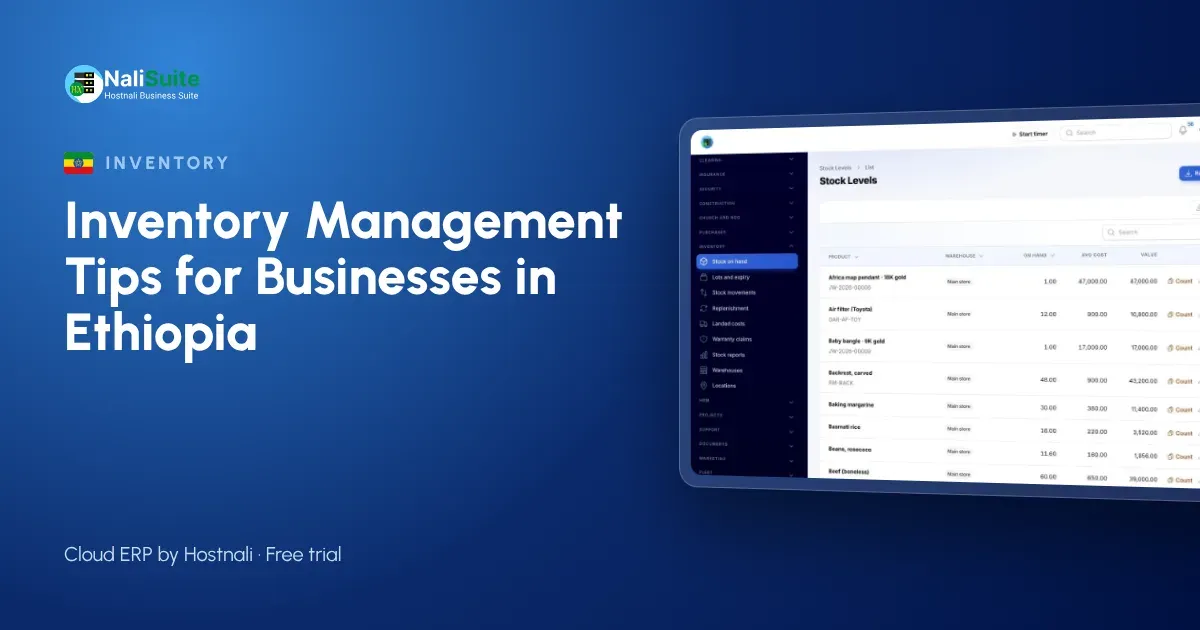
For many Ethiopian businesses, getting stock in is the hard part. Imported goods depend on foreign exchange and long lead times, and local supply can be uneven. Once the goods arrive, losing track of them is the last thing you can afford. These tips help shops, importers and pharmacies keep stock under control.
Batches, lots and expiry
If a product has a shelf life, record its batch and expiry date when it arrives. That one habit lets you sell oldest first, spot near-expiry lines in time to discount or return them, and answer a recall without turning the store upside down.
For regulated products such as medicines, traceable batches are not just good practice; they are often expected by regulators and suppliers.
Stock realities in Ethiopia
Importers and distributors in Addis Ababa often wait weeks or months for a shipment, so a reorder point has to account for long lead times. When stock finally arrives it may be distributed to branches in Adama, Hawassa or Bahir Dar.
Pharmacies and medical suppliers must track batches and expiry dates closely. And because cash is still common, sales and stock must be recorded together, or counts drift quickly.
Losses, theft and mistakes
Losses come from three places: receiving, selling and the stockroom. At receiving, check quantities against the purchase order before signing. At the till, make sure every sale goes through the point of sale rather than a notebook. In the stockroom, count small sections often and record write-offs for damage or expiry.
Track the shrinkage figure month by month. If it rises, you know which area to look at first.
Example: a medical supplier in Addis Ababa
A medical supplies importer in Addis Ababa supplies clinics in three regions. Each shipment is booked in with batch numbers and expiry dates. Reorder points are set high enough to cover the long import lead time, and orders are placed with the supplier while there is still enough stock to last until the next shipment.
The expiry report each month shows which batches to send to the busiest clinics first, so less stock expires on the shelf.
One stock list for every location
Running two shops from one stock list is how goods go missing. Instead, treat each shop, warehouse or even a delivery van as a separate location. Transfers between them are recorded like any other movement, and each branch’s reports show its own stock and sales.
Head office still sees the total, so purchasing decisions are based on the whole business.
Mistakes to avoid in Ethiopia
- Reorder points that ignore import time. Weeks of lead time need a higher reorder point than local supplies.
- Receiving without a purchase order. Without one, there is nothing to check the shipment against.
- Mixing branch stock. Each town’s stock should be its own location, or transfers become guesswork.
- Forgetting expiry. Medicines and food need batch and expiry tracking from the day they arrive.
Free up cash tied in slow stock
Every business has lines that looked like a good idea and now gather dust. A monthly report of items with little or no movement shows them clearly. Clear them with a promotion, bundle them, or return them if your supplier allows, and remove them from future orders.
The cash you free up is often enough to stock more of your best sellers.
Getting started in Ethiopia
Import your products with cost price, selling price and barcode, then count your stock to set opening levels in each store or warehouse.
For imported lines, record the supplier and the realistic lead time, including customs and transport, and set reorder points to match. Record batch numbers and expiry dates for medicines, food and cosmetics. Use purchase orders for every delivery and check goods against them before you accept them.
If you supply branches in other towns, record each transfer, so every branch’s stock is right and you can see where goods sell fastest.
Frequently asked questions
How do I set reorder points when imports take months?
Multiply average daily sales by the full lead time (order to delivery), then add a safety margin for delays. Review it whenever lead times change.
What is cycle counting?
Counting a small part of your stock each week instead of everything at once, so errors are caught early and the shop never closes for a stock-take.
What is a reorder point?
The stock level at which you place a new order: average daily sales multiplied by the supplier’s lead time, plus a safety buffer.
Try NaliSuite
NaliSuite inventory comes with every plan from ₵25 a month, together with the point of sale, purchases and accounting. Start a free trial and import your product list in minutes. See plans.