 ETB
 KES - Kenya
 UGX - Uganda
 TZS - Tanzania
 RWF - Rwanda
 NGN - Nigeria
 ZAR - South Africa
 USD - Zimbabwe
 GHS - Ghana
 ZMW - Zambia
 USD - International

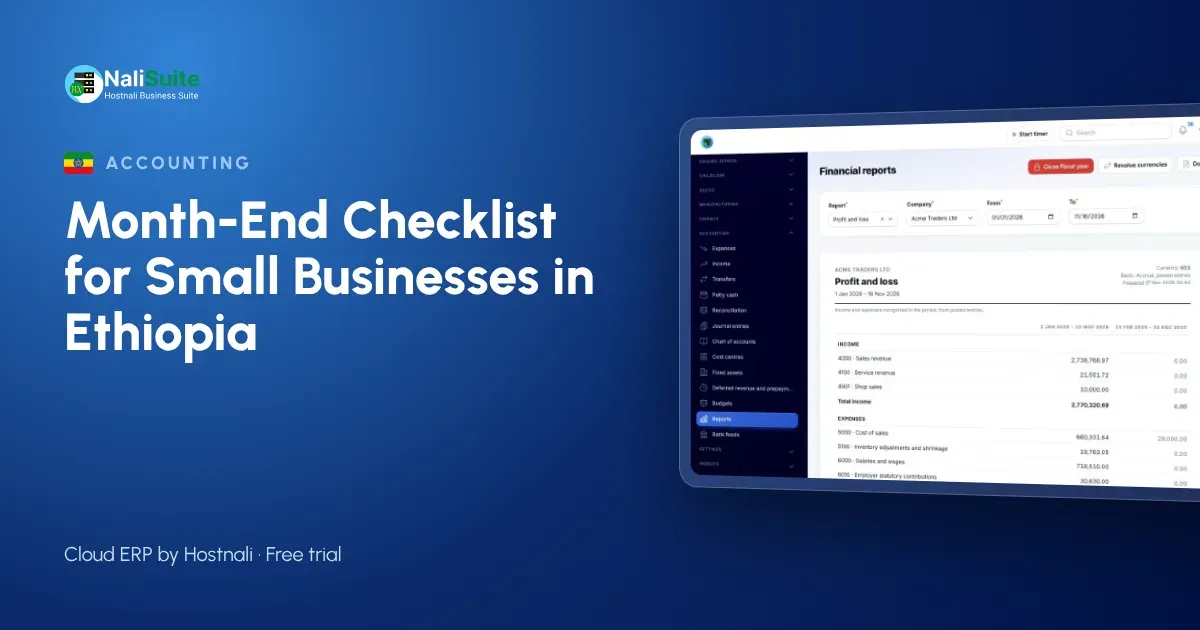
In Addis Ababa, Hawassa or Bahir Dar, small businesses often keep two sets of numbers without meaning to: what the receipt book says, and what the bank says. Month end is when those two have to become one.
This guide works through the problems that usually stop an Ethiopian business from closing its month cleanly. Each section explains what goes wrong and what to do about it. A short checklist follows at the end.
Problem: receipts and bank deposits tell different stories
Sales are recorded in a receipt book or cash register, but money reaches the bank in a different pattern: daily deposits, transfers from customers and payments from online sales.
Fix it:
- Download the bank statement for every business account.
- Match each deposit with the sales receipts it came from.
- Match each customer transfer with the invoice it pays.
- List anything you cannot match and follow it up before you close.
NaliSuite Accounting imports bank statements and suggests the invoice or sale each line belongs to. The bank reconciliation feature explains the matching step by step.
Problem: cash goes out without a record
Small cash payments, such as transport, tea for customers, minor repairs and stationery, often go unrecorded.
Fix it: Keep a petty cash book or record each payment in your system the same day, with a receipt where possible. At month end, count the cash box and check it equals the opening balance plus top-ups minus recorded spending.
Problem: supplier invoices are filed, not recorded
Invoices from suppliers sit in a folder until they are paid.
Fix it: Record every supplier invoice in the month the goods or services were received. Match it with the purchase order or delivery note. Unpaid invoices still belong to the month, and leaving them out overstates profit.
Problem: credit customers are not followed up
Fix it: At every month end, list unpaid invoices by age. Send a reminder for recent ones and call customers with older balances. Agree a date for payment and write it down. NaliSuite Invoicing sends invoices, statements and reminders by email or WhatsApp, and the online payments feature lets customers pay through the provider you connect.
Problem: stock is counted only at year end
Fix it: Count high-value and fast-selling items every month. Compare the count with the records and note each difference with a reason. In shops, pharmacies and spare parts businesses, a monthly count of 30 to 50 lines usually covers most of the value.
Problem: payroll deductions are not tracked
Fix it: Check that wages for the month were approved and paid, and record the income tax and pension contributions you deduct as amounts owed until they are paid. NaliSuite’s payroll app lets you set up the deductions your business must make and produces payslips for each employee. Confirm the current rates with the Ministry of Revenues and the pension authority.
Problem: VAT is calculated from memory
Fix it: If your business is registered for VAT, the standard rate in Ethiopia is 15%. Add up VAT on sales and VAT on purchases from your recorded invoices, not from estimates, and check invoices for the wrong rate. Confirm filing dates and invoicing requirements with the Ministry of Revenues. The free VAT calculator helps check the VAT on a single price.
Problem: last month keeps changing
Fix it: Once the reports are reviewed, lock the period. Any later correction is then a decision, with a note explaining it.
Your month-end checklist
| Step | Done |
|---|---|
| Bank statements matched with sales and invoices | ☐ |
| Petty cash counted and spending recorded | ☐ |
| Supplier invoices recorded with delivery dates | ☐ |
| Unpaid invoices reviewed and customers contacted | ☐ |
| Key stock counted, differences recorded | ☐ |
| Payroll checked, deductions recorded | ☐ |
| VAT figures prepared from records | ☐ |
| Profit and loss, balance sheet and receivables reviewed | ☐ |
| Month locked | ☐ |
A worked example from Adama
A building materials supplier in Adama sells to contractors on credit. At the first structured close, the owner found three contractors owed money for more than 90 days, and one of them had kept placing new orders. The business set a simple rule: no new credit for any customer with an invoice more than 60 days overdue. Within two months, the oldest balances had fallen sharply.
Which reports to read
- Profit and loss: compare with last month and the same month last year.
- Balance sheet: check bank and cash balances against statements and counts.
- Receivables: check whether the total owed by customers is rising.
If any of these surprises you, look for a missing or misdated entry before assuming the business changed.
Frequently asked questions
How long should a month-end close take?
For a small business with a few hundred transactions, a few working days. Recording sales and bills daily makes it much faster.
Can I use the Ethiopian calendar for my close?
Many businesses report by Gregorian month for banks and partners but think in Ethiopian months day to day. Agree with your accountant which calendar your books follow and use it consistently.
What should I do with a deposit I cannot identify?
Record it as an unidentified receipt, ask the bank for the sender’s details and clear it as soon as you know who paid.
Do I need software to close the month?
No, but software reduces the time spent matching bank lines and producing reports.
Try NaliSuite
NaliSuite gives Ethiopian businesses invoicing, bank matching, stock, payroll and accounting in one cloud system. Plans start at ₵25 a month with a free trial; see the plans or find out more about NaliSuite.