 ETB
 KES - Kenya
 UGX - Uganda
 TZS - Tanzania
 RWF - Rwanda
 NGN - Nigeria
 ZAR - South Africa
 USD - Zimbabwe
 GHS - Ghana
 ZMW - Zambia
 USD - International

Whether you run a café chain in Addis Ababa or a manufacturer in Adama, buying is where cash leaves the business fastest. Without purchase orders, it is hard to know who ordered what, at which price, and whether it ever arrived.
This guide explains a purchase order process that works for small and medium businesses in Ethiopia.
Signs your buying needs a process
- Orders go out before anyone approves them. If orders go out first and get approved later, the approval is just paperwork.
- Not recording partial deliveries. If half the order arrives, record half. Otherwise the bill for the full order looks correct.
- Paying from statements. Pay matched bills, not supplier statements, so nothing is paid twice.
- No limits. Without approval limits, every request waits for the owner and the process gets skipped.
From request to payment
| When | What you record | Why it matters |
|---|---|---|
| Before ordering | The request | Stops orders nobody needs |
| Before the supplier ships | The approved PO | Fixes the price and quantity |
| On delivery | What arrived | Catches short or damaged goods |
| Before paying | The matched bill | Stops overpaying and double payment |
Example: a café chain in Addis Ababa
Think of an example café chain with four branches in Addis Ababa. Each branch manager bought milk, cups and pastries from whoever was nearest, at whatever price was offered that day. The owner could not compare prices across branches or tell which supplier was cheapest.
After setting up purchase orders, branch managers raise requests, the operations manager approves them and groups orders for the same supplier, and suppliers receive one PO per delivery with agreed prices. Each branch records what it receives. At month end, the owner can see spending per branch and per supplier, and pays matched bills by bank transfer.
Three-way matching
Matching is the check that catches short deliveries, wrong prices and double billing. It compares:
| Paper | Says | Checked against |
|---|---|---|
| PO | What was ordered and the price | The bill |
| Delivery record | What came | The PO and the bill |
| Bill | What is owed | The PO and the delivery |
Software can do the comparison for you and flag only the bills that disagree, so your accounts person spends time on exceptions, not on every line.
What a good purchase order shows
Keep purchase orders short and clear: who is buying, from whom, what, how many, at what price, where and when to deliver, and on what payment terms. The PO number is the thread that ties the order, the delivery and the bill together, so make sure suppliers put it on every document.
Approval limits that keep things moving
Approval limits keep the process fast. A branch manager might approve small orders alone, while larger ones go to the owner. In NaliSuite you can set these approval rules once and the right person is notified on their phone.
VAT and supplier invoices in Ethiopia
VAT in Ethiopia is charged at 15%. Check that each VAT-registered supplier’s invoice shows their TIN and the VAT correctly, and keep it with the matched bill for your records with the Ministry of Revenues.
Rules on invoices and withholding can change, so confirm the current requirements with the Ministry of Revenues and set your tax rates in your system accordingly. NaliSuite lets each business set its own rates.
Comparing suppliers and prices
Once every purchase goes through a PO, you can compare suppliers properly: who delivers on time, who sends short, and who has raised prices. For a business in Ethiopia buying from several suppliers in Addis Ababa and the regions, this is often the biggest saving.
Keep agreed prices on each supplier’s record so new POs use them automatically, and review them every quarter. Where a supplier delivers late repeatedly, the delivery records show it plainly.
Matched bills are paid by bank transfer with the bill number in the reference, which makes the monthly bank reconciliation a short job. Bank reconciliation in NaliSuite suggests the matches.
Running it in NaliSuite
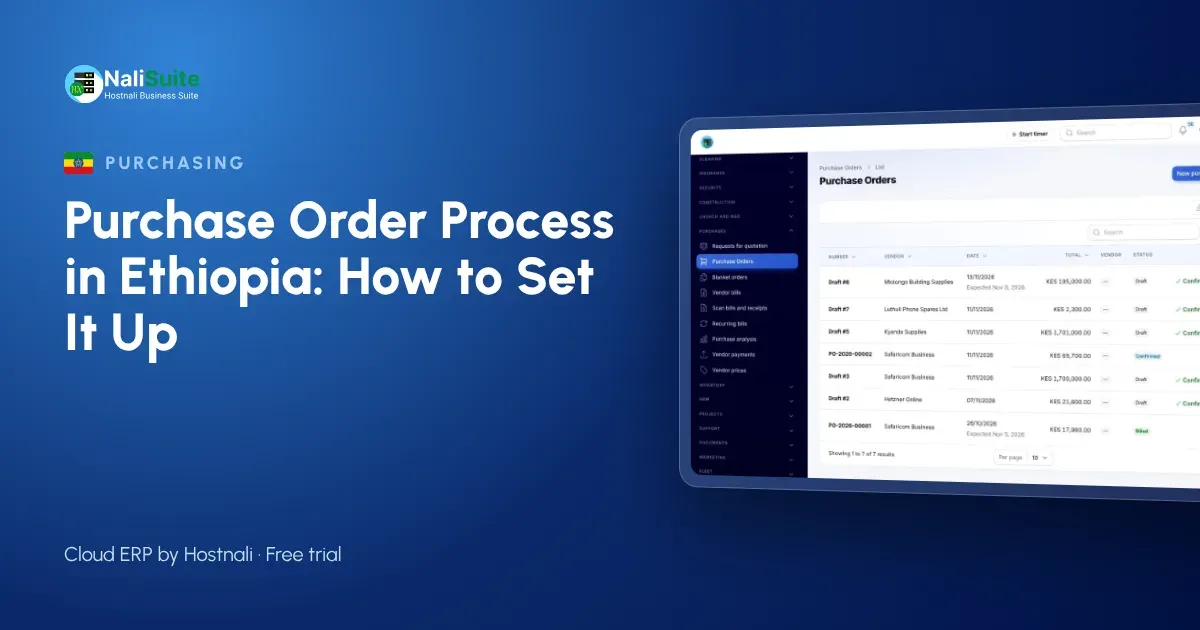
You can run this process on paper, but software makes it much easier. In NaliSuite Purchases, requests, approvals, purchase orders and supplier bills live in one flow. Receiving updates inventory automatically, and matched bills post to accounting without anyone typing them again.
Frequently asked questions
What should a supplier invoice in Ethiopia show?
At least the supplier’s name and TIN, the items, quantities, prices and any VAT. Confirm the current requirements with the Ministry of Revenues.
How do I pay suppliers?
Most suppliers are paid by bank transfer. Pay only bills that match a PO and a delivery, and record each payment.
What is a goods received note?
A record of what actually arrived from the supplier, including any short or damaged items. It is one of the three documents you match before paying.
How long does it take to set up?
A small business can set up suppliers, approval limits and its first purchase orders in a day.
Try NaliSuite
Run purchases, stock and accounting together in NaliSuite, from ₵25 a month with a free trial. View plans.