 ETB
 KES - Kenya
 UGX - Uganda
 TZS - Tanzania
 RWF - Rwanda
 NGN - Nigeria
 ZAR - South Africa
 USD - Zimbabwe
 GHS - Ghana
 ZMW - Zambia
 USD - International

In Addis Ababa, a growing number of businesses earn the same amount from the same customers every month: private schools, landlords, software and internet providers, maintenance companies and consultancies on retainer. When billing for them is done by hand, it is slow, inconsistent and easy to fall behind on.
This guide sets out the decisions behind good recurring billing in Ethiopia, then shows how to put them into a system so invoices go out without anyone having to remember.
The terms come first
Recurring billing is only as good as the agreement behind it. For each type of customer, decide:
- What is included each period.
- The price in birr, or another currency if you bill international clients.
- The period: monthly, termly, quarterly or yearly.
- When payment is due after the invoice.
- How changes and cancellations work.
Write this into a short contract or your standard terms, and give a copy to each customer.
Periods and dates
Most services bill monthly. Schools often bill by term, and some businesses offer a yearly option with a discount, which improves cash flow.
For the billing date, choose between:
- A fixed day for everyone, which is simple and suits rent and service contracts.
- Each customer’s start date, which suits memberships and software.
Consider your customers’ calendar. Many organisations work by the Ethiopian calendar and fiscal year; agree with each customer which dates your invoices follow, and keep to it.
How customers pay
Most business customers in Ethiopia pay by bank transfer, and some pay in cash. If you sell online or to customers abroad, you may also take card payments through a payment provider.
NaliSuite Invoicing sends each invoice by email or WhatsApp, and invoices can carry a link to pay online through the provider you connect; see online payments. Transfers are matched from your bank statement in NaliSuite Accounting, with the bank reconciliation feature suggesting which invoice each payment belongs to.
Changes during the period
Decide how you treat:
- Upgrades: a customer adds services halfway through a month.
- Downgrades: a customer reduces services.
- Pauses: a school holiday, a temporary closure.
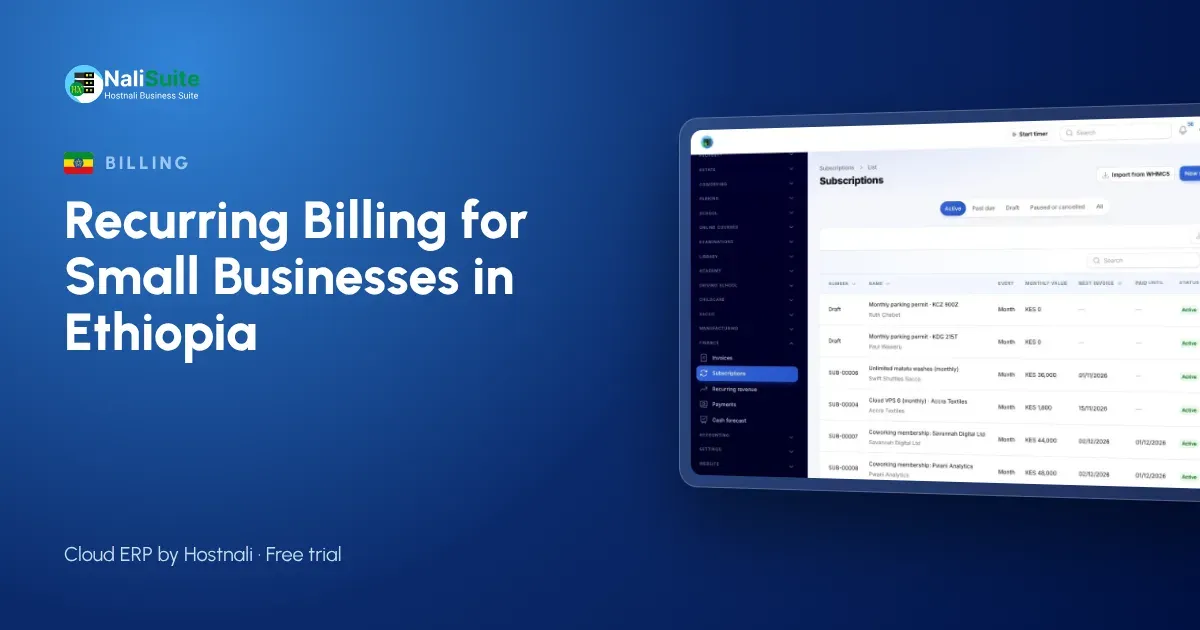
The fairest approach is to charge or credit only for the days that are left in the period. NaliSuite Subscriptions calculates this automatically when a subscription changes and lets you pause and resume with clear dates.
Late payment
Set a process and use it for every customer:
- Reminder before the due date.
- Reminder on the due date.
- A statement and phone call a week later.
- Suspension of service after written notice, if your contract allows.
NaliSuite sends reminders and statements automatically before and after the due date, so the process runs even in busy weeks.
VAT and invoices
If your business is VAT-registered, each recurring invoice must include VAT at 15%. Set the VAT on the plan so it applies consistently. Check with the Ministry of Revenues which invoicing and receipt rules apply to your business, including any requirements for electronic invoices. Some services, such as education, may be treated differently; confirm with your accountant.
Putting it into the system
- Create plans for each package, such as “Grade 1 tuition, termly” or “IT support, standard, monthly”.
- Add a subscription for each customer, with the start date and, where needed, an end date.
- Set the reminder schedule.
- Turn on the customer portal, where customers can see invoices and payments and pay what is due.
From then on, invoices are created and sent on schedule.
Reading the results
For a recurring business, three figures matter each month:
| Figure | What it tells you |
|---|---|
| Recurring revenue | Predictable income from subscriptions |
| New and lost customers | Whether the business is growing |
| Churn | The share of customers you lose |
NaliSuite shows these on a dashboard over time. If churn rises, find out why from the customers who left.
Example: a private school in Addis Ababa
A primary school with about 400 pupils prepared fee invoices by hand at the start of each term, and the finance office spent weeks matching bank deposits to pupils. With termly subscriptions per pupil, invoices went out on the same day for everyone, reminders were automatic and deposits were matched from the bank statement. Parents could check their balance in the portal instead of visiting the office.
When a customer disputes an invoice
Disputes are rarer when invoices are automatic, but they still happen: a service was interrupted, a pupil left early or a price change was not communicated. Agree how you will handle them. Keep the invoice open, check the subscription record and the contract, and either issue a credit note for the part in dispute or explain why the charge stands. Recording the outcome against the customer means the next person who looks at the account understands what happened.
Frequently asked questions
Can I bill some customers by term and others monthly?
Yes. Each subscription has its own period.
What if a parent pays in instalments?
Each instalment is recorded against the invoice, and the remaining balance stays visible until it is paid.
Can I bill international clients in US dollars?
Yes, if your agreement says so. Set the currency on their subscription and confirm with your accountant how to record it.
Will billing stop when a contract ends?
Yes, if you set an end date on the subscription.
Try NaliSuite
NaliSuite runs recurring billing for Ethiopian businesses, from termly school fees to monthly service contracts, with reminders and matching built in. Plans start at ₵25 a month with a free trial; see the plans or learn about NaliSuite.