 ETB
 KES - Kenya
 UGX - Uganda
 TZS - Tanzania
 RWF - Rwanda
 NGN - Nigeria
 ZAR - South Africa
 USD - Zimbabwe
 GHS - Ghana
 ZMW - Zambia
 USD - International

Addis Ababa’s restaurants, from traditional injera houses in Bole to cafés in Piassa, serve some of the most loyal customers anywhere. Teff, butter and meat prices move often, so knowing your plate cost is the first step to a healthy margin.
Ethiopian details
Customers pay by cash, card and bank transfer, and mobile wallets are growing fast, so make sure each payment is recorded on the bill. Keep the till running through power cuts with an offline till that syncs later.
If you bake injera or bread for other outlets, or cater events, the Food production add-on plans daily production, tracks batches with dates and handles wholesale deliveries. For VAT and receipt requirements, check with the Ministry of Revenues or your accountant.
Ingredient stock that keeps itself up to date
Every dish sold uses ingredients. In Restaurant Pro, ingredients come out of stock each time a dish sells, so your Inventory shows what you should have without a nightly count.
Do a physical count once a week and compare. If the difference is large, look at three things: portions, waste and security. The add-on’s waste log records spoiled or dropped food with a reason, which separates honest waste from missing stock. When ingredients run low, raise a purchase order in Purchases so suppliers deliver before you run out.
Know your plate cost
Food cost is the number that decides whether a busy restaurant actually makes money. To know it, you need recipes: how much of each ingredient goes into each dish. Once recipes are written down, the plate cost follows from your purchase prices.
NaliSuite’s Restaurant Pro add-on holds those recipes, shows the plate cost and food-cost percentage for every dish, and groups the menu into stars, plowhorses, puzzles and dogs. A dish that sells well but costs too much to make shows up straight away, which is the moment to adjust the price or the portion.
Keep selling when the network drops
A restaurant cannot tell hungry customers to wait for the internet. Use a till that works offline and uploads sales safely later: that is how NaliSuite’s offline POS behaves, and it runs in the browser on the devices you already own.
Let customers pay by cash or card or bank transfer, and record each payment on the sale. At closing, the till’s takings can be checked against the cash and payments received. The payments feature explains how the money is matched.
Example: an injera house in Addis Ababa
A traditional restaurant in Bole serves injera with tibs, shiro and kitfo, and bakes its own injera every morning. Teff prices rose sharply, but the owner was unsure which dishes were still profitable, and injera left over at night was simply thrown away.
With recipes for each dish, plate costs now follow the price of teff and meat. The waste log showed how much injera was discarded each night, so the morning bake was adjusted to the day’s bookings and typical sales. Food cost dropped without changing a single menu price.
From order to bill without retyping
Every time an order is copied from one paper to another, something is lost: a side dish, a drink, an extra portion. Record the order once, on the till, against the table.
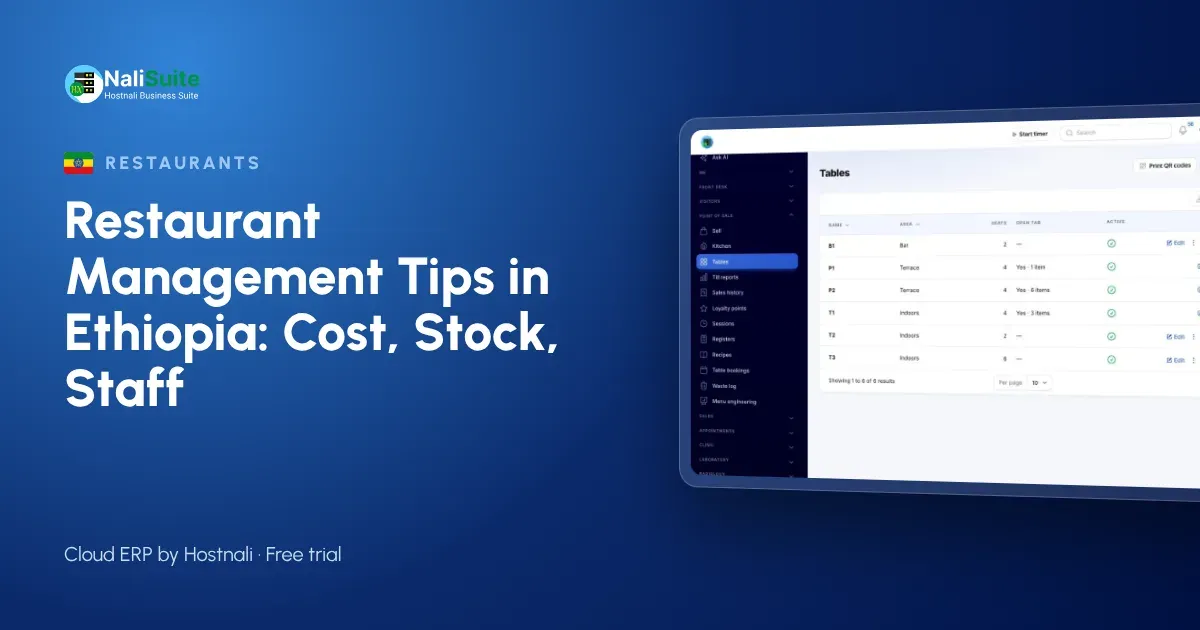
NaliSuite’s Point of Sale works with restaurant tables, so each table’s orders build up during the meal and the payment can be split across methods. Table bookings from Restaurant Pro let you plan staff and prep for the busy nights.
Where restaurants usually lose money
- Portions that grow during busy service.
- Ingredients bought without a purchase order and never checked on delivery.
- Food thrown away without anyone recording it.
- Menu prices that were set years ago and never updated.
- Cash and mobile money takings that are not matched to the till.
Each of these is easy to see once recipes, stock and the till share one system.
Pay staff on time, from the same records
Wages paid late or wrongly are a fast way to lose good cooks and waiters. Keep attendance in HR, with check-in from the phone, and run pay from those records in Payroll, with payslips by email or WhatsApp.
Separate logins for each person on shift, instead of one shared login, protect honest staff and make cash differences easier to trace.
Frequently asked questions
Can I track injera baked each morning?
Yes. The Food production add-on plans daily batches and records what was made, and Restaurant Pro’s waste log records what is thrown away.
What if the power goes off during service?
The till keeps selling offline and syncs sales when the connection returns.
Do I need special hardware?
No. The till runs in the browser on a phone, tablet or laptop, and works with standard thermal receipt printers and barcode scanners.
Try NaliSuite
NaliSuite puts the till, recipes, stock, purchasing, staff and accounting in one cloud system, with plans from ₵25 a month. See how it fits restaurants, cafés and food producers, or compare the plans and start a free trial.