 GHS
 KES - Kenya
 UGX - Uganda
 TZS - Tanzania
 RWF - Rwanda
 NGN - Nigeria
 ZAR - South Africa
 USD - Zimbabwe
 ETB - Ethiopia
 ZMW - Zambia
 USD - International

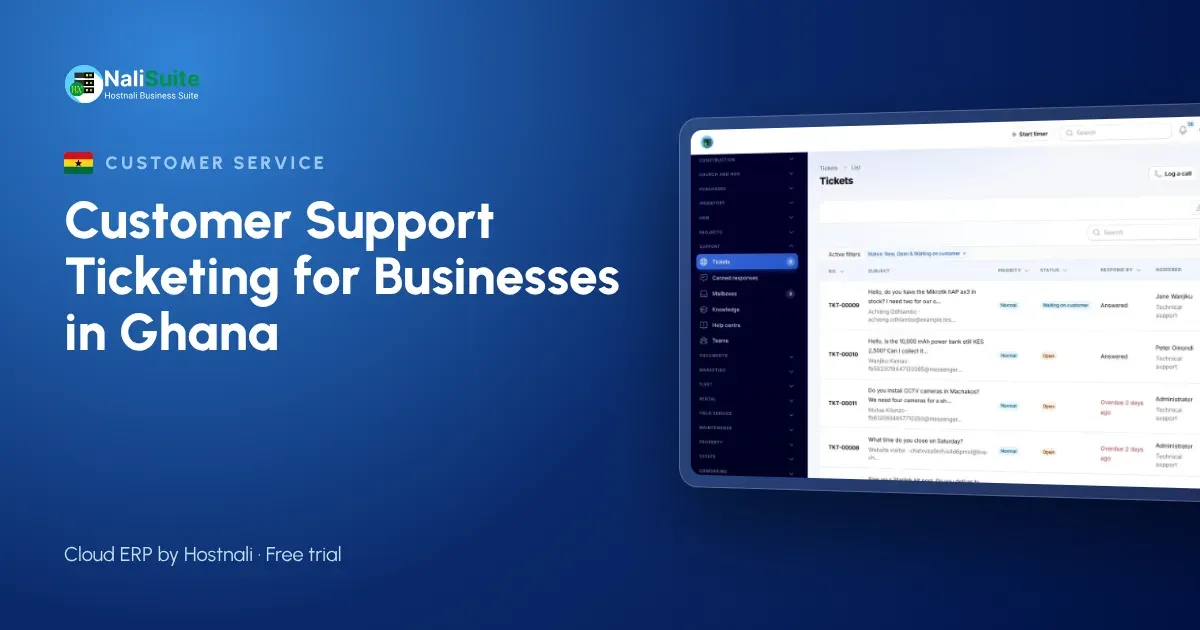
Ghanaian customers reach businesses in whichever way is easiest at that moment: a phone call from the market, a WhatsApp voice note in the evening, an email from the office, a comment on Facebook. Each channel is useful. The problem is that most businesses treat each one separately, so nobody sees the full picture.
This guide goes channel by channel, then shows how a ticketing system brings them together. Our example is a company in Kumasi that sells and supports point-of-sale systems for shops and pharmacies.
The example business
The company, based in Adum, Kumasi, has around 140 business customers across Ashanti and the Bono region. Its support team of four handles login problems, receipt printer issues, training requests and billing questions. Before ticketing, each agent kept their own notes, and customers repeated their story every time they called.
Channel 1: phone calls
Phone is still the first choice for urgent problems. A shop owner whose till has frozen at lunchtime will call, not email.
What to do: log every call as a ticket in NaliSuite Helpdesk, even if it is solved on the spot. That way the next agent knows the shop called yesterday about the same printer, and patterns become visible.
Channel 2: WhatsApp
WhatsApp is where most non-urgent questions arrive, often with screenshots or voice notes.
What to do: connect the business number through the WhatsApp Business Cloud API so messages arrive as tickets in the shared inbox instead of on one agent’s phone. Any agent can pick them up, and the history stays with the business. The WhatsApp feature explains the set-up.
Channel 3: email
Email suits longer requests, such as a new branch to set up or a billing dispute.
What to do: point your support address at Helpdesk. Every email becomes a ticket, and replies go out from the same address so the conversation stays in one thread.
Channel 4: web forms and live chat
A form on your website collects the details you need up front: business name, issue type, a contact number. Live chat catches visitors while they are on your site.
What to do: add both to your website and route them into Helpdesk. Forms are especially good for training requests, because they arrive with all the information filled in.
Channel 5: Facebook and Instagram
Social messages are public-facing, and a slow reply is visible to everyone.
What to do: bring Messenger and Instagram messages into the same inbox, so they are answered with the same priority rules as everything else.
Bringing the channels together
With all five channels in one inbox, the Kumasi team works from a single queue. The practical set-up:
- Priorities. Urgent for a till that will not sell, High for a printer fault, Normal for training and billing, Low for feature requests.
- Targets. First-response and resolution targets per priority, with escalation when a ticket is about to miss one.
- Teams. A Technical team and an Accounts team, with tickets shared out by round robin.
- Statuses. New, Open, Waiting on customer, Resolved.
Answering the same questions once
Many questions repeat: how to reprint a receipt, how to add a product, how to close the day. Save the answers as canned replies. Then publish them as articles in a public help centre and in the customer portal, so shop owners can find the answer at 9pm without waiting for anyone.
With the AI Business Assistant add-on, AI drafts replies from the conversation and your help articles, using your own Anthropic API key. The agent always reviews before sending.
Charging for support
The Kumasi company sells support plans. Agents log time on tickets, and time beyond the plan is billed from NaliSuite Invoicing. Customers pay by MTN MoMo or card, and mobile money payments are recorded against the invoice.
In the customer portal, each shop can open tickets, follow them and see its invoices in one place.
Watching the numbers
- Which channel brings the most tickets.
- How long customers wait for a first reply.
- Which tickets missed their targets.
- How customers rated the help.
The company found that most urgent calls came at the end of the month, when shops ran stock counts, and now sends a short guide to every customer in the last week of each month.
Customer data
Tickets include names, numbers and business details, which are personal data under Ghana’s Data Protection Act, 2012 (Act 843). Keep them in the helpdesk rather than on personal phones, and limit access to the staff who need it.
Training as support
Some tickets are really training needs. When the same shop raises three questions about closing the day, the agent can offer a short training session instead of another reply. Tagging these tickets makes it easy to see which customers need help getting started, and to turn the most common lessons into help articles.
Frequently asked questions
Can voice notes from WhatsApp be handled in the helpdesk?
Messages from your connected WhatsApp Business number arrive as tickets, so the conversation is handled in the shared inbox with its history.
Can a customer have several tickets open?
Yes. Each request is its own ticket, and you can see all of a customer’s tickets together.
Do customers need to create an account?
No, they can write in on any channel. The customer portal is optional for those who want to follow their tickets online.
Try NaliSuite
Helpdesk, Invoicing and the customer portal are part of every NaliSuite plan, from ₵25 a month. See the plans and bring your channels together during the free trial.