 GHS
 KES - Kenya
 UGX - Uganda
 TZS - Tanzania
 RWF - Rwanda
 NGN - Nigeria
 ZAR - South Africa
 USD - Zimbabwe
 ETB - Ethiopia
 ZMW - Zambia
 USD - International

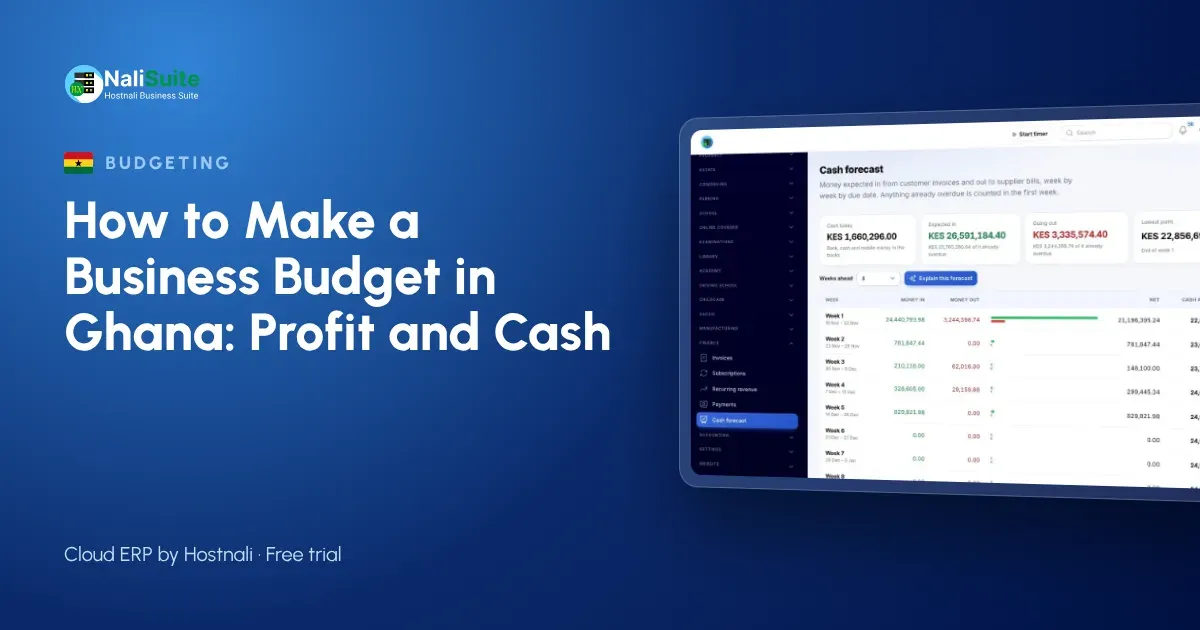
Ghanaian business owners know the feeling: the books say the business made a profit, but there is not enough money to pay suppliers this week. That gap between profit and cash is the most important thing a budget can reveal. A good budget plans both, side by side, so you are never surprised by a month that looks good on paper and empty in the bank.
This guide shows how to make a budget for a Ghanaian small business with two views – profit and cash – and how to split it by branch or department as you grow.
Profit and cash are different questions
- The profit view asks: over this month, did we earn more than it cost us to run the business?
- The cash view asks: will there be enough money in the account and on mobile money to pay what is due this month?
They differ because of timing. You may sell to a company in March and be paid in May. You may pay a year’s rent in January. You may buy three months of stock before the Christmas season. Each of these changes cash without changing profit in the same month.
Building the profit view
For each of the next twelve months, write down:
- Expected sales. Use last year’s figures as a guide and adjust for known changes: a new product, a price increase, a new branch in Kumasi or Takoradi, a lost customer.
- Cost of sales. Stock, materials, packaging and delivery, planned as a share of sales.
- Operating costs. Salaries, rent (the monthly share), power, data, transport, marketing and software.
- Payroll contributions. SSNIT for each employee: 13% of basic salary from the employer and 5.5% from the employee, under the Tier 1 and Tier 2 schemes. PAYE is deducted from staff pay and passed to GRA.
Sales minus all costs is your planned profit before tax for each month.
Building the cash view
Now move every item to the month the money actually moves:
| Item | Profit view | Cash view |
|---|---|---|
| Sale to a company on 60-day terms | Month of sale | Two months later |
| Yearly rent paid upfront | One-twelfth each month | All in the month paid |
| Christmas stock bought in October | Month the stock is sold | October |
| VAT collected from customers | Not income | Paid to GRA when due |
| New equipment | Spread over its life | Month of purchase |
Start with the money you have now, add cash coming in, take away cash going out, and you get the expected balance at each month end. Any month that goes negative is a warning.
Taxes and levies
If your business is registered for VAT, plan the VAT and any levies you collect as money owed to the Ghana Revenue Authority, not as income. Rates and levies have changed in recent years, so check the current figures with GRA and set them in your system. Income tax and any other taxes that apply need their own lines.
Budgeting by branch or department
As soon as you have more than one location or line of business, one combined budget can hide problems. A pharmacy with branches in Accra and Tema may be making good money in one and losing in the other.
Give each branch or department its own budget, then add them up. You will see:
- which branch covers the overheads,
- where costs are rising faster than sales,
- whether a new branch is on track to break even.
NaliSuite accounting supports budgets and cost centres, so you can plan spending per branch, department or project and compare actual results with the budget at any time. For groups with separate companies, multi-company keeps each company’s books separate, with reports for one company or all of them.
A sample pharmacy budget
A sample pharmacy with two branches plans an average month, in plain example numbers:
| Accra | Tema | |
|---|---|---|
| Sales | 160,000 | 90,000 |
| Cost of medicines (68%) | 108,800 | 61,200 |
| Salaries and SSNIT | 22,000 | 15,000 |
| Rent and power | 9,000 | 7,500 |
| Other costs | 4,000 | 3,000 |
| Profit before tax | 16,200 | 3,300 |
In the cash view, the owner sees that insurance and corporate clients pay the Accra branch about 45 days after the sale. October and November, when stock for the festive season is bought, would leave the account short. The owner arranges to spread the stock purchase over three deliveries.
Review and adjust
Every month, compare actual results with both views. If a branch’s costs rise above plan for two months in a row, find out why. If customers pay later than planned, chase them, and update the cash view.
Because invoices, bills, MTN MoMo and bank payments, and payroll post automatically to the books in NaliSuite, the actual figures are always ready. Bank and mobile money reconciliation checks them against your statements, and statutory payroll works out PAYE and SSNIT every month.
Frequently asked questions
Which is more important, the profit budget or the cash budget?
Both. Profit shows if the business is worth running; cash shows if it can keep running.
How much cash reserve should I keep?
Enough to cover your fixed costs for the slowest stretch your cash view shows. Build it up gradually.
Can I use a spreadsheet?
Yes, but you must type in actual figures every month. Software that fills them in automatically makes it much more likely you will keep reviewing.
Try NaliSuite
NaliSuite keeps budgets, cost centres, books, payroll and mobile money payments together. Plans start at ₵25 a month, shown in cedis, with a free trial. See the plans.