 GHS
 KES - Kenya
 UGX - Uganda
 TZS - Tanzania
 RWF - Rwanda
 NGN - Nigeria
 ZAR - South Africa
 USD - Zimbabwe
 ETB - Ethiopia
 ZMW - Zambia
 USD - International

In Accra and Kumasi, buyers rarely choose a supplier on price alone. They choose the one whose quotation they understand, who answered quickly and who seems organised enough to deliver. That makes the quotation a sales tool, not just a price.
This guide looks at the quoting mistakes Ghanaian small businesses make most often, what each one costs and how to put it right.
Mistake: replying with a voice note or a single figure
It is quick to answer a WhatsApp enquiry with “GH₵… for everything.” It is also easy for the customer to forward that figure to two competitors and ask them to beat it.
Instead: send a proper quotation, as a PDF or link, with your name, a quote number and the details. It looks professional, can be forwarded to the person who approves the purchase and shows exactly what is included.
Mistake: not asking enough questions
A caterer quoting for “a party of 100” without asking about the menu, venue, service staff and date will either underprice or overprice.
Instead: confirm the details that change the price before you quote: quantities, specifications, delivery place, timing and any special requirements. Write the answers into the scope.
Mistake: leaving out business details
Many companies, NGOs and public institutions in Ghana need your TIN before they can process a quote. Some also ask for your business registration and, if relevant, your VAT registration.
Instead: put your business name, address, phone, email and TIN in the header of every quotation, and keep your registration documents ready to attach.
Mistake: confusing taxes
Ghana’s VAT and the levies charged alongside it have changed several times, and customers are often unsure what a price includes.
Instead: if you are registered for VAT, show the price before tax, each tax or levy on its own line and the total including tax. Confirm the current rates with GRA before you set up your quote template, and update it whenever they change. If you are not registered, do not add VAT. The free VAT calculator lets you enter the current rate yourself.
Mistake: no validity period
With cedi exchange rates and supplier prices moving, a quote that never expires is a risk.
Instead: state clearly that the quote is valid for a set time, for example 14 days, and that prices may be revised after that.
Mistake: no payment terms
Instead: say how much deposit you need, when the balance is due and how the customer can pay: MTN MoMo, bank transfer or card. For example: “50% on confirmation, balance on delivery.”
Mistake: one take-it-or-leave-it option
Instead: where it makes sense, offer two levels, or add optional lines. A customer comparing a basic and an upgraded option is thinking about which one to choose, not whether to choose you.
Mistake: retyping everything
Writing each quote in a word processor, then retyping it into an invoice, wastes time and introduces errors.
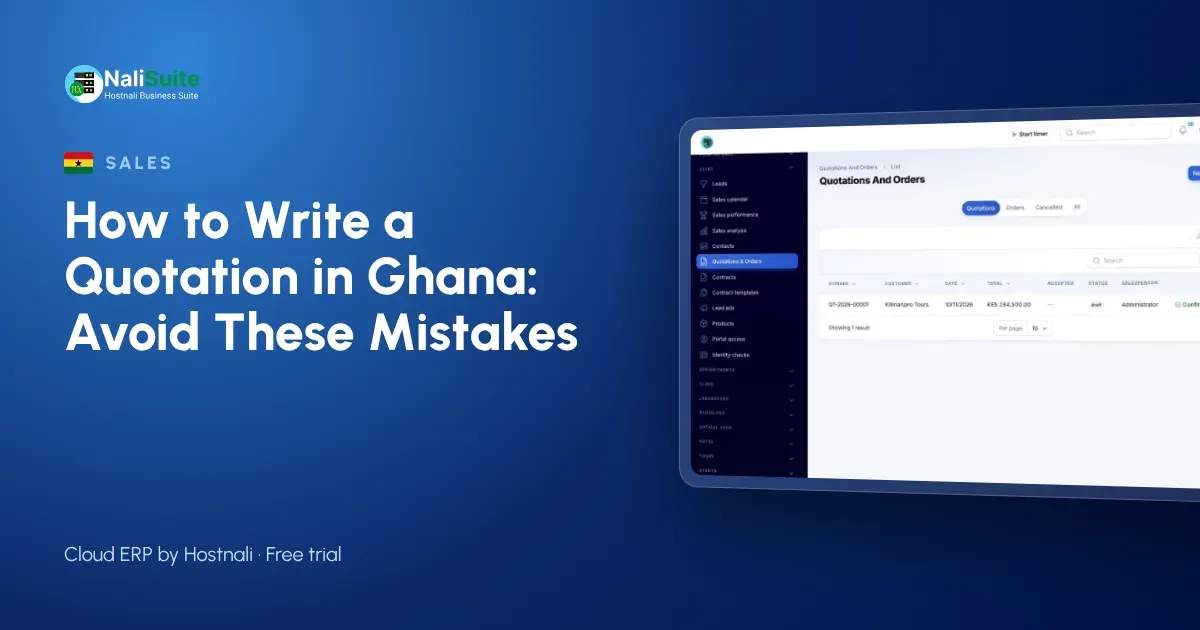
Instead: use a system that keeps your prices and taxes in one place. NaliSuite Sales and Quotations builds each quote from your product list with taxes worked out, adds optional lines and discounts, and sends a branded PDF by email or WhatsApp. The customer accepts through a secure link and you are notified.
Mistake: forgetting to follow up
Instead: call or message two or three days after sending. Ask whether the quote is clear and when a decision is expected. Track each quote in the CRM app so none slip away.
Turning acceptance into cash
When a quote is accepted:
- Confirm the order in writing.
- Send a deposit invoice.
- Deliver.
- Invoice the balance.
In NaliSuite, an accepted quote becomes an order and then an invoice, with deposits and part invoices supported. Every invoice from NaliSuite Invoicing can carry a link to pay by MTN MoMo or card, as described on the mobile money payments page.
An example from Kumasi
A furniture maker in Kumasi used to quote by phone. About half his quotes turned into jobs, and several customers disputed what had been agreed. He switched to written quotes with a clear scope (“solid wood, varnished, delivery within Kumasi included”), a 14-day validity and a 60% deposit. Disputes stopped, and because he followed up every quote two days later, more of them turned into orders.
Keep a price list up to date
Most quoting delays come from hunting for current prices. Keep a single list of what you sell with today’s price for each, and review it whenever a supplier changes theirs or the cedi moves sharply. In NaliSuite you can keep separate price lists for groups such as retail, wholesale and corporate customers, so the right price appears on each quote without you having to remember it. A quote built from an up-to-date list is faster to send and less likely to lose you money.
Frequently asked questions
Should my quotation be in cedis?
For customers in Ghana, yes, unless you have agreed another currency. State the currency clearly.
Do I need to include my TIN?
Yes. Many organisations need it to process your quote and pay you.
Can I send a quote by WhatsApp?
Yes, as a PDF or link rather than a typed message.
How do I handle a customer who wants a discount?
Reduce the scope, change materials or adjust payment terms, then issue a revised quote with a new reference.
Try NaliSuite
NaliSuite helps Ghanaian businesses quote, invoice and collect by MoMo from one record. Plans start at ₵25 a month with a free trial; see the plans or read about NaliSuite.