 GHS
 KES - Kenya
 UGX - Uganda
 TZS - Tanzania
 RWF - Rwanda
 NGN - Nigeria
 ZAR - South Africa
 USD - Zimbabwe
 ETB - Ethiopia
 ZMW - Zambia
 USD - International

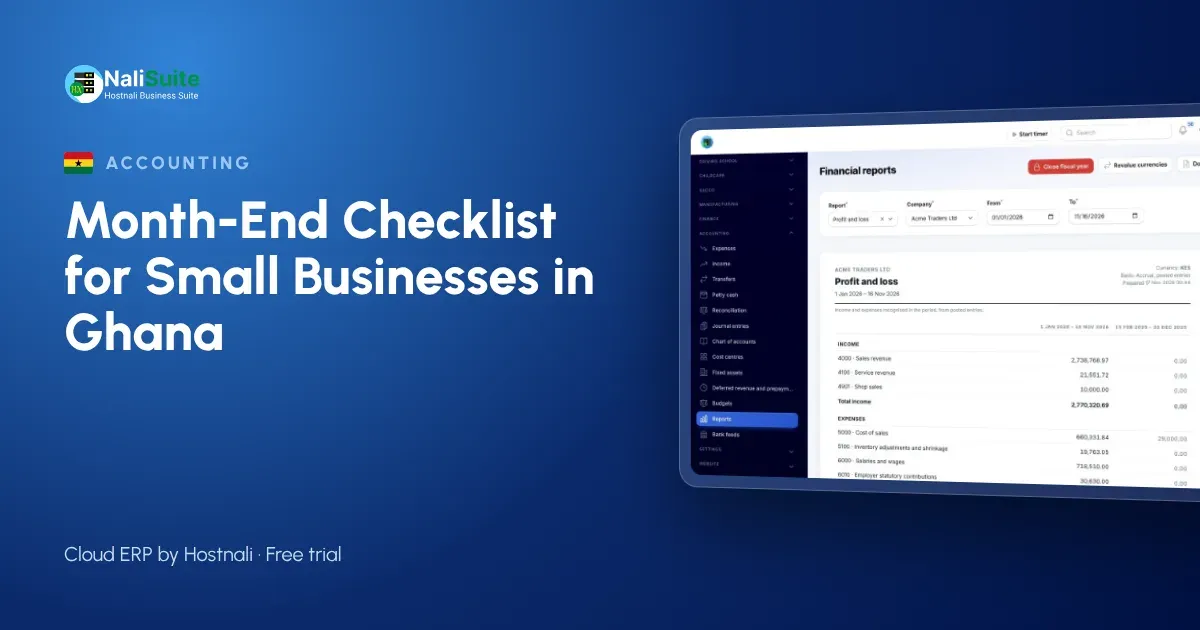
Checklists are easier to follow when you can see someone use one. So instead of a list of rules, this guide follows an example business in Accra through its month-end close, one step at a time, and explains why each step is there.
The business is fictional, but the problems are the ones Ghanaian small businesses run into every month.
Meet the business
Efua runs a cosmetics and beauty supply shop in Osu, with a second small outlet in Tema. She has five staff. Customers pay by MTN MoMo, card, bank transfer and cash. Some salons buy on credit and pay at the end of the month. Her bookkeeper, Kwame, comes in for two days at the start of each month.
Until recently, “month end” meant paying salaries, paying GRA and SSNIT and hoping the bank balance was healthy. Then a supplier dispute showed she could not say what she had bought or paid for in the previous quarter. She decided to close every month properly.
Step 1: Gather every record of money
On the first working day, Kwame collects:
- the MTN MoMo merchant statements for both shops;
- the bank statement for the business account;
- the card settlement report from the payment provider;
- the till reports from both outlets;
- every supplier invoice received during the month.
Why: you cannot match what you have not collected. Gathering first avoids stopping halfway through to hunt for a statement.
Step 2: Match money in
Kwame goes through each MoMo payment, bank credit and card settlement and links it to a till sale or an invoice. Most lines match. Eleven do not: payments with no reference, two part payments from salons and one amount that matches nothing.
He lists the eleven and Efua calls the salons that afternoon. By the evening, only two are left, which are recorded as unidentified receipts until the senders are found.
In NaliSuite Accounting, statements are imported and the system suggests the matching invoice for each line, so Kwame only works on the exceptions. The reconciliation feature explains how this is done.
Step 3: Record money out
Next come supplier bills. Kwame enters each one with the date the goods arrived, not the date it was paid. He also records:
- MoMo and bank charges;
- transport and loading costs paid in cash, with receipts;
- the electricity bill for both shops, even though it is still unpaid.
Why: a bill that is left out makes the month look more profitable than it really was.
Step 4: Chase what customers owe
Kwame prints the list of unpaid invoices. Three salons owe money. Two are a week late; one is two months behind.
Efua sends the two recent ones a short WhatsApp message with a link to pay. She phones the third and agrees a payment plan, and stops further credit until the balance is cleared.
With NaliSuite Invoicing, each reminder carries a link the customer can use to pay by MTN MoMo or card. The mobile money payments page explains how the payment is then matched to the invoice.
Step 5: Count the stock that matters
Efua does not do a full stock-take every month. Instead, she counts the 40 lines that sell most and the 10 most expensive. Two hair products are short in Tema. The count shows they were sent from Osu but never received into Tema’s stock: a transfer that was not recorded. Kwame records the transfer and the difference disappears.
Step 6: Check payroll
Payroll was paid at the end of the month, but Kwame checks it again: are there any new staff, any unpaid leave, any overtime? He records PAYE and SSNIT as amounts owed, ready to pay before the deadlines: SSNIT by the 14th and PAYE by the 15th of the following month.
NaliSuite’s payroll for Ghana calculates PAYE and SSNIT on each payslip and sends payslips by email or WhatsApp.
Step 7: Prepare VAT and read the reports
The business is VAT-registered. Kwame adds up the VAT on sales and on purchases from the recorded invoices and checks a sample of invoices for the correct rate. Rates and levies in Ghana have changed several times, so he confirms the current figures with GRA before filing. The free VAT calculator lets him enter the rate himself to check a price.
Then he and Efua read three reports together:
- Profit and loss: better than last month, mainly because of the Tema outlet.
- Balance sheet: bank and MoMo balances agree with the statements.
- Unpaid invoices: down, now that one salon is on a plan.
Step 8: Lock the month
Finally, the month is locked. If a late supplier invoice arrives, Kwame will either record it in the current month or reopen the period on purpose.
What changed after three months
- The close takes a day and a half instead of “whenever there is time”.
- MoMo and bank matching is done weekly, so month end has fewer surprises.
- Efua knows which outlet is more profitable and which products move.
- When the supplier dispute came up again, she had every invoice and payment to hand.
Frequently asked questions
Do I need a bookkeeper to close the month?
Not always. A business owner can follow these steps, but a bookkeeper is faster and less likely to miss things.
What if my MoMo number is also my personal number?
Get a separate merchant number for the business. Mixing personal and business payments makes matching very difficult.
How do I record goods sent between my shops?
As a stock transfer from one location to the other, so each shop’s stock stays accurate.
Can I see my figures before the month is closed?
Yes, but treat them as provisional until the close is finished.
Try NaliSuite
NaliSuite gives Ghanaian businesses invoices with MoMo pay links, statement matching, payroll and stock across outlets. Plans start at ₵25 a month with a free trial; see the plans or read about NaliSuite.