 GHS
 KES - Kenya
 UGX - Uganda
 TZS - Tanzania
 RWF - Rwanda
 NGN - Nigeria
 ZAR - South Africa
 USD - Zimbabwe
 ETB - Ethiopia
 ZMW - Zambia
 USD - International

For a contractor in Kumasi or a supermarket in Tema, every cedi spent with suppliers comes out of the margin. Yet buying is often the least controlled part of a growing business: orders by phone, deliveries signed by whoever is around, bills paid from memory.
This guide sets out a purchase order process that Ghanaian SMEs can run every day without slowing work down.
A day in the life of a contractor in Kumasi
Imagine an example building contractor in Kumasi with three sites running at once. Site foremen order cement, iron rods and sand from different suppliers, and the office only learns about it when the invoices arrive. One supplier bills for 300 bags of cement delivered to a site that received 250.
With purchase orders, each foreman raises a request for the site, the office approves it against the project budget, and the supplier gets a PO with the site address. The foreman records what actually arrives. The office matches the bill to the PO and the delivery note, finds the 50-bag difference and pays only for what came, by bank transfer or MTN MoMo.
Why buying without POs costs money
Most buying problems are not fraud. They are gaps: an order nobody approved, a delivery nobody counted, a bill nobody checked against the order. A purchase order process closes each gap with one simple step.
Building the process
- Request. The person who needs the item records what, how many and why.
- Approval. A manager says yes or no, with limits so small purchases move fast.
- Purchase order. The approved request goes to the supplier with agreed prices and delivery details.
- Goods received. The store checks the delivery against the PO and records what arrived.
- Bill and payment. The supplier’s bill is checked against the PO and the delivery, then paid.
Matching order, delivery and bill
Matching is the check that catches short deliveries, wrong prices and double billing. It compares:
| Document | What it tells you |
|---|---|
| Purchase order | What you agreed to buy, and at what price |
| Goods received note | What actually arrived, and in what condition |
| Supplier bill | What the supplier is asking you to pay |
A bill that matches goes into the payment run. A bill that does not goes back to the supplier with a question, and is paid once it is corrected or a credit note arrives.
What a good purchase order shows
Keep purchase orders short and clear: who is buying, from whom, what, how many, at what price, where and when to deliver, and on what payment terms. The PO number is the thread that ties the order, the delivery and the bill together, so make sure suppliers put it on every document.
Setting approval limits
Think of limits as permission to move fast. Staff know what they can order without asking, and the owner is only involved when the amount or the supplier is out of the ordinary.
Supplier records in Ghana
Keep each supplier’s TIN on their record and make sure it appears on the invoices you receive. Store the supplier invoice with the matched bill so your records are complete when you file with the Ghana Revenue Authority.
Tax rules change, so check the current VAT and levy treatment of your purchases with GRA and set the rates in your system yourself. In NaliSuite, the business sets its own tax rates, so a change in the law is a quick settings update rather than a new system.
Keeping project costs under control
For contractors and businesses with several sites in Ghana, the purchase order is also a cost-control tool. Link each request to a project or site, and the approved POs show what has been committed before the bills even arrive.
When a site manager asks for more materials, the office can see what has already been ordered and delivered for that site. Overspending shows up early, not at the end of the job.
Settle matched bills by bank transfer or MoMo, quoting the bill number, so that the month-end bank and MoMo reconciliation lines up payment by payment. See bank and mobile money reconciliation.
Putting it into a system
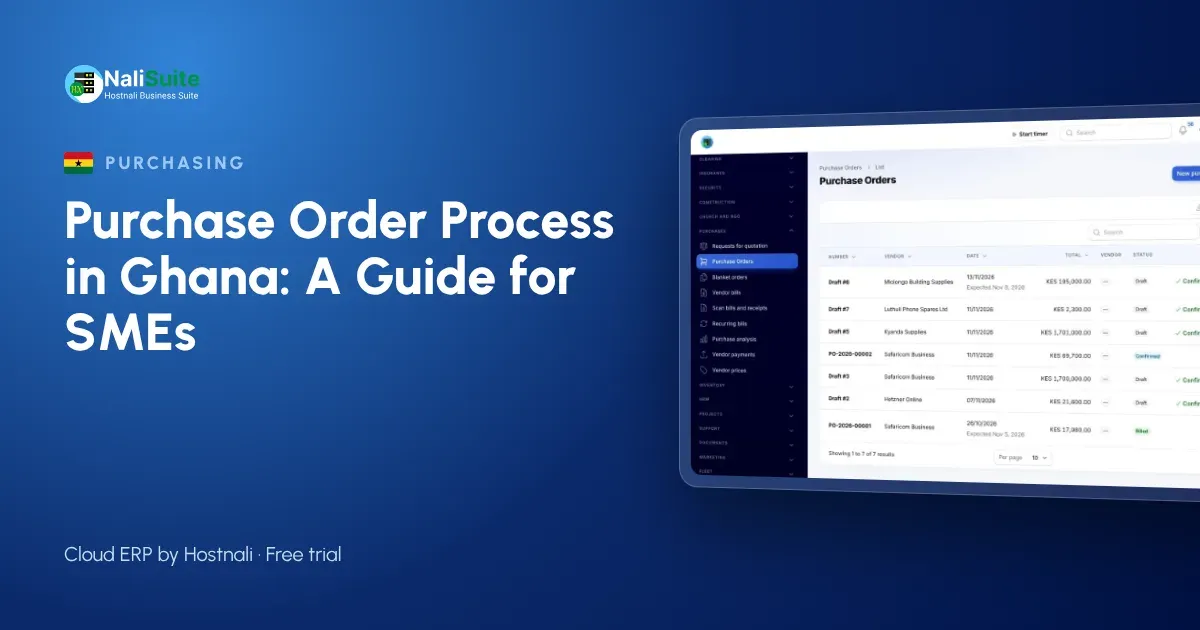
A system keeps every step connected. In NaliSuite, a request becomes a PO, a delivery updates stock, and the supplier bill lands in accounting already matched. The Purchases app shows what is ordered, received and owed at any moment.
Frequently asked questions
Can I pay suppliers by MoMo?
Yes, many Ghanaian suppliers accept MTN MoMo as well as bank transfers. Record each payment against the matched bill.
Which tax rates should I use on purchases?
Check the current rates with the Ghana Revenue Authority and set them in your system. NaliSuite lets you set and update your own tax rates.
Is a purchase order legally binding?
Once a supplier accepts a PO, it usually forms the basis of the agreement on price, quantity and delivery. Keep the accepted PO with the bill.
Do small businesses really need purchase orders?
If more than one person buys on behalf of the business, yes. Even a simple request-and-approve step stops most mistakes.
Try NaliSuite
NaliSuite runs purchases, inventory and accounting in one cloud ERP, with plans from ₵25 a month and a free trial. See plans and prices.