 GHS
 KES - Kenya
 UGX - Uganda
 TZS - Tanzania
 RWF - Rwanda
 NGN - Nigeria
 ZAR - South Africa
 USD - Zimbabwe
 ETB - Ethiopia
 ZMW - Zambia
 USD - International

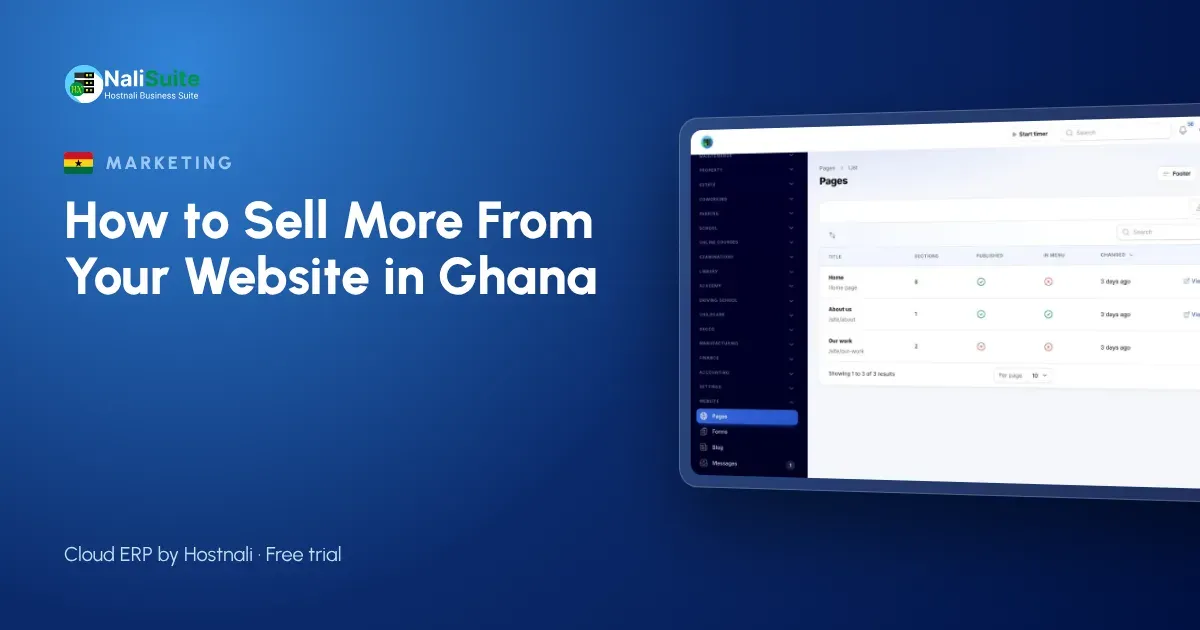
Advice about selling online can feel abstract. It is easier to see what works by watching one business change its website. So this article follows an example: a furniture workshop in Kumasi with a website that looked nice and sold almost nothing. The business is invented, but its problems and fixes are typical of small businesses across Ghana.
The starting point
Let’s call the business Owusu Woodworks. It makes beds, wardrobes, dining sets and office furniture, sells from a showroom in Kumasi and delivers across Ashanti and, for larger orders, to Accra.
Its old website had:
- a large photo slideshow on the homepage, slow to load on mobile data;
- one “Products” page with forty photos and no prices;
- a contact form that emailed a Gmail account the owner rarely checked;
- no address, no reviews and no information about delivery.
Visitors came, mostly from Instagram, and left. The owner assumed people “just use WhatsApp”. That was only part of the story.
Change 1: a homepage that says what they sell
The new homepage opens with one sentence: “Solid wood furniture made in Kumasi, delivered across Ashanti and to Accra.” Below it, four buttons lead to Bedroom, Dining, Office and Custom orders. The slow slideshow is replaced by one good photo.
Lesson for your business: a stranger should understand what you sell, for whom and where within a few seconds.
Change 2: a page for each category, with prices
Each category gets its own page with products, sizes, wood types and “from” prices in cedis. Custom work shows typical starting prices and what affects them.
Lesson: buyers compare. Showing prices, or “from” prices, keeps them on your site instead of sending them to a competitor who does.
Change 3: proof that the business is real
The new site adds the showroom address with a map, opening hours, photos of the workshop and the team, and six reviews from customers who agreed to be quoted. The contact email moves from Gmail to an address on the business’s own domain, through Hostnali’s email hosting.
Lesson: trust is often the deciding factor for a first purchase online.
Change 4: two ways to buy
Standard items can now be ordered online. Customers add a bed or a dining set to a cart, choose delivery and pay. For custom orders, a short form asks for the item, size and location, plus a WhatsApp button and a tap-to-call number.
The owner built the new site with Hostnali’s AI website builder, which creates a site from a description of the business and includes online shop designs with a cart, checkout and delivery options. The site is hosted on Hostnali web hosting, which loads quickly on mobile data.
Lesson: let ready buyers buy, and give everyone else a quick way to ask.
Change 5: fast, tracked quotations
Custom orders used to wait days for a price. Now every enquiry goes into NaliSuite. Website forms create leads in the CRM, where the owner sees every open enquiry and who is handling it.
Using the sales app, the workshop sends a branded quotation by email or WhatsApp, often the same day. The customer accepts online, the quotation becomes an order, and a deposit invoice goes out. Customers pay by MTN MoMo or card; see mobile money payments.
Lesson: for businesses that sell by quotation, reply speed matters more than website design.
Change 6: staying in touch
A subscribe form invites visitors to “get new designs first”. New subscribers receive a short welcome sequence, and the list receives one email a month about new pieces. After delivery, customers get a thank-you email asking for a review. All of this runs from the NaliSuite marketing app, only for people who opted in, as Ghana’s Data Protection Act, 2012 (Act 843) expects.
Lesson: most visitors do not buy on their first visit. Give them a reason to come back.
What changed, in summary
| Area | Before | After |
|---|---|---|
| Homepage | Slow slideshow, no message | One clear sentence and four categories |
| Products | One page, no prices | A page per category with “from” prices |
| Trust | No address or reviews | Map, photos, reviews, business email |
| Buying | Contact form only | Online orders plus a quick custom-order form |
| Quotations | Days by WhatsApp | Same-day quotations accepted online |
| Follow-up | None | Subscribe form, welcome emails, review requests |
The owner’s own measure of success was simple: fewer visitors leaving without a word, and more custom orders confirmed each month.
How to apply this to your business
- Write your one-sentence homepage message.
- Give each main product or service its own page with prices or “from” prices.
- Add your address, photos, reviews and a business email.
- Decide which items can be bought online and which need a quotation.
- Send every enquiry to a system that tracks follow-up.
- Add a subscribe form and a welcome email.
If you would rather have someone build it for you, Hostnali’s web design service can.
Frequently asked questions
Do customers in Ghana really buy online?
Many do, especially when they can pay with mobile money or card and see clear delivery terms. Others prefer to ask first, so offer both routes.
Should I list prices for custom work?
Show typical starting prices and what affects them. It filters serious buyers and saves time.
Can website enquiries go into NaliSuite automatically?
Yes. Form submissions become leads in the CRM or tickets in the helpdesk.
What does NaliSuite cost?
Plans start at ₵25 a month, with the website, CRM, sales and marketing apps included.
Try NaliSuite
Follow Owusu Woodworks’ six changes with your own website. See the NaliSuite plans and start a free trial.