 ETB
 KES - Kenya
 UGX - Uganda
 TZS - Tanzania
 RWF - Rwanda
 NGN - Nigeria
 ZAR - South Africa
 USD - Zimbabwe
 GHS - Ghana
 ZMW - Zambia
 USD - International

Mekdes runs a garment workshop in Bahir Dar, making school uniforms and workwear for local factories. Two factories have asked her to supply far larger orders next year, which means buying more sewing machines and fabric up front. Her first visit to a bank ends with a long list of documents and the advice to come back when she has them all.
Her experience is common. Ethiopian banks and microfinance institutions want to see a well-documented business before they lend, and many also expect security. Each lender sets its own requirements and makes its own decisions, but the records below are the ones most applications need. Preparing them early turns a frustrating process into a manageable one.
Legal documents
- Trade licence for the business, renewed and current. Licensing is handled by the Ministry of Trade and Regional Integration or the relevant regional trade bureau.
- Commercial registration certificate, and for a company, the memorandum and articles of association and the list of shareholders and managers.
- TIN certificate from the Ministry of Revenues.
- Identification for the owner, partners or managers who will sign.
- Premises documents: lease agreement or proof of ownership.
Check renewal dates. An expired trade licence is an easy reason for an application to stall.
Tax records
- Tax clearance certificate from the Ministry of Revenues, which lenders commonly ask for.
- Recent tax declarations, including VAT or turnover tax declarations as they apply to your business.
If any declarations are late, sort them out before applying.
Financial statements
- Financial statements for recent years: profit and loss statement and balance sheet. Depending on your business form and the loan size, the lender may ask for statements audited by an authorised auditor.
- Interim accounts for the months since the last year-end.
Lenders read these to judge whether the business earns enough to repay. Our guide to reading a profit and loss statement in Ethiopia explains what they focus on.
Bank statements
- Statements for the business accounts, usually covering several months.
Statements tell the lender how much money really moves through the business. If customer payments arrive in a personal account mixed with household spending, the business looks smaller than it is. Our guide to separating business and personal money in Ethiopia explains how to fix that.
Customers, suppliers and existing loans
- Debtors list: who owes you, how much and for how long.
- Creditors list: suppliers you owe.
- Existing loans: lender, balance and repayment schedule.
- Contracts or purchase orders from customers, such as Mekdes’s letters of intent from the two factories.
The business plan
Lenders expect to understand what the money will do. Prepare:
- The purpose and amount, with quotations or pro-forma invoices for machines, vehicles or stock.
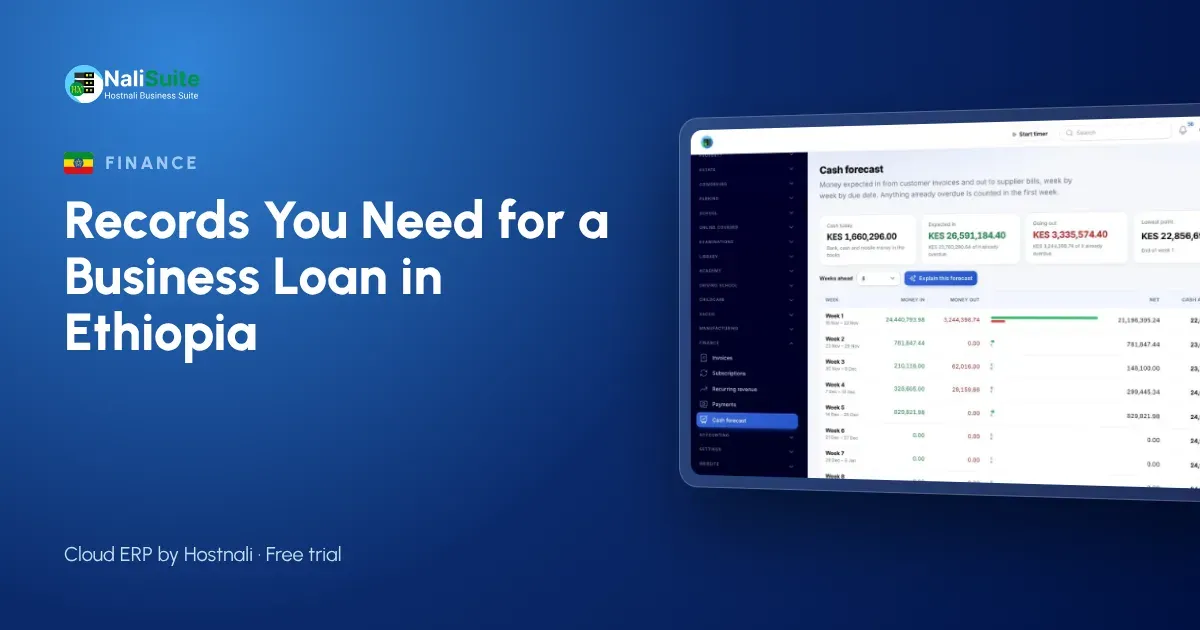
- A cash flow forecast for the loan period showing how repayments will be met. Our cash flow guide for Ethiopian businesses explains how to build one.
- A short description of the market: your customers, competitors and why demand will hold.
Collateral documents
Many loans in Ethiopia require security. Prepare the documents for what you can offer:
- Title deed or lease certificate for property.
- Vehicle registration papers (libre).
- Invoices and import or customs documents for machinery.
- Guarantor details, where asked.
Lenders value the security themselves, but clear ownership documents speed this up.
Mekdes’s application, organised
| Group | What she gathered |
|---|---|
| Legal | Trade licence, commercial registration, TIN certificate, IDs, lease |
| Tax | Tax clearance certificate, recent declarations |
| Financial | Two years of statements, interim accounts for this year |
| Bank | Twelve months of business account statements |
| Customers | Letters of intent from two factories, debtors list |
| Plan | Machine quotations, twelve-month cash flow forecast, one-page market note |
| Security | Lease certificate for her workshop plot, invoices for existing machines |
The second visit to the bank was a discussion about the factories’ orders, not about missing documents.
After you apply
Expect questions. A credit officer may visit the premises, ask how a large customer pays, or ask you to explain a month when sales dipped. Answer with records rather than memory: the invoice, the bank line, the contract. Keep copies of everything you submitted, so that if the lender asks for an update in three months you can send the same documents with fresh figures instead of starting again.
Keeping records ready
Most of the work in a loan application is finding and updating records. If they are kept up to date as you go, the application is mostly a matter of exporting them. NaliSuite Accounting posts each sale, supplier bill and wage payment as it happens, so profit and loss, balance sheet and cash flow statements are always current, and fixed assets such as machines are recorded with their depreciation. Invoicing keeps the debtors list, bank reconciliation shows the books agree with your statements, and Documents holds licences, certificates and contracts in one place.
Frequently asked questions
Do I need audited financial statements?
It depends on your business form and the lender. Ask the lender before you apply.
What can I offer as collateral?
Property, vehicles, machinery or guarantees are common. Each lender decides what it accepts and how it values it.
How many months of bank statements are needed?
It varies; many lenders ask for six to twelve months.
Will complete records guarantee approval?
No, but they make your application easier and faster to assess.
Try NaliSuite
Keep your records ready for the next application. NaliSuite starts at ₵25 a month with a free trial. See the plans.