 ZMW
 KES - Kenya
 UGX - Uganda
 TZS - Tanzania
 RWF - Rwanda
 NGN - Nigeria
 ZAR - South Africa
 USD - Zimbabwe
 GHS - Ghana
 ETB - Ethiopia
 USD - International

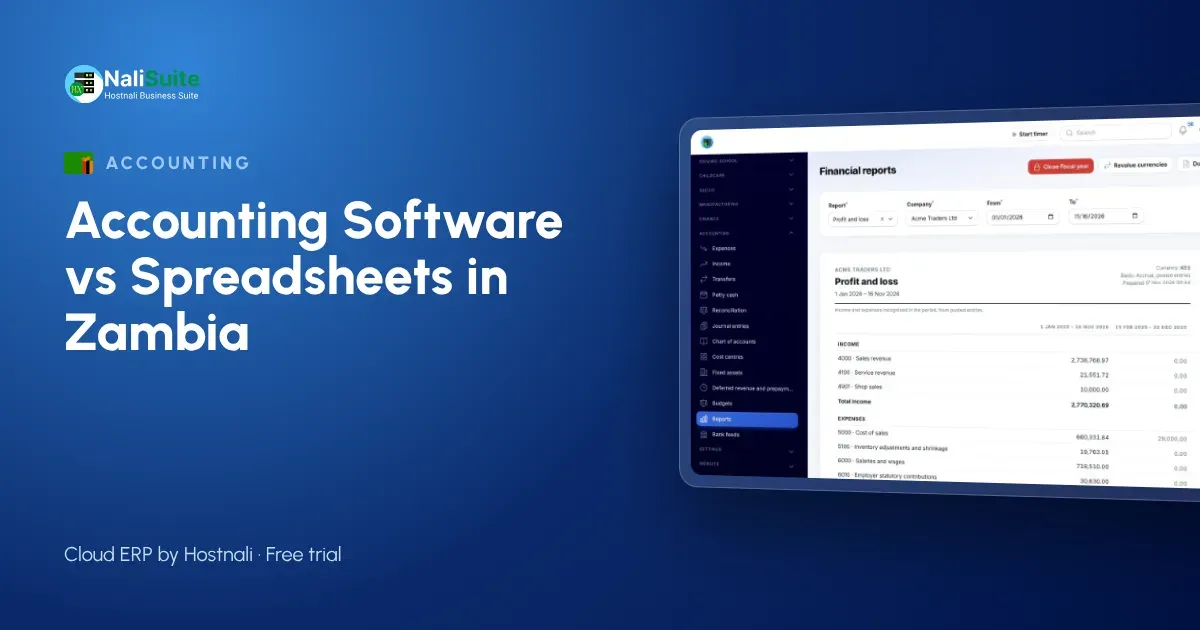
In Lusaka, Kitwe and Ndola, plenty of solid businesses still close their month in a spreadsheet. Some do it well. But the same few beliefs keep owners on Excel long after it has started to cost them. Here they are, with the facts behind each.
“We are too small for accounting software”
Size is not the test. Volume and complexity are. A two-person agro-dealer selling to farmers on credit has more bookkeeping than a ten-person consultancy that bills three clients a month. If you extend credit, handle many payments or charge VAT, you are not too small.
“Mobile money is easy to track in a sheet”
MTN MoMo, Airtel Money and Zamtel Kwacha make collecting easy. Recording is another matter. Each payment arrives with a phone number and an amount, not an invoice number. Matching them in Excel becomes a daily chore, and unmatched payments pile up.
In NaliSuite, mobile money and bank statements are imported into reconciliation and paired with open invoices, and customers can pay straight from a pay link on the invoice using mobile money or card.
“ZRA only looks at the return”
ZRA, and your accountant, will want the return to agree with your invoices, receipts and the records filed under your TPIN. VAT at 16% has to be right on each sale and purchase, not just in the monthly total. Software calculates it line by line, which keeps the return and the invoices consistent. You can check single amounts with the VAT calculator.
“Switching takes months”
For a small business, moving is a matter of days: export your lists, import them, enter opening balances and run both systems for one month.
Facts that favour a spreadsheet
To be balanced, Excel still makes sense when:
- you work alone and sell mostly for cash;
- you are not registered for VAT;
- you have only a few transactions a week.
If all three are true, a disciplined spreadsheet is fine for now.
Facts that favour software
- Credit customers need statements and reminders, which Invoicing sends for you.
- Several users need one set of books, not copies of a file on different laptops.
- Stock needs to move with each sale, not be updated by hand.
- Lenders want management accounts from a real ledger, such as the Accounting app.
A quick comparison
| Spreadsheet | NaliSuite | |
|---|---|---|
| Mobile money matching | By hand, daily | Imported and suggested |
| VAT at 16% | From totals | Per line |
| Customer statements | Built manually | Generated |
| Source of each figure | Typed | Posted from documents |
| Access | One computer | Any browser |
How to move across
- Choose the first day of a month.
- Export customers, suppliers and products to CSV.
- Import them, then enter opening balances and unpaid invoices.
- Record a month in both and compare the totals.
- Archive the spreadsheet.
The switching guide covers moving from QuickBooks or Pastel as well.
A second example: a Kitwe mining supplier
A supplier in Kitwe sells safety equipment and spares to mining contractors. Orders are large, payment terms are long and each contractor has its own order numbers. In the spreadsheet, invoices were listed by date, so finding everything owed by one contractor meant filtering and adding by hand.
In software, every invoice sits on the contractor’s account with its order number, so a full statement is a click away and reminders go out when invoices pass their due date. Stock of fast-moving items updates with each sale, and the owner sees which lines are worth reordering.
Zambian checklist before switching
- Capture each customer’s and supplier’s TPIN during the import.
- Set up VAT at 16% on the right products before issuing the first invoice.
- List every mobile money number and bank account the business uses.
- Agree opening balances with your largest customers before going live.
Load-shedding and connectivity
Power cuts are part of business life in many Zambian towns. A workbook on one office computer is out of reach when that computer is off. Books kept online can be reached from a phone on mobile data, and the till keeps selling offline and syncs when the connection returns.
Frequently asked questions
Do I need an accountant to set it up?
Not necessarily. Many owners import their lists themselves, though an accountant can help check opening balances.
Can it handle kwacha and US dollars?
Yes. Invoice in the customer’s currency and keep your books consistent.
Is there a free trial?
Yes, and plans start at ₵25 a month afterwards.
Can I send reminders automatically?
Yes. Overdue invoices can get reminders on the schedule you choose, with a pay link included.
Will my old Pastel or Excel reports still be available?
Keep them as an archive. The new system starts from your opening balances, so historic reports stay where they are.
Try NaliSuite
If more than one of these beliefs was keeping you on Excel, it may be time to test the alternative. See NaliSuite plans.