 ZMW
 KES - Kenya
 UGX - Uganda
 TZS - Tanzania
 RWF - Rwanda
 NGN - Nigeria
 ZAR - South Africa
 USD - Zimbabwe
 GHS - Ghana
 ETB - Ethiopia
 USD - International

Few Zambian businesses earn the same amount every month. Agro-dealers do most of their trade before planting, builders’ merchants slow down in the rains, school suppliers peak before each term, and many shops in Lusaka and the Copperbelt follow mine and civil service paydays. A budget that ignores these rhythms will be wrong in almost every month.
This guide shows how to build a budget around your seasons, keep an eye on cash as well as profit, and split the budget by branch as the business grows.
Map your year first
Before writing any numbers, draw a simple timeline of your year. Mark:
- Your busy months, and what drives them: planting, harvest, school terms, Christmas, the dry building season.
- Your quiet months, and why.
- Big payments: rent paid upfront, licence renewals, insurance, stock for the busy season.
- When customers pay: on the day, on payday, or 30 days after an invoice.
This map is the skeleton of your budget. It is also a useful conversation with your staff, who often know the patterns better than anyone.
Plan sales for each month
Using last year’s figures and your map, estimate sales month by month. For a sample hardware store in Kitwe, the pattern might look like this:
| Period | Sales pattern |
|---|---|
| May to October (dry season) | Strong: building work and renovations |
| November to December | Mixed: building slows, Christmas trade picks up |
| January to April (rains) | Weaker: fewer building projects |
Write a figure for each month rather than an average. Be cautious with growth you have not yet seen.
Plan the costs
Split them into two groups:
- Costs that follow sales: stock, transport from suppliers, packaging, delivery, charges for receiving MTN MoMo, Airtel Money or card payments. Plan these as a share of sales.
- Costs that stay fixed: rent, salaries, power and backup power, security, data, licences and insurance. Plan these at what you actually pay.
Spread yearly costs across the months in the profit view, but show them in full in the month you pay them in the cash view.
Separate profit from cash
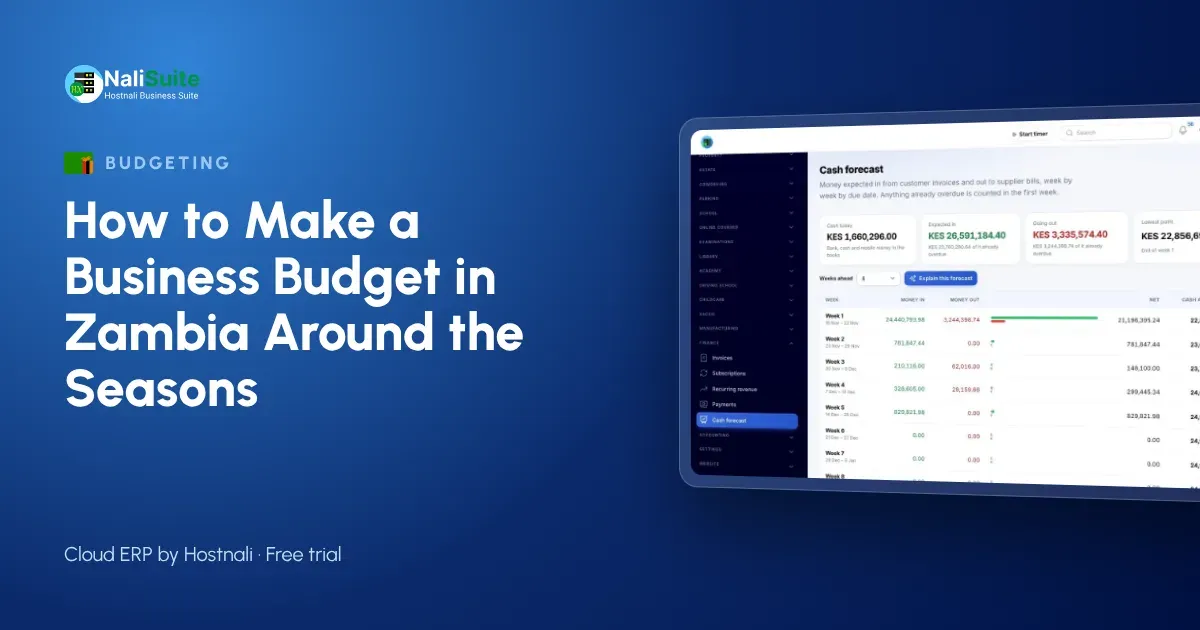
Seasonal businesses feel the difference between profit and cash more than most. A Chipata agro-dealer buys fertiliser and seed months before farmers pay for it. The profit appears in the selling season; the cash leaves much earlier.
Add a cash line to your budget:
- Start with your current bank and mobile money balance.
- Add the cash you expect to receive each month.
- Subtract the cash you expect to pay out, including stock bought ahead of the season.
- Note the balance at each month end.
If a month goes negative, decide now: build a reserve from the busy season, negotiate supplier terms, take deposits from farmer groups or stagger purchases.
Taxes and staff costs
If your business is registered for VAT, the standard rate in Zambia is 16%. VAT you collect is owed to the Zambia Revenue Authority; plan it as a payment, not as income. Income tax and any other taxes need their own lines. Check current rules and dates with ZRA.
Budget the gross salary of each employee and the deductions and contributions that apply to your business. NaliSuite does not claim a statutory payroll calculation for Zambia, but you can set up your own deductions in payroll, so the payslips and the budget use the same figures.
A budget per branch
If you have more than one branch – say Kitwe and Ndola – budget each separately, then add them up. Branch budgets show which location carries the business and which needs attention. NaliSuite accounting supports budgets and cost centres, so you can track each branch, department or project against its own plan. With the multi-company and branches setup, each branch has its own tills, stock and staff, with reports for one branch or all of them.
A sample month in the dry season
For the Kitwe hardware store, in plain example numbers:
- Sales: 850,000.
- Stock and transport (72%): 612,000.
- Salaries: 95,000.
- Rent, power and security: 48,000.
- Other running costs: 25,000.
- Planned surplus before tax: 70,000.
In February, sales are planned at 450,000 with the same fixed costs, which gives a small loss. The owner plans to carry it with a reserve built from the dry-season months.
Check it every month
Compare actual results with the plan at every month end. Look at the biggest gaps first. If the rains start early or a big customer delays payment, update the coming months. Because NaliSuite posts invoices, bills, payments and payroll to the books automatically, the actual figures are ready when you are, and bank and mobile money reconciliation keeps them accurate.
Frequently asked questions
Why can’t I just use a monthly average?
Because a seasonal business can be profitable for the year and still run out of cash in its quiet months. Monthly figures show when.
How much reserve does a seasonal business need?
Enough to cover fixed costs through the quiet months your budget shows. Build it up during the busy season.
Should I budget for stock bought ahead of the season?
Yes, in the cash view in the month you pay for it. It is one of the biggest causes of cash shortages.
Try NaliSuite
NaliSuite keeps budgets, branches, books, payroll and mobile money payments together. Plans start at ₵25 a month, shown in kwacha, with a free trial. Compare the plans.