 ZMW
 KES - Kenya
 UGX - Uganda
 TZS - Tanzania
 RWF - Rwanda
 NGN - Nigeria
 ZAR - South Africa
 USD - Zimbabwe
 GHS - Ghana
 ETB - Ethiopia
 USD - International

A price is a promise. It tells the customer what they will get and tells you what you will keep. Zambian small businesses, from agro-dealers in Chipata to boutiques in Lusaka’s malls, often get the first half right and forget the second: the price feels fair, but nothing is left after costs.
This guide looks at pricing in three layers – value, cost and margin – and shows how to keep them balanced as your business grows.
Layer 1: What is the customer paying for?
Customers rarely buy only the item. They pay for being able to get it nearby, today, from someone they trust. Think about:
- Convenience: a shop in the compound saves a trip into town.
- Reliability: a supplier who always has stock is worth more to a contractor in Kitwe than a cheaper one who often runs out.
- Advice and after-sales: farmers buying seed and fertiliser value someone who explains how to use it.
- Payment options: taking MTN MoMo or Airtel Money makes buying easier for many customers.
Write down the two or three things that make your business worth choosing. They decide how far above the cheapest price you can sit.
Layer 2: What does it cost you?
Value sets the ceiling; cost sets the floor. Work out the full cost of a unit:
- Supplier price.
- Transport from Lusaka or the Copperbelt, or from across the border for imports, with any duty and clearing charges.
- Packaging and handling.
- Losses from damage or expiry.
- A share of monthly overheads: rent, staff, power and backup power, phone and data, and your own pay.
The total, divided by the units in the batch, is your floor price.
Layer 3: How much should you keep?
Margin is the share of the selling price you keep after cost. Different products deserve different margins:
| Product type | Example | Margin thinking |
|---|---|---|
| Traffic builders | Airtime, sugar, cooking oil | Thin; they bring people in |
| Core range | Everyday stock | Your standard target |
| Specialist | Spares, imported tools, seed varieties | Wider; slower to sell |
To get the price for a target margin, divide the full cost by one minus the margin. For a 30% margin, cost ÷ 0.7.
Don’t forget VAT
If your business is registered for VAT, the standard rate in Zambia is 16%, and that part of the price belongs to the Zambia Revenue Authority. Measure margins on the price before VAT and show VAT clearly on invoices for business customers. Check any special rules for your products with ZRA. The free VAT calculator works out VAT-inclusive and VAT-exclusive prices.
Make discounts earn their keep
A discount should buy you something: a bigger order, quicker payment, a loyal customer, or space on the shelf. Some useful rules:
- Volume discounts only above a set quantity.
- Early-payment discounts only when payment arrives by the agreed date.
- Seasonal promotions with a clear start and end, for example before the planting season.
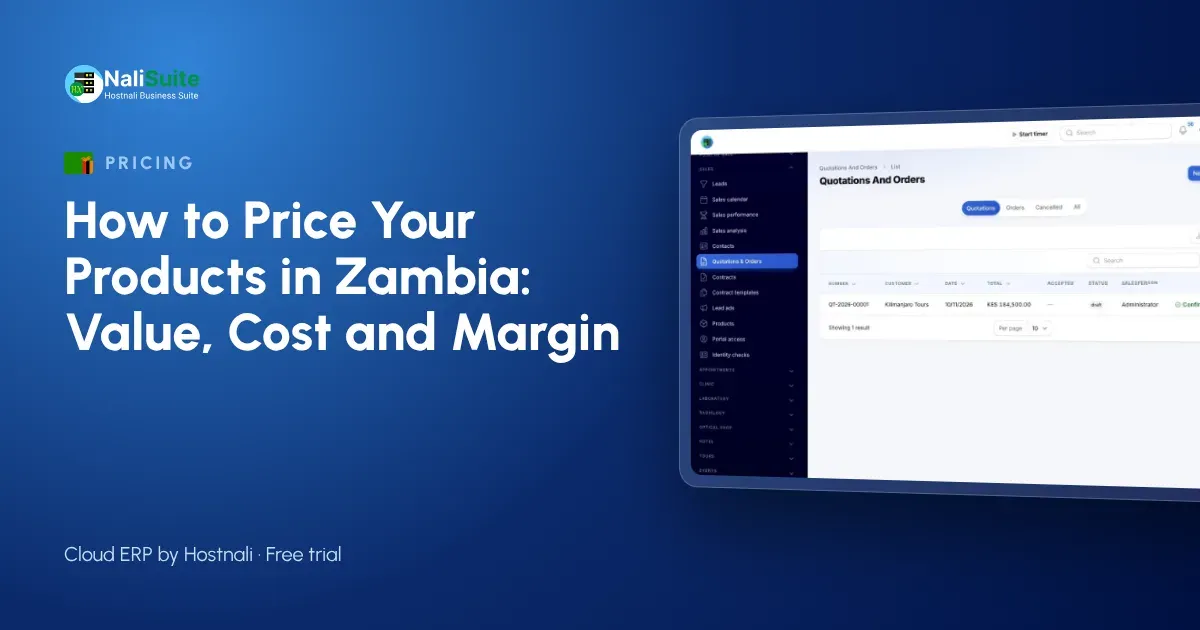
In the NaliSuite sales app, price lists can be set per customer group or quantity, and promotions apply automatically between the dates you choose. Your point of sale uses the same prices, so counter staff cannot drift.
An example from an agro-dealer
An agro-dealer in Chipata sells a sample bag of fertiliser. Using plain example numbers:
- Supplier price: 520.
- Transport from Lusaka: 30.
- Handling and storage: 10.
- Share of overheads: 40.
- Full cost: 600.
For a 15% margin on a fast-moving product: 600 ÷ 0.85 ≈ 706. The dealer sells at 705 for single bags, and offers 690 per bag to farmer groups ordering twenty bags or more and paying upfront. That still clears the floor and wins larger orders.
Watch margins as you go
A price is only right for as long as costs stay where they were. Check your margins monthly and whenever a supplier changes prices or transport costs jump. NaliSuite inventory records each product’s cost including freight, and accounting shows gross margin by product, so a slipping margin shows up before it turns into a loss.
Smaller packs, wider reach
In many Zambian communities, customers buy in small amounts because cash comes in small amounts. Splitting large packs into smaller ones – a kilogram of seed instead of ten, a small bottle of cooking oil, small sachets – lets more people buy, and the price per kilogram or litre can carry a higher margin to cover the extra packing. Work out the cost of the packaging and labour for each smaller pack, so the margin is real and not swallowed by bags and time.
Frequently asked questions
What if my customers cannot afford a higher price?
Look at your costs first: a better supplier, larger orders or less waste. Smaller pack sizes can also keep the price within reach while protecting your margin.
Should I give credit to regular customers?
Only to customers with a good record, with a limit and agreed payment dates. Credit costs you money, so the price for credit sales can reasonably be a little higher.
How can I compare my prices with competitors?
Check a few key items regularly, but set your price from your cost and the value you offer, not from someone else’s price alone.
Try NaliSuite
NaliSuite links your stock costs, price lists, quotations and till so your prices always cover your costs. Plans start at ₵25 a month, shown in kwacha, with a free trial. Compare the plans.