 ZMW
 KES - Kenya
 UGX - Uganda
 TZS - Tanzania
 RWF - Rwanda
 NGN - Nigeria
 ZAR - South Africa
 USD - Zimbabwe
 GHS - Ghana
 ETB - Ethiopia
 USD - International

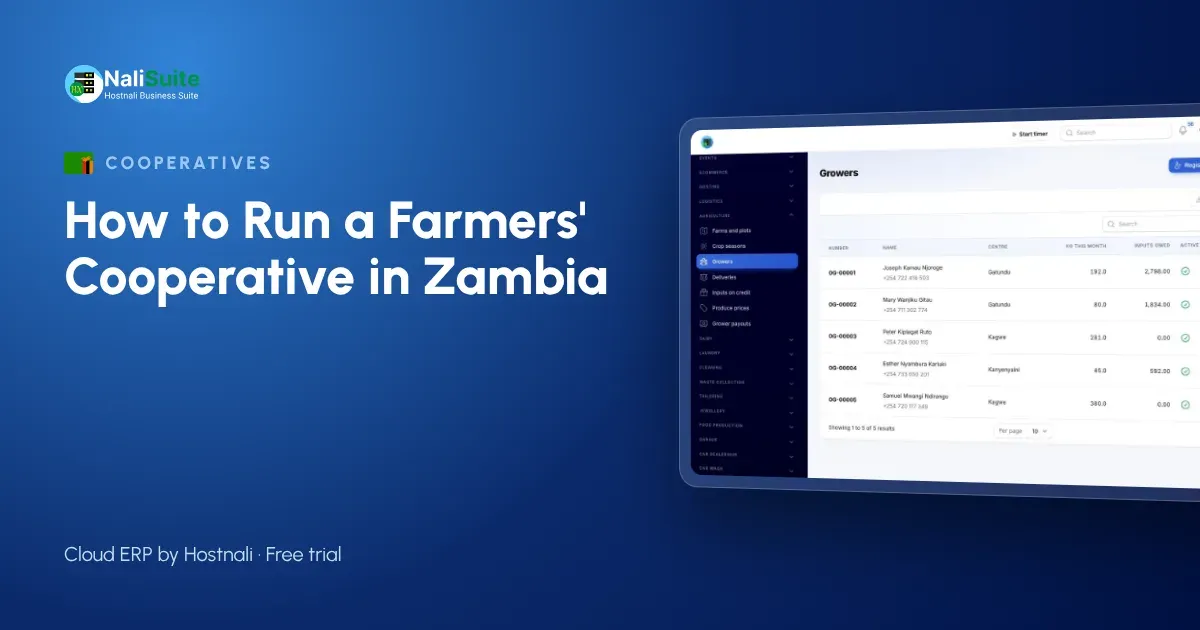
Zambian cooperatives help smallholders bulk their maize, soya and groundnuts, collect milk on shared routes and buy inputs at better prices. The weak point is usually administration: deliveries in one book, inputs in another, payments in a third. This guide shows how to bring those records together so that every member is paid correctly and can see why.
A worked example: a dairy cooperative near Choma
Imagine a dairy cooperative near Choma in Southern Province. Members bring milk to the collection centre every morning, where it is tested and measured before going to the processor. Members buy feed and veterinary supplies from the cooperative shop on credit. At month end the committee needs to know how much milk each member supplied, what they owe the shop and what to pay them. When deliveries and shop credit are recorded against each member as they happen, the payout list builds itself.
Make the collection point the source of truth
The collection point is where errors either start or stop. Capture each intake as it happens, with the member number, quantity, grade and the price that applies on that day, and give the member a receipt by text.
For milk, record morning and evening intake separately and reject deliveries that fail the quality check at the door, rather than arguing about them at month end.
Members first: a register you can rely on
Treat the member register as the cooperative’s most valuable document. Each entry needs the member number, full name, phone, payout details, route or centre, joining date and a contact person in the family.
Limit who can change payout details, and keep a note of every change and who made it. A changed phone number or bank account is the easiest way for money to go astray.
Pay members on time, every time
Fix a payout date and keep to it. On that date, the system works out each member’s earnings, takes off the agreed deductions and produces the payout list. Pay members by MTN MoMo or Airtel Money, and record each payment against the member so the statement shows it.
Paying late, even by a week, pushes members to side-sell to traders who pay cash at the gate.
Advances, inputs and store credit
Members often take seed, fertiliser, feeds, veterinary drugs or a cash advance before they are paid. Record every item against the member on the day it is taken, with its value.
That way the payout calculation already knows what to recover. Each item appears as its own line on the statement, so members can see that what was deducted is what they took.
Agree the deductions and show every one
Before the season starts, agree in writing which deductions apply: store credit, advances, a levy, share capital, savings contributions or loan repayments. Then show each one separately on the statement, never as a single lump.
A member who can see ‘feeds’, ‘share capital’ and ‘loan repayment’ as three lines understands where their money went. A member who sees one unexplained deduction assumes the worst.
Paying members by mobile money
Mobile money is widely used in rural Zambia, so paying members by MTN MoMo or Airtel Money saves them a trip to town. Confirm each member’s number before the first payout and keep a second contact on file.
Show every deduction, from shop credit to savings contributions, as its own line on the statement. Members who understand their statement are less likely to side-sell to traders at the farm gate.
Doing it in NaliSuite
You do not need to build this from scratch. In NaliSuite, the Agriculture and Outgrowers add-on registers the growers who supply you, records weighed collections priced by grade with a text receipt, and settles inputs given on credit in each payout. Dairy groups use the Dairy Cooperative Milk Collection add-on for routes, intake with density rejection, store credit and monthly payouts.
The SACCO and Microfinance add-on adds member savings, share capital and loans, and members can see statements in a portal. The store’s stock lives in Inventory, the books in Accounting, and the farms and cooperatives page shows how they fit together.
Statements and transparency
Send every member a statement each period: deliveries with dates and weights, the price applied, each deduction and the amount paid. Share it by text or WhatsApp, or let members log in to see it.
At the annual general meeting, show the totals: volume collected, what buyers paid, what was paid to members and what the cooperative kept. Openness is the best defence against rumours.
Member records are personal data. Keep them secure, use them only to run the cooperative and follow the Data Protection Act No. 3 of 2021, overseen by the Office of the Data Protection Commissioner.
Frequently asked questions
Can members be paid by MTN MoMo or Airtel Money?
Yes. Each member’s payout can go to their mobile money number, and the payment is recorded against their statement.
Can the cooperative run a shop on credit?
Yes. Goods taken from the cooperative shop are recorded against the member and deducted from the next payout, with each item shown on the statement.
Will it work at collection points with weak internet?
Clerks can record deliveries on a phone or laptop in the browser; plan for a working connection at each centre, or record at the main office the same day.
How long does it take to set up?
Most cooperatives start with the member register and one collection point, then add the others once the first is running smoothly.
Try NaliSuite
Pick one route or collection centre, set it up during a free trial and run it alongside your current books for a month. View plans and prices.