 ZMW
 KES - Kenya
 UGX - Uganda
 TZS - Tanzania
 RWF - Rwanda
 NGN - Nigeria
 ZAR - South Africa
 USD - Zimbabwe
 GHS - Ghana
 ETB - Ethiopia
 USD - International

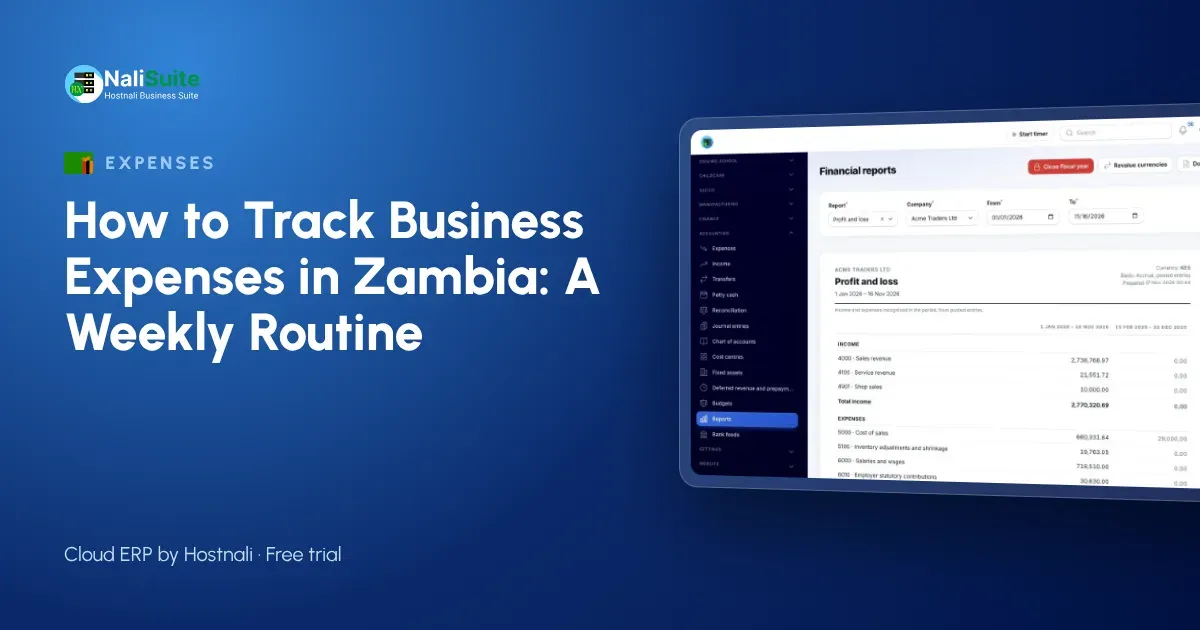
Most Zambian business owners know roughly what they sell each day. Far fewer know what they spend. Fuel, transport, airtime, small repairs, casual labour and mobile money charges slip out a little at a time, and by month end the numbers simply do not add up.
The answer is a routine, not a big software project. This guide sets out what to do every day, every week and every month to keep expenses under control, with tips for shops, workshops and service businesses in Lusaka, the Copperbelt and beyond.
Every day: capture
The daily job takes five to ten minutes and makes everything else possible.
- Photograph every receipt on the day you get it.
- Write a petty cash voucher for every cash payment: date, amount, purpose, who was paid, and a signature.
- Note mobile money payments: when you pay by MTN MoMo or Airtel Money, add the purpose to the reference or note it straight away. A confirmation SMS without a purpose is hard to categorise a month later.
- Keep supplier invoices together with the payment they belong to.
If someone else spends for the business – a driver buying fuel, a supervisor paying a casual worker – they hand in the receipt or voucher before the end of the day.
Every week: review and approve
Once a week, the owner or manager:
- Reviews the week’s expenses by category. Anything unusual? Fuel higher than normal? A repair nobody mentioned?
- Approves claims and supplier bills waiting for payment.
- Tops up petty cash only for the total of vouchers presented, and counts the float.
- Chases missing receipts while the details are fresh.
With NaliSuite purchases, purchase orders, bills and expenses above a set amount wait for approval automatically. Staff can submit claims with a photo of the receipt from their phones through employee self-service, so the weekly review happens on one screen instead of a pile of paper.
Every month: reconcile and report
At the start of each month:
- Reconcile the bank and mobile money statements against your records. Every payment needs a matching expense, and every expense needs to appear on a statement or in petty cash.
- Look for duplicates and gaps: the same bill entered twice, a payment with no receipt.
- Summarise spending by category and compare it with last month and with your budget.
NaliSuite accounting imports statements or connects bank feeds and suggests matches. Bank and mobile money reconciliation lists anything still unmatched.
Choose categories that make sense to you
A simple list that fits most Zambian small businesses:
| Category | Examples |
|---|---|
| Stock and materials | Goods for resale, raw materials |
| Fuel and transport | Diesel, petrol, minibus fares, haulage |
| Staff and casuals | Wages, casual labour, staff meals |
| Premises | Rent, repairs, security |
| Power | ZESCO units, generator fuel, solar maintenance |
| Phone and data | Airtime, bundles |
| Mobile money and bank charges | Transfer and withdrawal charges |
| Licences and fees | Council licences, professional fees |
| Marketing | Radio adverts, printing, social media |
| Equipment | Tools, computers, furniture |
Keep the same list all year so months can be compared.
Tax records
If your business is registered for VAT, you will usually need proper tax invoices from suppliers to claim input VAT, and ZRA may ask to see records supporting your expenses. Check the current requirements with ZRA, and keep both the paper and a photo of each receipt for as long as the rules require.
Cut the typing
If you receive many supplier bills, the Document AI add-on reads PDFs and phone photos of receipts – supplier, invoice number, dates, lines, VAT and totals – so you check and save instead of typing. A receipt already paid becomes an expense; a supplier invoice becomes a draft bill. It uses your own Anthropic API key.
An example from a workshop
A sample motor workshop in Ndola started the routine after the owner noticed that profit was falling while sales were steady. Within two months, the weekly reviews showed that parts were being bought twice: once by mechanics on the way to work, and again by the office from the regular supplier. All parts now go through purchase orders, and the duplicate spending stopped.
Common mistakes to avoid
- Paying business costs from a personal mobile money line.
- Letting petty cash run without vouchers.
- Recording the payment but not what it was for.
- Leaving reconciliation until year end.
Small steps count
Start with one habit – photographing receipts – and add the others week by week.
Frequently asked questions
I am the only person in the business. Do I still need this?
Yes. A simple daily habit saves you days at year end and shows you where money goes.
How do I track expenses paid by mobile money?
Add the purpose to the payment reference, save the confirmation and reconcile the mobile money statement monthly.
What should I do with old, untracked receipts?
Enter what you can for the current year, then start the routine from today.
Try NaliSuite
NaliSuite keeps expenses, approvals, mobile money payments and reconciliation together. Plans start at ₵25 a month, shown in kwacha, with a free trial. Compare the plans.