 ZMW
 KES - Kenya
 UGX - Uganda
 TZS - Tanzania
 RWF - Rwanda
 NGN - Nigeria
 ZAR - South Africa
 USD - Zimbabwe
 GHS - Ghana
 ETB - Ethiopia
 USD - International

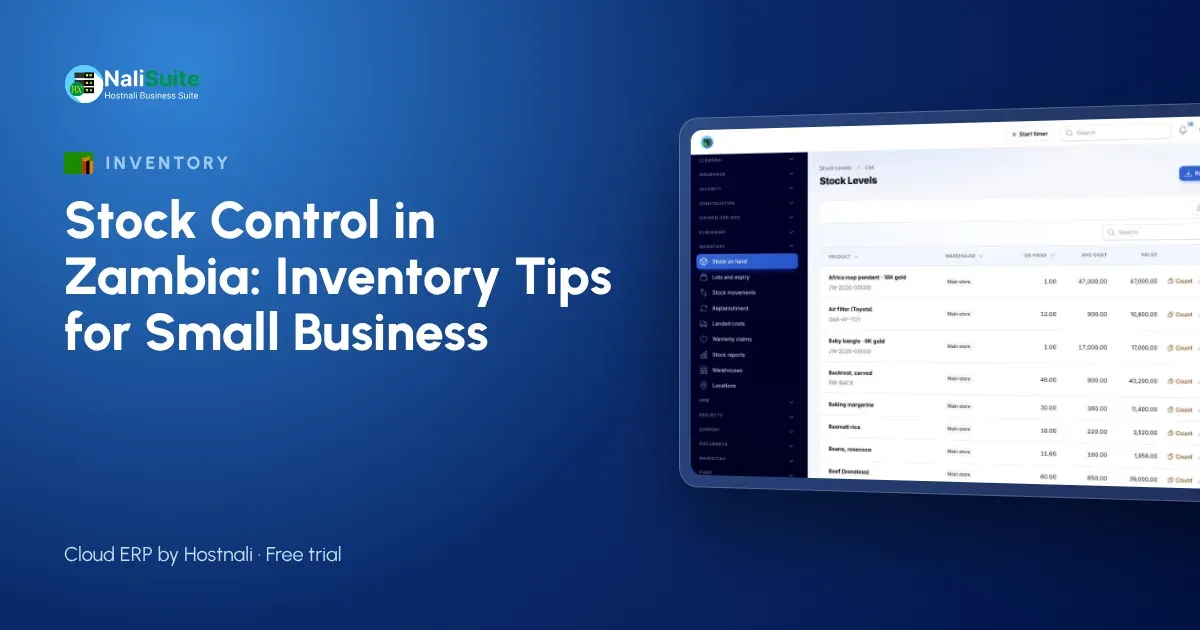
Whether you run a hardware store in Kitwe, a pharmacy in Lusaka or a grocery in Livingstone, stock is where most of your money sits. Good stock control means fewer empty shelves, less dead stock and fewer losses. Here are practical tips for Zambian small businesses.
Get your opening stock right
Everything else depends on knowing what you have today. Pick a quiet day, count every item once, and enter the figures as your opening stock. Use barcodes where you can: a phone camera or a cheap USB scanner is faster and more accurate than writing on paper.
After that first full count, switch to cycle counting: count a different section each week, starting with fast movers and high-value items. Small, regular counts catch errors early and never close the shop.
Stock challenges in Zambia
Many Zambian businesses buy from suppliers in Lusaka or import through South Africa, which means lead times of days or weeks. Running out of a key item can cost you a customer to the shop next door.
Load-shedding adds another risk: if the till goes down and sales are written on paper, stock records fall behind. And pharmacies must keep close track of batches and expiry dates.
Set reorder points for your best sellers
A reorder point is the stock level at which you place a new order. Work it out from how much you sell each day and how long your supplier takes to deliver, then add a small safety buffer. For example, if you sell 10 cartons a day and delivery takes 5 days, reorder when you have about 60 left.
Start with your top 50 items. Once those never run out, extend reorder points to the rest of the range.
Example: a hardware store in Kitwe
A hardware store in Kitwe supplies contractors on the Copperbelt. The owner sets reorder points for cement, roofing sheets and fittings based on how much sells in a typical week and how long suppliers take to deliver. Purchase orders go out when stock falls below the reorder point, and deliveries are checked against the order before they are booked in.
Counting high-value items like tools every week has cut losses that used to show up only at year-end.
Batches, lots and expiry
If a product has a shelf life, record its batch and expiry date when it arrives. That one habit lets you sell oldest first, spot near-expiry lines in time to discount or return them, and answer a recall without turning the store upside down.
For regulated products such as medicines, traceable batches are not just good practice; they are often expected by regulators and suppliers.
Mistakes Zambian businesses can avoid
- Paper sales during outages. Notes written during load-shedding often never reach the stock records; an offline till fixes that.
- Optimistic lead times. If deliveries from South Africa usually take two weeks, plan for two weeks, not five days.
- No write-offs. Damaged or expired stock that stays on the books hides real losses.
- Counting everything once a year. Weekly counts of your top items catch problems early.
Losses, theft and mistakes
Losses come from three places: receiving, selling and the stockroom. At receiving, check quantities against the purchase order before signing. At the till, make sure every sale goes through the point of sale rather than a notebook. In the stockroom, count small sections often and record write-offs for damage or expiry.
Track the shrinkage figure month by month. If it rises, you know which area to look at first.
Getting started in Zambia
Start with a spreadsheet of products, cost prices, selling prices and barcodes, import it, and count once to set opening stock.
Set reorder points that reflect your suppliers’ real delivery times, especially for goods that come from South Africa. Use purchase orders and check deliveries against them. Record batches and expiry dates for medicines and food.
Keep your till and stock in one system, so sales made during load-shedding still reduce stock once the till syncs. Then review slow movers monthly and stop reordering what does not sell.
Frequently asked questions
What is the quickest way to start?
Import your product list from a spreadsheet, count your stock once to set opening levels, and set reorder points for your top 50 items first.
What is cycle counting?
Counting a small part of your stock each week instead of everything at once, so errors are caught early and the shop never closes for a stock-take.
What is a reorder point?
The stock level at which you place a new order: average daily sales multiplied by the supplier’s lead time, plus a safety buffer.
Try NaliSuite
Ready to get stock under control? NaliSuite inventory with reorder rules, batches and branches is included in every plan from ₵25 a month. Start a free trial.