 ZMW
 KES - Kenya
 UGX - Uganda
 TZS - Tanzania
 RWF - Rwanda
 NGN - Nigeria
 ZAR - South Africa
 USD - Zimbabwe
 GHS - Ghana
 ETB - Ethiopia
 USD - International

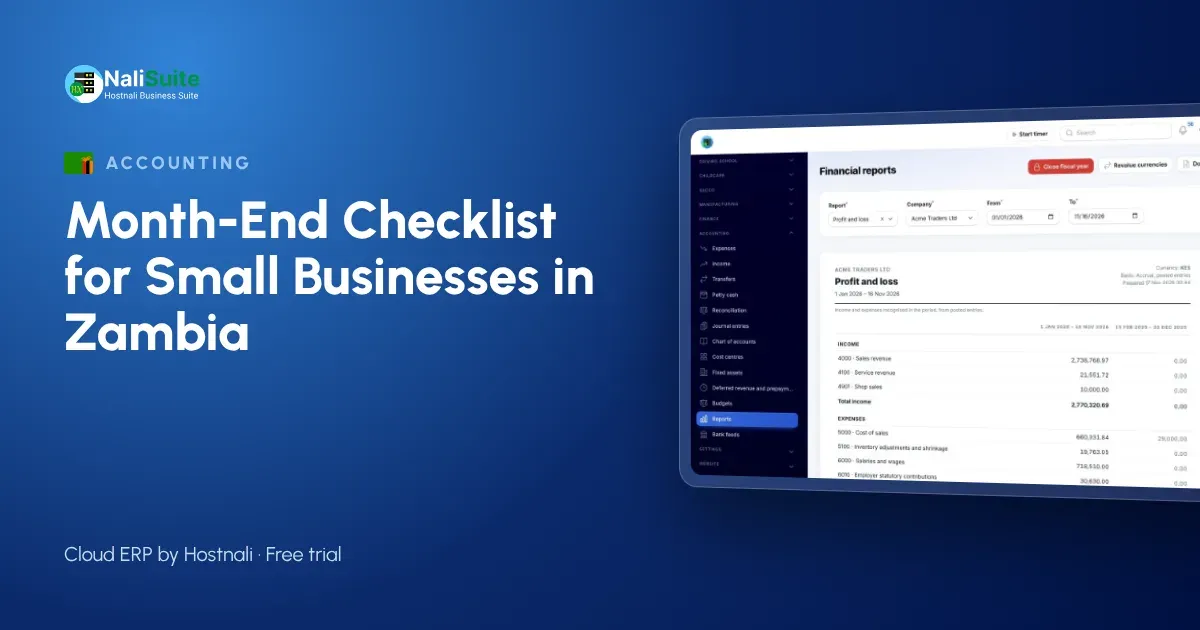
A month-end checklist only helps if it fits how your business actually runs. The best way to see that is to follow a business through one. This guide uses an example agro-dealer in Lusaka and goes through the close in the order it is done.
The business is made up, but the details, from MTN MoMo payments to farmers buying on credit before the rains, are typical of small Zambian firms.
The example business
Mulenga runs an agro-dealer shop near Lusaka’s Soweto market, selling seed, fertiliser, chemicals and small tools. He employs four people. Farmers and smaller traders pay by MTN MoMo, Airtel Money, cash and sometimes bank transfer. Cooperatives buy on credit and pay after harvest.
His wife, Chanda, does the books after hours. Before they started closing each month, they only found out how the business had done when the accountant prepared the annual accounts.
First morning: everything on one table
Chanda starts by collecting:
- MTN MoMo and Airtel Money statements for the shop’s merchant numbers.
- The bank statement.
- The daily cash sheets.
- All supplier invoices, including the ones sent as photos on WhatsApp.
Lesson: collect first, then match. Stopping halfway to look for a statement is how closes drag on for weeks.
First afternoon: matching the money
Chanda links each wallet payment and bank credit to a sale or invoice. Most match. The ones that do not are small part payments from farmers who paid in two instalments. She links both instalments to the same invoice.
The daily cash sheets add up to slightly more than the cash banked. The difference is change kept in the till overnight, which she records as the till float.
NaliSuite Accounting imports bank and mobile money statements and proposes a match for each line. The reconciliation feature shows how it works.
Second day: what the business owes
Chanda records every supplier invoice with the date the stock arrived. A fertiliser delivery that came on the 30th is recorded in the month, even though the invoice arrived on the 2nd. She also records:
- transport costs for collecting stock from suppliers;
- MoMo, Airtel Money and bank charges;
- the shop’s ZESCO bill.
Lesson: costs belong to the month in which they happened, not the month they were paid.
Second day, continued: what customers owe
Two cooperatives owe money. One is within the agreed terms. The other is past the date they agreed. Mulenga calls the chairperson and they agree on a date after the next market day.
NaliSuite Invoicing sends statements and reminders by email or WhatsApp, each with a link to pay by MTN MoMo, Airtel Money or card. The mobile money payments page explains how payments are matched for you.
Third day: stock and staff
Stock
Mulenga counts fertiliser bags, seed packs and chemical containers: his most valuable lines. Two bags of fertiliser are missing. Checking the delivery notes shows a delivery was short and nobody noticed. He takes it up with the supplier.
Lesson: counting each month catches receiving errors while the supplier still remembers the delivery.
Wages
Chanda checks that all four staff were paid and that the deductions were recorded as amounts owed. NaliSuite’s payroll app lets you set up the deductions that apply to your business and produces payslips. Check the current rates with ZRA and NAPSA.
Third day, continued: VAT and the reports
The shop is registered for VAT. The standard rate in Zambia is 16%, though some agricultural goods are treated differently, so Chanda checks how each product is set up. She adds up VAT on sales and purchases from the recorded invoices. She confirms current rules and deadlines with ZRA before filing. The free VAT calculator helps check individual prices.
She and Mulenga then read:
- Profit and loss: lower than last month, as expected before the planting season begins.
- Balance sheet: wallet and bank balances agree with the statements.
- Unpaid invoices: one cooperative overdue, now with an agreed date.
Last step: lock the month
The month is locked. If another late invoice turns up, Chanda will record it in the current month or reopen the period deliberately.
The checklist they now use
- Collect all statements and invoices.
- Match MoMo, Airtel Money, bank and cash.
- Record bills with delivery dates and include all fees.
- Review unpaid invoices and contact customers.
- Count key stock and record differences.
- Check wages and record deductions.
- Prepare VAT figures.
- Read the three reports.
- Lock the month.
What they learned
- Matching weekly makes the monthly close much shorter.
- Seasonal businesses need monthly figures more, not less: they show how much cash is needed before the busy season.
- A short delivery found in the same month is easy to resolve; found six months later, it is lost money.
Frequently asked questions
How long does a month-end close take for a business like this?
About two to three evenings at first, and less once matching is done weekly.
Should farmers’ part payments be recorded separately?
Record each payment separately but link them all to the same invoice, so you can see the remaining balance.
Is it worth closing the month in the quiet season?
Yes. Quiet months show your fixed costs clearly and help you plan cash for the busy season.
Can I use NaliSuite from my phone?
Yes. NaliSuite runs in the browser on a phone, tablet or laptop.
Try NaliSuite
NaliSuite gives Zambian businesses invoicing with mobile money pay links, statement matching, stock and payroll in one system. Plans start at ₵25 a month with a free trial; see the plans or read about NaliSuite.