 ZMW
 KES - Kenya
 UGX - Uganda
 TZS - Tanzania
 RWF - Rwanda
 NGN - Nigeria
 ZAR - South Africa
 USD - Zimbabwe
 GHS - Ghana
 ETB - Ethiopia
 USD - International

A distributor in Kitwe or a lodge in Livingstone may deal with dozens of suppliers a month. When orders are placed by phone and bills are paid as they arrive, mistakes are almost guaranteed.
This guide shows Zambian businesses how to buy with purchase orders, from the first request to paying the supplier.
Signs your buying needs a process
- Letting the driver sign for everything. Whoever receives goods should count them against the PO.
- Changing prices by phone. If a price changes, change the PO, so the bill can be matched.
- Keeping bills in a drawer. Record each bill as it arrives, so you know what you owe and when.
- Skipping small orders. Small orders add up. Keep the process quick enough that nobody wants to skip it.
From request to payment
| Stage | Who | What happens |
|---|---|---|
| Request | Staff | Records what is needed and why |
| Approval | Manager or owner | Approves within the set limit |
| Purchase order | Buyer | Sends agreed prices and delivery details |
| Receiving | Storekeeper | Checks the delivery against the PO |
| Bill and payment | Accounts | Matches the bill, then pays it |
Example: a mining supplies distributor in Kitwe
Take an example distributor in Kitwe that sells safety boots, gloves and tools to mines on the Copperbelt. It imports some stock and buys the rest locally. Sales staff used to promise customers items and then phone suppliers for them, so the same item was sometimes ordered twice.
With purchase orders, every order starts as a request linked to a customer order or a reorder level. A manager approves it, the supplier receives a PO, and the warehouse records what arrives. Bills are matched to the PO and the delivery, then paid by bank transfer or MTN MoMo.
Three-way matching
Three-way matching sounds technical, but it simply means comparing three documents before you pay:
| Question | Answered by |
|---|---|
| Did we order this, at this price? | The purchase order |
| Did it arrive, and in good condition? | The delivery record |
| Is the supplier charging only for that? | The bill |
If all three agree, pay. If they don’t, ask the supplier before paying. Most differences are honest mistakes, but they only get fixed if someone looks.
What a good purchase order shows
The best purchase orders leave nothing to guess. List each item with its quantity and unit price, the delivery address and date, the payment terms and a PO number. When the supplier copies that number onto the delivery note and invoice, your team can match all three at a glance.
Approval limits that keep things moving
Set a limit per person or per department. Requests under the limit are approved by the manager; anything above it goes to the owner. The owner then spends time only on the purchases that matter.
VAT and supplier records in Zambia
VAT in Zambia is charged at 16%. Keep each supplier’s TPIN on their record, check that it appears on the invoices you receive, and store the invoice with the matched bill so your records are ready for the Zambia Revenue Authority.
Confirm the current invoice requirements with ZRA and set your tax rates in your system. NaliSuite lets each business keep its own rates up to date.
Imports, local suppliers and stock levels
Zambian businesses often mix imported stock with local purchases. Imports take weeks, so raise those POs early, based on reorder levels rather than empty shelves. Local suppliers in Lusaka or the Copperbelt can fill the gaps.
Set reorder levels in your stock system, and let low stock create a purchase request automatically. The buyer then reviews requests, groups them by supplier and sends one PO each.
When a matched bill falls due, pay it by bank transfer or mobile money and write the bill number in the payment narration; the monthly reconciliation then takes minutes. See bank and mobile money reconciliation.
Running it in NaliSuite
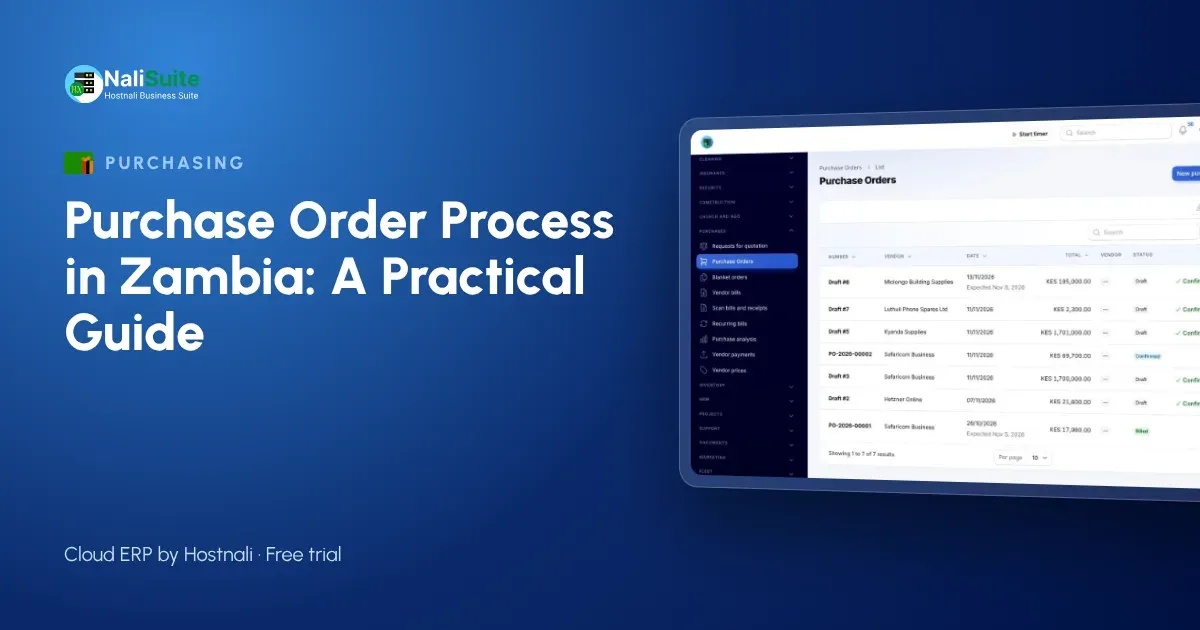
Software turns the process into a few taps. NaliSuite Purchases takes a request through approval to a PO, records what is received into inventory, and sends matched supplier bills to accounting, ready to pay.
Frequently asked questions
Can I pay Zambian suppliers by mobile money?
Yes. Plenty of suppliers on the Copperbelt and in Lusaka take MTN MoMo or Airtel Money, and larger ones prefer bank transfers. Note the transaction ID on the bill you paid.
What should I check on a supplier invoice?
The supplier’s name and TPIN, the items and quantities, the prices agreed on the PO and any VAT.
Who should approve purchase orders?
Usually a department head or manager for everyday purchases, and the owner for large or unusual ones. Set the limits in your system.
Can suppliers see our purchase orders?
They receive each PO by email or WhatsApp and should quote its number on their delivery note and bill.
Try NaliSuite
NaliSuite brings purchase orders, inventory and supplier bills into one cloud system. Plans start at ₵25 a month. See what is included.