 ZMW
 KES - Kenya
 UGX - Uganda
 TZS - Tanzania
 RWF - Rwanda
 NGN - Nigeria
 ZAR - South Africa
 USD - Zimbabwe
 GHS - Ghana
 ETB - Ethiopia
 USD - International

Zambian restaurants serve nshima with village chicken in Lusaka, fish from the Kafue in Mazabuka and quick lunches on the Copperbelt. Load-shedding and rising maize and cooking oil prices make good systems more important than ever.
Example: a lunch restaurant in Lusaka
A restaurant near Cairo Road serves nshima, beef stew and greens to office workers. At lunchtime the queue is long, the cashier takes cash and mobile money, and at the end of the day the takings never quite matched.
They moved to a till that records every payment method against each order, and wrote recipes so each plate takes its mealie meal, beef and vegetables out of stock. The cash-up now matches, and a weekly count shows that cooking oil was being used far faster than the recipes allowed, which was fixed in the kitchen.
Cost every dish before you price it
Many restaurants set menu prices by looking at the competition, then discover months later that a popular dish barely covers its ingredients. Work the other way round: write a recipe for each dish, with the quantity of every ingredient, and let the system calculate the plate cost.
The Restaurant Pro add-on links each dish to its recipe and shows the plate cost and food-cost percentage per dish. Its menu engineering view sorts dishes into stars, plowhorses, puzzles and dogs, so you can see which dishes earn their place on the menu and which need a new price, a smaller portion or a quiet retirement.
Ingredient stock that keeps itself up to date
Every dish sold uses ingredients. In Restaurant Pro, ingredients come out of stock each time a dish sells, so your Inventory shows what you should have without a nightly count.
Do a physical count once a week and compare. If the difference is large, look at three things: portions, waste and security. The add-on’s waste log records spoiled or dropped food with a reason, which separates honest waste from missing stock. When ingredients run low, raise a purchase order in Purchases so suppliers deliver before you run out.
Run the floor from the till
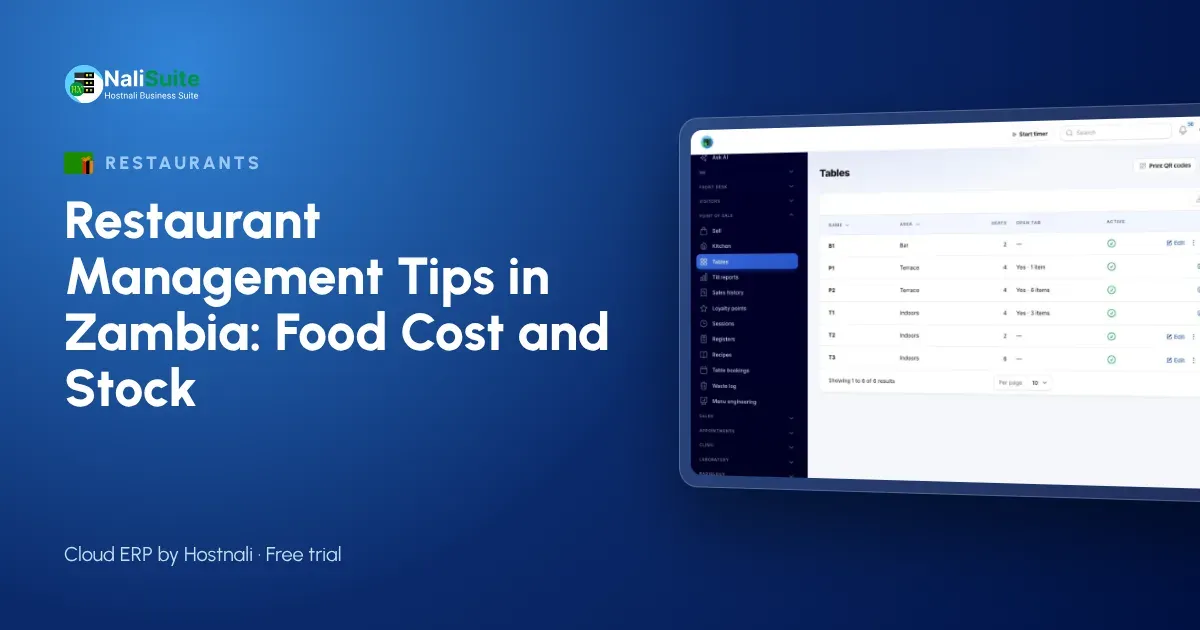
A clear system on the floor saves arguments at the end of the night. Open each table on the till, add dishes as they are ordered, and close it when the guests pay.
The Point of Sale app supports restaurant tables, split payments and receipts by SMS or WhatsApp. With Restaurant Pro you can also take table bookings, which helps the kitchen prepare for the evening rush.
Payments and power cuts
Two things should never stop a sale: a lost connection and a customer who wants to pay differently. NaliSuite’s till keeps selling when the internet drops and syncs later, so the offline POS is ready for a power cut in the middle of lunch.
Accept cash and MTN MoMo, Airtel Money or card, split a bill between payment methods if needed, and send receipts by SMS or WhatsApp. The payments feature records each payment against the right sale, which makes cashing up quick.
Zambian details
Customers pay by MTN MoMo, Airtel Money and card, so record each payment on the bill. Load-shedding makes an offline till essential: it keeps selling and syncs every sale later.
For VAT on your receipts, check current requirements with ZRA. If you also run outside catering for weddings and kitchen parties, the Food production add-on costs quotes per head and turns them into orders with a deposit invoice.
Where restaurants usually lose money
- Portions that grow during busy service.
- Ingredients bought without a purchase order and never checked on delivery.
- Food thrown away without anyone recording it.
- Menu prices that were set years ago and never updated.
- Cash and mobile money takings that are not matched to the till.
Each of these is easy to see once recipes, stock and the till share one system.
Staff, shifts and pay
Kitchens and floors run on shifts, and wages are usually the biggest cost after food. Record attendance properly so that overtime and absences flow into pay without arguments. NaliSuite HR handles attendance and leave from staff phones, and Payroll turns them into pay runs and payslips.
Give each waiter and cashier their own login instead of sharing one, so it is always clear who was working the till on each shift. It is fairer to good staff and makes problems easier to trace.
Frequently asked questions
Can customers pay by MTN MoMo or Airtel Money?
Yes. Both are recorded against the order at the till, along with cash and card.
Does the till work during load-shedding?
Yes. It keeps selling offline and syncs when power and internet return.
What does Restaurant Pro add to the till?
Recipes that deduct ingredients from stock with every sale, plate cost and food-cost percentage per dish, menu engineering, table bookings and a waste log. It is an add-on to any NaliSuite plan.
Try NaliSuite
Start with the till and inventory, then add Restaurant Pro when you are ready to cost every dish. Plans start at ₵25 a month. Read about NaliSuite for restaurants and choose a plan.