USD
 KES - Kenya
 UGX - Uganda
 TZS - Tanzania
 RWF - Rwanda
 NGN - Nigeria
 ZAR - South Africa
 USD - Zimbabwe
 GHS - Ghana
 ETB - Ethiopia
 ZMW - Zambia

Across Africa, millions of small businesses keep their books in Excel or Google Sheets. A trader in Lusaka, a consultancy in Kigali and an online shop in Accra may have little else in common, but they share the same moment of truth: the day the spreadsheet stops telling them what they need to know.
Two firms, one month
Imagine two logistics brokers working across East and Southern Africa. They bill clients in US dollars and local currencies, pay transporters by bank and mobile money and file taxes in two countries.
Firm A uses a workbook with a tab per country and a summary sheet. At month-end the partner spends three days converting currencies, matching receipts and building the profit figure.
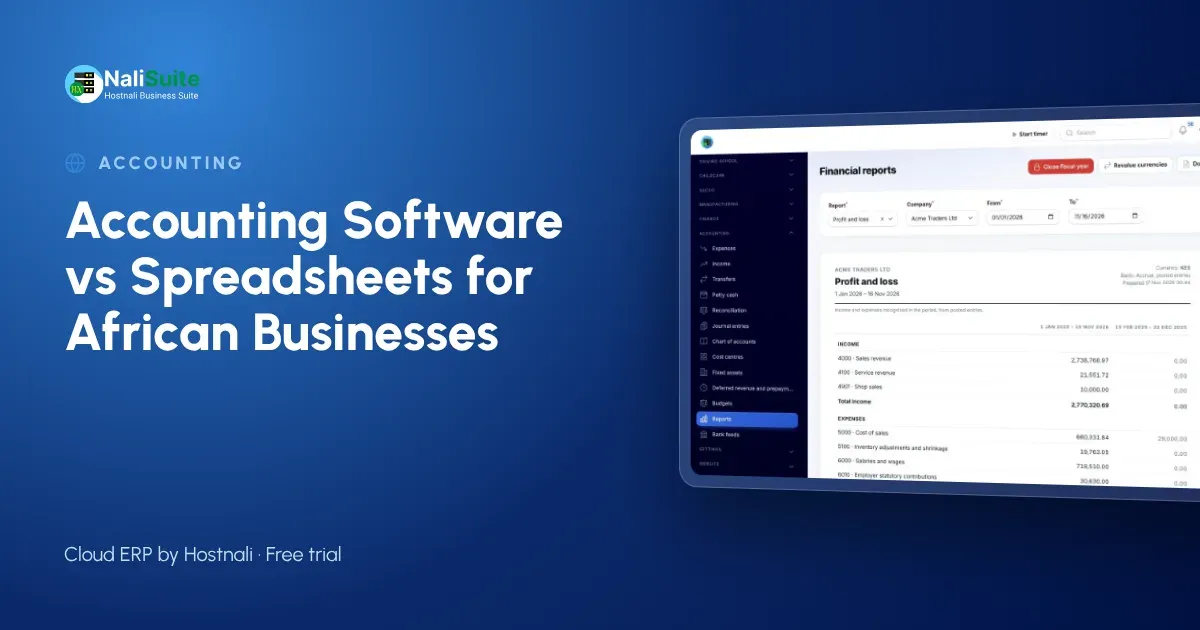
Firm B uses accounting software. Invoices are issued in each client’s currency, receipts are imported from bank statements and the profit and loss report is ready on the first working day.
Why multi-country work breaks spreadsheets
Currencies
Each conversion in a spreadsheet is a manual step and a possible error. Software records the invoice in the customer’s currency and handles the books consistently.
Different tax rules
VAT or sales tax rates, invoice requirements and filing deadlines differ by country. A spreadsheet cannot know them. In software, each invoice carries the tax that applies to it, and you can check a single amount with the VAT calculator. Some countries, such as Kenya and Nigeria, now require electronic invoicing for many businesses; NaliSuite provides connections where those systems exist.
Many ways to be paid
Customers pay by M-Pesa, MTN MoMo, Airtel Money, card and bank transfer. Matching all of these by hand is where most errors start. Reconciliation imports statements and pairs each receipt with its invoice, and invoices can carry a pay link for mobile money and card.
The questions investors ask
Growing businesses eventually talk to banks, investors or buyers. They ask for monthly management accounts, a list of who owes the business and evidence behind the numbers. Firm B produces all three from its Accounting app. Firm A has to rebuild them, and the rebuilt version is harder to trust.
A fair comparison
| Factor | Spreadsheet | Accounting software |
|---|---|---|
| Upfront cost | None | A monthly plan |
| Time per month-end | Days | Hours |
| Currencies | Manual | Built in |
| Source of entries | Manual typing | Invoices, bills and payments |
| Access from anywhere | Depends on the file | Any browser |
| Credibility with lenders | Low | High |
When to switch
There is no fixed turnover at which you must move. Practical triggers are:
- registering for VAT in any country you trade in;
- hiring your first staff member who touches money;
- selling on credit to more than a handful of customers;
- trading in more than one currency.
How to switch
- Choose the start of a month or financial year.
- Export lists of customers, suppliers and products.
- Import them and post opening balances in each currency.
- Run both systems for one month and compare.
- Archive the workbook.
If you are coming from QuickBooks, Xero or Sage, the switching guide explains the extra steps.
A second example: a pan-African online course provider
An education company sells online courses to learners in Kenya, Nigeria and Ghana. Payments arrive through mobile money in one country, cards in another and bank transfers from corporate clients. The founders kept one spreadsheet per country and spent the first week of each month merging them.
In software, each sale is an invoice in the learner’s currency, payments are matched as they arrive, and the founders see one set of books. Recurring corporate contracts are billed every period by the Subscriptions app, so nobody has to remember to send them.
Questions to answer before switching, wherever you trade
- Which currencies do you invoice in, and which do you report in?
- Which countries are you registered for VAT or sales tax in, and at what rates?
- Do any of your countries require electronic invoicing or fiscal devices?
- Which payment channels does each country use: mobile money, card or bank?
- Who signs off the books each month?
Frequently asked questions
Can one account cover businesses in several countries?
NaliSuite supports more than one company under one login, each with its own settings.
Is a spreadsheet ever the better choice?
For a sole trader with few transactions and no VAT, it can be. Most growing businesses outgrow it within a couple of years.
What does it cost in US dollars?
Plans start at $2.10 a month, shown in your currency, with a free trial.
Can I run separate companies in different countries?
Yes. NaliSuite supports several companies and branches, each with its own settings, from one login.
Do I need an accountant in every country?
Usually yes for filing, since tax rules differ. One shared set of books makes their work faster wherever they are.
Try NaliSuite
Firm B’s partner spends month-end planning instead of reconciling. You can too. See NaliSuite plans.