USD
 KES - Kenya
 UGX - Uganda
 TZS - Tanzania
 RWF - Rwanda
 NGN - Nigeria
 ZAR - South Africa
 USD - Zimbabwe
 GHS - Ghana
 ETB - Ethiopia
 ZMW - Zambia

Across Africa, small businesses run on a mix of mobile money, bank transfers, paper receipts and WhatsApp messages. That mix is exactly why AI can help, and also why it often disappoints: a tool cannot answer from records that are not there.
This overview looks at what AI does well for African SMEs today, the conditions it needs, how data protection laws across the continent apply, and how to keep the cost visible.
The African SME reality
Three things shape how AI fits a small African business.
- Records are scattered. Sales on a till, payments on mobile money statements, supplier bills on paper, credit customers in a notebook.
- Teams are small. The owner is often also the bookkeeper and the customer service desk.
- Margins are tight. A new monthly cost has to earn its place quickly.
So the useful question is not “what can AI do?” but “which hour of my week can it give back?”
Where AI earns its place
Reading bills and receipts
Typing supplier invoices and receipts is one of the biggest time sinks in a small business. Document AI reads supplier invoices in PDF and photos of till receipts, and picks out the supplier, invoice number, dates, lines, VAT and totals. Suppliers are matched by tax number or name, or added if new. A person checks what was read, then saves it as a draft bill or, for a receipt already paid, an expense.
Answering questions from your own records
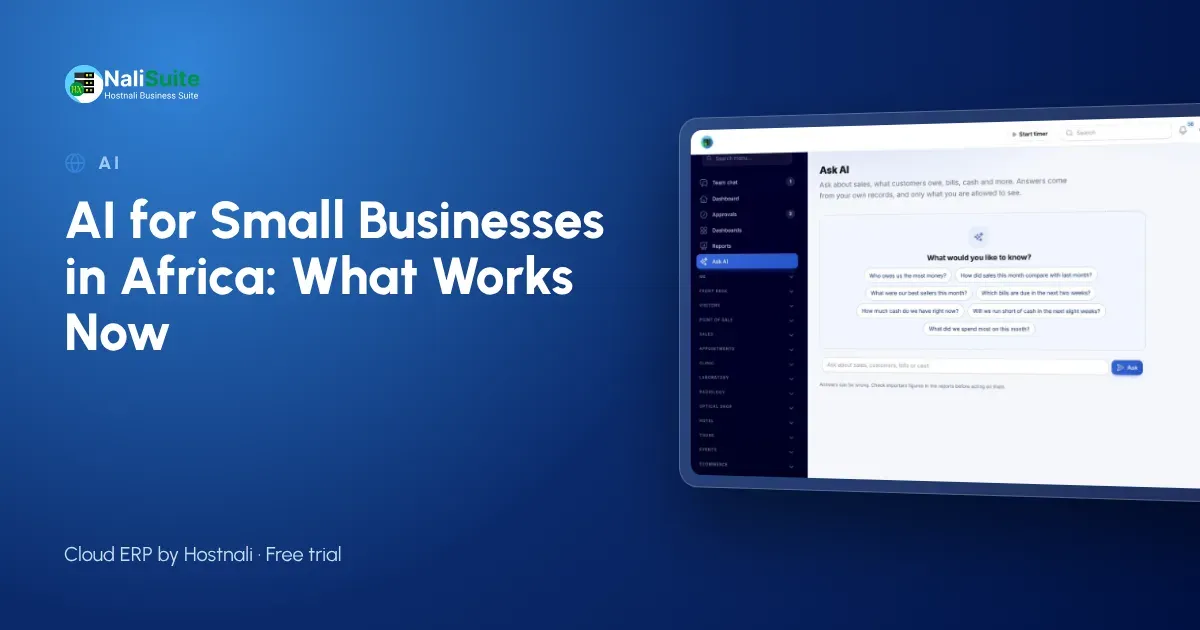
The AI business assistant answers plain-word questions such as “who owes us the most?” or “which products sold best last month?” from your live sales, invoices, bills and books. Each person only gets answers from what their role allows them to see, which matters when branch staff use it too.
Seeing cash ahead
The assistant also gives a cash-flow forecast: money in and out week by week, with a plain-words summary. For businesses that pay suppliers in one currency and collect in another, or that face seasonal swings, seeing a tight week early is valuable.
Drafting customer replies
Where customer questions come in as tickets in the Helpdesk app, the assistant drafts replies for staff to edit and send.
The condition: records in one place
All four uses depend on one thing: your sales, invoices, bills and payments being in one system. That is the real first step. Once accounting, invoicing and the till share the same records, AI has something reliable to read.
Data protection across the continent
Most African countries now have a data protection law, and they apply when you process personal data with AI tools. A few examples:
| Country | Law | Authority |
|---|---|---|
| Kenya | Data Protection Act | Office of the Data Protection Commissioner |
| Nigeria | Nigeria Data Protection Act | NDPC |
| South Africa | POPIA | Information Regulator |
| Ghana | Data Protection Act, 2012 (Act 843) | Data Protection Commission |
| Uganda | Data Protection and Privacy Act, 2019 | Personal Data Protection Office |
| Tanzania | Personal Data Protection Act, 2022 | Personal Data Protection Commission |
| Rwanda | Law No. 058/2021 | National Cyber Security Authority |
The common rules are similar: use personal data for clear purposes, keep it secure, limit access and know where it goes. If you operate in several countries, check each one, especially when data crosses borders.
NaliSuite’s AI add-ons use your own Anthropic API key, under your own account and its terms. NaliSuite sends only what each request needs.
Keeping the cost visible
Each AI add-on is a NaliSuite marketplace add-on to any plan. The AI usage is billed by Anthropic to your own key, so it appears in your own Anthropic account rather than inside a bundle. Light use costs little; heavy use more. That makes it easy to test one task, measure it and decide.
Example: a cross-border trader
A trading company buys household goods from suppliers in several countries and sells through shops in two East African cities. Supplier invoices arrive as PDFs in different formats; local purchases come as paper receipts. The company set up Document AI first. Staff upload or photograph each document on arrival, and the finance lead checks the result daily. Once the bills were up to date, the owner started using the assistant’s weekly cash-flow forecast to time payments to overseas suppliers.
Getting started
- Bring sales, invoices and bills into one system.
- Pick one task for AI.
- Create an Anthropic API key and enter it in NaliSuite’s Settings.
- Use it for a month, check the results and look at the usage.
More on AI in NaliSuite.
What not to expect
AI will not organise a business that has no records, will not replace an accountant and will not make decisions for you. It will save hours on reading documents and pulling figures together, if the records are there and a person checks the result.
Frequently asked questions
Does AI need fast internet?
NaliSuite runs in the browser; AI requests need a connection when you ask a question or upload a document.
Can AI file tax returns?
No. It helps keep records accurate; returns stay with you and your accountant.
Is the AI included in every plan?
The AI add-ons are marketplace add-ons you can add to any plan, with usage billed by Anthropic to your own key.
Try NaliSuite
Try NaliSuite free, then from $2.10 a month, with the AI add-ons available on any plan. See the plans.