USD
 KES - Kenya
 UGX - Uganda
 TZS - Tanzania
 RWF - Rwanda
 NGN - Nigeria
 ZAR - South Africa
 USD - Zimbabwe
 GHS - Ghana
 ETB - Ethiopia
 ZMW - Zambia

Across Africa, small and medium businesses are selling further from home. A logistics firm in Nairobi bills clients in Kampala and Kigali, a software agency in Lagos serves customers in Accra, and a safari supplier in Arusha invoices tour operators in Europe. When customers are in another city or another country, “pop into the office for a copy” stops being an option.
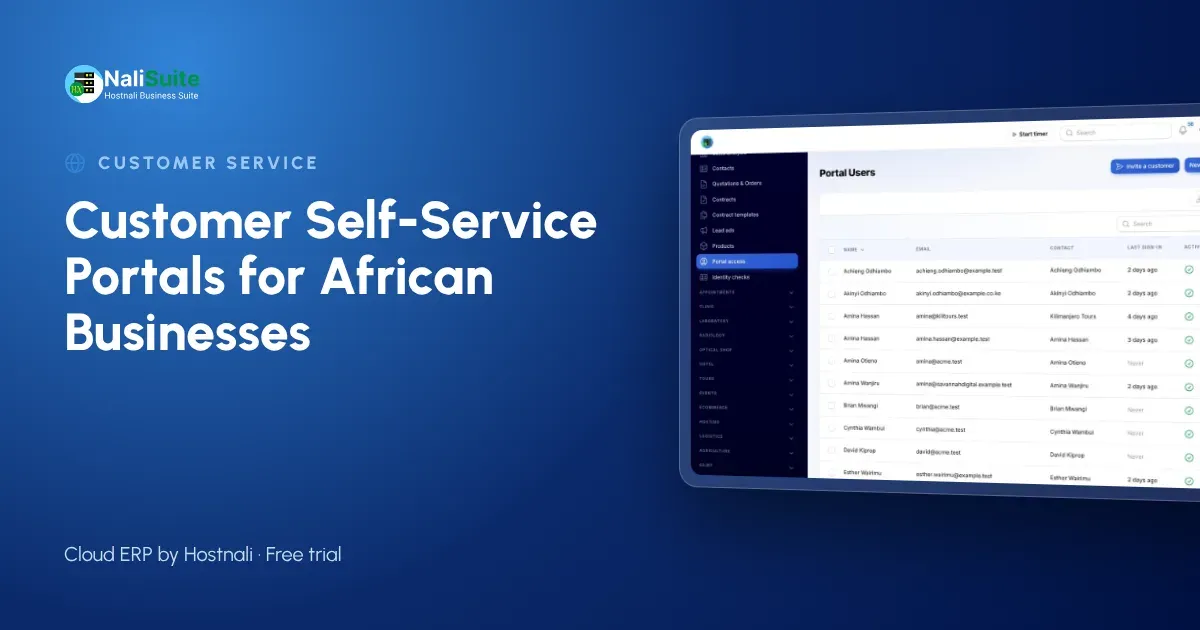
A customer self-service portal gives every customer, wherever they are, the same access to their invoices, payments, quotations and support. This guide looks at portals from a pan-African angle: what to include, how payments differ between markets, and how to handle data protection when customers are spread across borders.
What a good portal includes
The NaliSuite customer portal is a built-in app on every plan. Customer contacts are invited by email, and each one sees only their own organisation’s records. Inside, they can:
- view invoices and statements and download copies whenever they need them;
- pay outstanding invoices, by mobile money where it is available or by card;
- review and accept quotations, then follow the resulting orders;
- open support tickets and read your knowledge base;
- download shared documents and sign them online;
- manage subscriptions, where you allow it.
Everything shown comes from the apps the business already runs in: invoicing, sales, the helpdesk and documents.
Payments: one portal, different habits
How customers prefer to pay varies a lot between African markets, and the portal should follow their habits rather than yours.
| Market | Common ways business customers pay |
|---|---|
| Kenya, Tanzania | M-Pesa, Airtel Money, card, bank transfer |
| Uganda, Rwanda, Zambia, Ghana | MTN MoMo, Airtel Money, card, bank transfer |
| West Africa (francophone) | Orange Money, Wave, card, bank transfer |
| Nigeria, South Africa | Card, instant bank payments, transfer |
NaliSuite connects to mobile money and to payment providers used across the continent. When a customer pays from an invoice in the portal, the payment is linked to that invoice automatically, which matters even more when you receive money in several currencies and channels. See mobile money payments for the details.
Serving customers across borders
Currency and language on documents
Invoice customers in the currency you agreed with them, and make sure quotations and statements are clear about it. Keep tax details correct for each customer’s country on the documents you issue.
Time zones and response times
A ticket raised in Lusaka at 8 a.m. may arrive while your office in Lagos is still closed. Service-level targets in the helpdesk make sure tickets are answered within agreed times, and knowledge base articles answer common questions at any hour.
One record per customer
Cross-border customers often have several contacts in different offices. Invite each contact separately; all of them see the same organisation’s records, so nobody receives a different version of the truth.
Data protection in several countries
Most African countries now have data protection laws, and if your customers are in several countries, more than one may apply. Examples include Kenya’s Data Protection Act, 2019, Nigeria’s Data Protection Act 2023, South Africa’s POPIA, Ghana’s Data Protection Act, 2012 (Act 843), Uganda’s Data Protection and Privacy Act, 2019, and Rwanda’s Law No. 058/2021.
The principles behind them are similar, and a portal makes them easier to follow:
- invite only contacts each customer has authorised;
- show each person only their own organisation’s records;
- remove access when people leave;
- share documents only with the customers they concern.
Check the specific requirements, such as registration with a regulator, in each country where you operate or have customers.
Signs you are ready for a portal
You do not need to be large. You are probably ready if several of these sound familiar:
- customers regularly ask for invoice copies or statements;
- payments arrive without references and take time to match;
- quotations sit unapproved for days;
- complaints are scattered across email, phone and chat apps;
- customers in other cities or countries cannot easily visit your office.
A rollout that works across markets
- Pick one market first. Start where you have the most repeat customers.
- Clean the data. Correct contacts, emails and tax numbers; merge duplicates.
- Pilot with a few customers and note their questions.
- Write help articles in the language your customers use.
- Launch, then expand to the next market with what you learned.
Example: a regional logistics company
A freight forwarder with offices in Mombasa and Kampala handles clearing and transport for importers in Kenya, Uganda, Rwanda and South Sudan. Each shipment produces several invoices: duties, transport, storage and handling. Clients used to call for copies at every step.
In the portal, each importer sees its shipments’ invoices as they are raised, pays with mobile money or card, accepts quotations for new consignments and raises queries as tickets. Clearing documents are shared through the portal. Staff in both offices work from the same helpdesk queue, so a client’s question does not depend on which office they call.
Frequently asked questions
Does the portal cost extra?
No. The customer portal is included in every NaliSuite plan, from $2.10 a month.
Can customers in different countries use the same portal?
Yes. Every invited contact signs in the same way and sees only their own organisation’s records.
Which payment methods can customers use?
Customers can pay outstanding invoices by mobile money or card, depending on the providers you connect.
Can the portal use my domain?
Yes, on plans that include a custom domain or with the custom domain add-on.
Try NaliSuite
Give customers across Africa one place to see invoices, pay and get help. Compare the NaliSuite plans and start a free trial.