USD
 KES - Kenya
 UGX - Uganda
 TZS - Tanzania
 RWF - Rwanda
 NGN - Nigeria
 ZAR - South Africa
 USD - Zimbabwe
 GHS - Ghana
 ETB - Ethiopia
 ZMW - Zambia

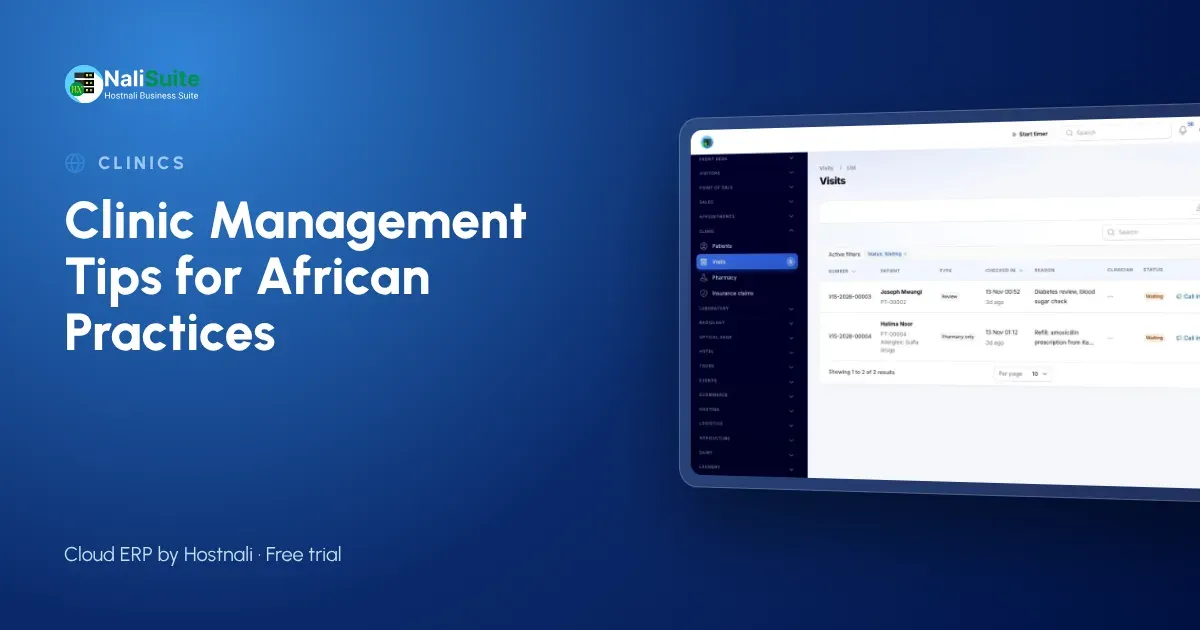
From Kampala to Accra and Lusaka, private clinics share the same challenges: busy waiting rooms, mixed cash and insured patients, medicines that expire and staff who wear many hats.
These tips apply wherever your practice is, with notes on what to check locally.
Example: a clinic group across two countries
Imagine a small clinic group with branches in two countries. Each clinic keeps its own stock and queue, but the owner sees one dashboard: patients seen, open insurance claims, takings by payment method and medicines to reorder per branch. Each branch bills in its own currency.
Close the gap between treatment and payment
Revenue leaks when a test is done but never billed, or a medicine is handed over and not charged. If every order and prescription lands on the visit bill automatically, nothing is forgotten.
Insured visits produce a claim for the covered share; patients pay their part by M-Pesa, MTN MoMo or Airtel Money, card or bank transfer. Follow up open claims weekly, because an unpaid claim is money you have already spent on care.
Common pitfalls, and the fix
| Pitfall | Fix |
|---|---|
| Patients wait without knowing their turn | One check-in queue shared by all rooms |
| Medicines expire on the shelf | Track batches and sell the oldest first |
| Tests done but not billed | Order tests from the visit so they land on the bill |
| Claims forgotten | Weekly review of open claims |
| Shared passwords | One login per staff member, access by role |
Get patient flow under control
A full waiting room is not always a sign of demand. Often it means nobody knows who arrived first, who is waiting for results and who only needs a refill. Check every patient in at reception so the queue is visible on screen, and let clinicians call the next person from their own room.
With the Clinic and Pharmacy add-on each arrival joins a waiting queue and is seen in order. Patients who booked ahead come through Appointment Booking, which gives them a confirmation and reminders, so the morning rush spreads across the day.
Connect the lab to the consultation
When the lab is a separate notebook, results arrive late and tests go unbilled. Ordering tests from the visit keeps everything on one record and one bill.
For practices with their own laboratory, the Medical Lab add-on adds panels such as a full blood count, normal ranges by sex and age, and two-step verification before reports are released.
Local rules and payments
Insurance and national health schemes differ by country, but the principle is the same: one visit, one bill, with the covered share as a claim and the patient’s share paid by mobile money, card or bank transfer.
Health data is sensitive personal data under most African data protection laws. Check your country’s data protection law and regulator, and give every staff member an individual login with only the access they need.
Keep one record per patient
Paper cards get lost, duplicated and filled in differently by each clinician. A single electronic record per patient, with allergies, long-term conditions and insurance cover on the first screen, protects patients and saves time at every visit.
At each consultation record vitals, notes and the diagnosis. The next clinician sees the full history, and you stop asking patients to repeat themselves.
Run the pharmacy from real stock levels
A dispensary that relies on memory runs out of the medicines patients need most and sits on boxes that expire. Prescriptions should come out of stock the moment they are dispensed, so the count on screen is the count on the shelf.
In NaliSuite, prescriptions are dispensed from your pharmacy stock and Inventory keeps quantities per location, with lots and reorder rules. Check the fast movers weekly and reorder before you run out, not after.
Your first month, step by step
Week one: load your patient list, services and medicine prices, and set up staff logins. Week two: run the queue and consultations on the system while the pharmacy counts stock. Week three: switch billing and payments by M-Pesa, MTN MoMo or Airtel Money, card or bank transfer to the visit bill. Week four: review the first reports and add the lab or booking add-on if you need them.
Frequently asked questions
Does it work in my country?
NaliSuite runs in the browser anywhere, with local currencies and payment methods. Check your local insurance and data protection rules.
Can we run several clinics?
Yes. Each branch keeps its own stock and tills, and managers can see one branch or all of them.
Is the clinic software an extra cost?
Clinic and Pharmacy, Medical Lab and Appointment Booking are add-ons to any NaliSuite plan, so you add only the ones your practice needs. Plans start from $2.10 a month.
Do we need to install anything?
No. NaliSuite runs in the browser on laptops, tablets and phones, so reception, consultation rooms and the pharmacy can work from the devices you already have.
Try NaliSuite
Start with patient records, the queue and billing, then add the lab or online booking as the practice grows. Read more about NaliSuite for health businesses or see the plans, from $2.10 a month with a free trial.