 GHS
 KES - Kenya
 UGX - Uganda
 TZS - Tanzania
 RWF - Rwanda
 NGN - Nigeria
 ZAR - South Africa
 USD - Zimbabwe
 ETB - Ethiopia
 ZMW - Zambia
 USD - International

Kofi supplies building materials to contractors around Kumasi. When his accountant hands him the year’s profit and loss statement, he looks at one figure, the profit at the bottom, and puts the rest aside. That figure tells him what happened, but not why, and by the time he sees it the year is over.
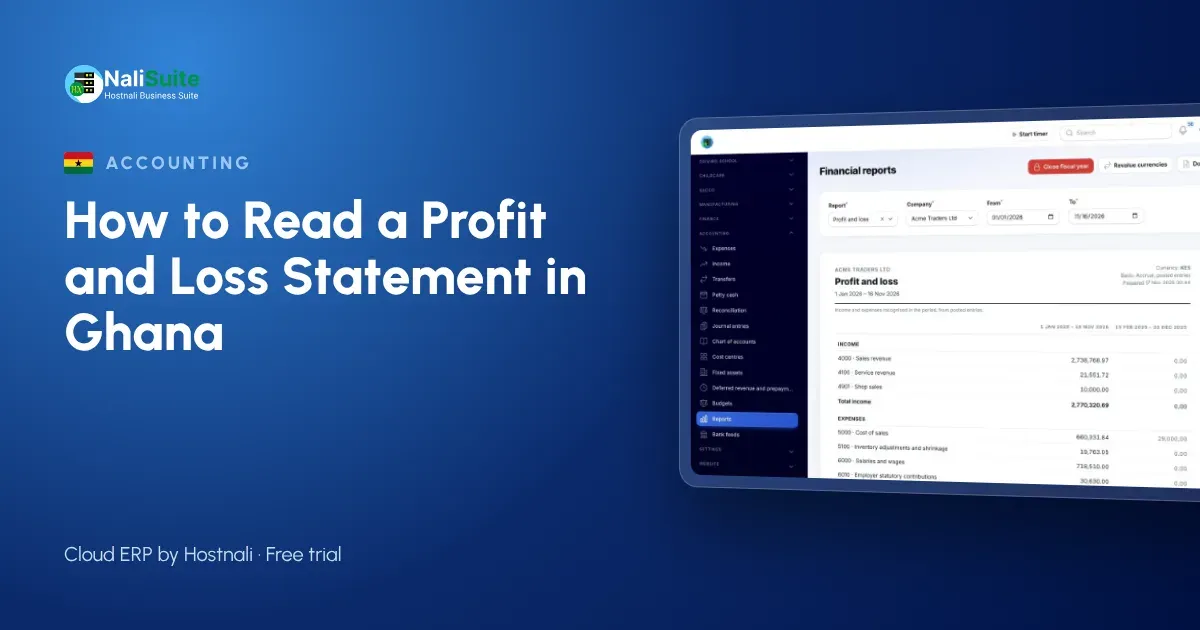
You do not have to read every line of a profit and loss statement (P&L) every month. Five numbers, checked in the same order each time, will tell you most of what you need to know. This guide explains each one.
First, what a P&L is
A profit and loss statement summarises income and costs over a period. It shows sales when they were made, even if a contractor pays in sixty days, and costs when they were incurred, even if you pay the supplier later. It is not a record of the cedis in your bank or MTN MoMo wallet. Cash and profit move differently, which is why a profitable business can still run short of money; see our cash flow tips for businesses in Ghana.
The layout is usually:
- Revenue
- Less cost of sales
- = Gross profit
- Less operating expenses
- = Operating profit
- Less finance costs and tax
- = Net profit
Number 1: Revenue, compared with last month and last year
Look at revenue against the previous month and the same month last year. A fall after Christmas is normal for many retailers; a fall in a month that is usually busy is a warning.
When prices change often, compare quantities too. If revenue went up 15% but your prices rose by 20%, you sold less.
Also check that revenue excludes VAT and the levies you collect on behalf of GRA. Those belong to the government, not to the business.
Number 2: Gross margin
Gross margin is gross profit divided by revenue. It tells you how much of every sale is left after paying for the goods or materials.
For Kofi, margin is the number that moves most. When cement and iron rod prices rise, his suppliers pass the increase on within days, but his quotes to contractors are often fixed weeks earlier. In one quarter his gross margin fell from 21% to 16% on unchanged volumes. The fix was not to sell more, but to add a price-validity date to every quote.
Number 3: The three biggest expenses
You do not need to study every expense line. Pick the three largest, usually staff costs, rent and transport, and work out each as a share of revenue. If any of them grows faster than sales for two or three months in a row, find out why.
Do not forget smaller items that grow quietly: MoMo and bank charges, data bundles, generator fuel during power cuts, and repairs to delivery vehicles.
Number 4: Operating profit
Operating profit is gross profit minus operating expenses. It shows whether the trading itself earns money, before loans and tax. It is the right figure to use when you ask whether a new branch, a new route or a new product line is worth it.
Number 5: Net profit and what it is used for
Net profit is what remains after interest and tax. Your accountant works out the tax charge; check the current rules with GRA. Then decide, deliberately, what happens to the profit: kept in the business to fund stock, paid to the owners, or set aside for a planned purchase.
Kofi’s monthly check, in one table
| Number | This month | Same month last year | Action |
|---|---|---|---|
| Revenue | Up 12% | Mostly price rises; volumes flat | |
| Gross margin | 16% | 21% | Add validity dates to quotes |
| Transport costs | Up 25% | Combine deliveries on the same route | |
| Operating profit | Down | Margin and transport explain it | |
| Net profit | Down | Hold off on the second truck |
Common reading mistakes
- Treating money you put in as income. A loan from a relative or your own savings is not revenue.
- Ignoring stock. Unsold stock is not an expense. If nobody counts it, cost of sales is unreliable.
- Mixing personal and business costs. Family expenses paid from the business account make profit look smaller than it is. Our guide to separating business and personal money explains how to stop this.
- Looking only once a year. A monthly P&L lets you change course while it still matters.
Getting a P&L you can trust
Accurate reports start with complete records. In NaliSuite Accounting, every invoice, supplier bill, payslip and stock movement posts to the ledger as you work, so the profit and loss statement, balance sheet and cash flow statement are always current, with the previous period alongside. Customers can pay invoices by MTN MoMo or card, and the receipts are matched to the right invoice. Bank and mobile money reconciliation catches anything that was missed, and payroll posts staff costs to the right lines each month.
Frequently asked questions
What is the difference between gross profit and net profit?
Gross profit is sales minus the direct cost of what you sold. Net profit is what is left after all other expenses, interest and tax.
Does GRA need my profit and loss statement?
Your income tax is based on your profit, so your accounts must be supported by proper records. Ask GRA or your accountant what your business needs to file.
How can my profit be high when my bank balance is low?
Customers may owe you money, you may have bought stock or equipment, or you may have repaid a loan. None of these show as expenses on the P&L.
Should I prepare the P&L myself?
You can produce monthly management figures yourself with accounting software. Use an accountant for the annual accounts and tax.
Try NaliSuite
Check your five numbers every month without building a spreadsheet. NaliSuite starts at ₵25 a month with a free trial. See the plans.