 GHS
 KES - Kenya
 UGX - Uganda
 TZS - Tanzania
 RWF - Rwanda
 NGN - Nigeria
 ZAR - South Africa
 USD - Zimbabwe
 ETB - Ethiopia
 ZMW - Zambia
 USD - International

Abena sells cosmetics and hair products from a shop near Kejetia market in Kumasi, and online through Instagram. Customers send money to her MTN MoMo number. From that same wallet she restocks, pays the shop rent, buys food for the house, contributes to her susu group and sends money to her mother in Sunyani. She works hard and the shop is always busy, yet she can never say how much the business earns.
If that sounds familiar, the cure is not a complicated accounting course. It is a set of habits that keep the business’s money on one side and yours on the other. Here is a plan to put them in place over 30 days.
Week 1: Set up the accounts
A business wallet or merchant account
Stop receiving customer payments on your personal MoMo number. Ask your mobile money provider about a merchant account for the business, or at the very least register a second SIM and wallet used only for business. Put the business number on your signboard, receipts, invoices and social media pages.
A business bank account
Open an account used only for the business. If you have registered a business name or company with the Office of the Registrar of Companies (ORC), the bank will usually ask for those documents and your GRA TIN. If you are not yet registered, a personal account dedicated to the business is still a big step forward.
Link everything to the business side
If you take card payments or online payments, make sure they settle into the business account, not your personal one.
Week 2: Decide how you will be paid
Owners who take money “when needed” end up with no idea of either their profit or their personal budget. Choose a fixed amount and a fixed day.
- Sole proprietors take drawings: a transfer from the business to your personal account. Drawings are not a business expense.
- Company owners can be paid a salary through payroll, with income tax and social security deducted. NaliSuite’s payroll for Ghana handles the calculations. Ask your accountant which arrangement fits.
Start modestly. You can increase your pay once a few months of clean figures show what the business can afford.
Week 3: Move the household out
Make a list of every personal payment that currently comes from business money: school fees, rent at home, family support, susu contributions, church dues, utilities. From now on, pay them from your personal account, funded by your pay.
If the business does help you one month, write it down as a loan to the owner and pay it back. That way the books stay honest.
For family members who work in the shop, agree on a wage or allowance rather than informal handouts from the drawer, and record goods taken home at cost.
Week 4: Start the record-keeping routine
Keep proof of every business cost
Supplier receipts, invoices and delivery notes support your costs at tax time and tell you where the money goes. Photograph them the day you receive them. In NaliSuite Purchases, a photographed supplier bill is read by Document AI so the supplier, lines and tax are filled in for you to check.
Reconcile once a week
Pick a day, say Monday morning. Download the MoMo and bank statements for the week and make sure every line is explained: a sale, a supplier payment, an expense, a transfer between your own accounts, or your drawings. NaliSuite’s bank and mobile money reconciliation imports the statements and suggests matches against your invoices and bills.
Invoice customers from the business
For credit customers, send invoices that show only the business MoMo and bank details. With NaliSuite Invoicing, customers can pay by MTN MoMo or card from a link on the invoice, and the payment is matched automatically.
Abena after 30 days
| Before | After |
|---|---|
| One MoMo wallet for everything | Business wallet for customers; personal wallet for home |
| Restocks from whatever is in the wallet | Restocks from the business account with receipts |
| Takes money daily for the house | Fixed drawings every Friday |
| Susu paid from takings | Susu paid from her personal wallet |
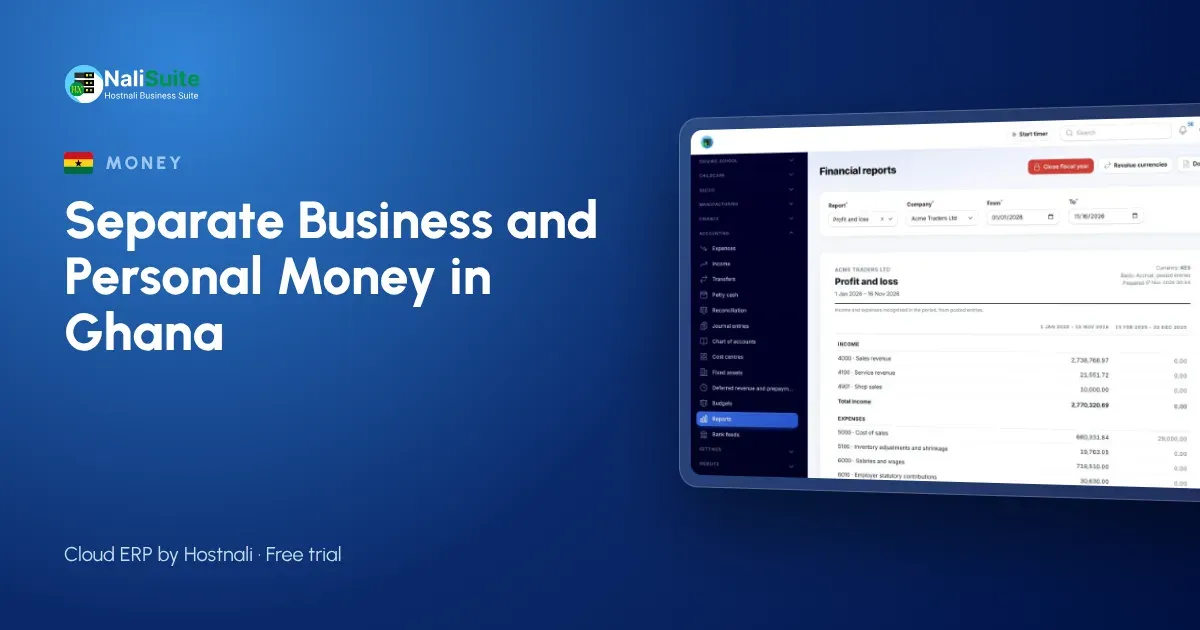
| No idea of profit | A monthly profit and loss statement |
Her first clean month shows that Instagram orders, which she thought were her best sales, earn less than counter sales once delivery riders and packaging are counted. She adds a delivery charge.
Why it matters beyond your own peace of mind
- Tax. Your income tax is based on profit, and GRA can ask for records to support it.
- Credit. Lenders and microfinance institutions judge a business by its statements. Mixed statements make you look smaller and riskier; see our list of records for a business loan in Ghana.
- Growth. You cannot hand over the books to an accountant, a partner or a manager when half of them are private.
Frequently asked questions
Do I need to register my business to separate money?
No, but registration with the ORC makes it easier to open a business bank account and a merchant wallet, and looks more credible to customers and lenders.
Can I keep using one phone?
Yes, with a dual-SIM phone: one SIM and wallet for business, the other personal.
Are my drawings a business expense?
No. They are profit you take out as owner and do not reduce taxable profit.
What about cash sales?
Deposit cash takings into the business account regularly instead of spending them, so all sales appear on the statement.
Try NaliSuite
Run the business on its own books with NaliSuite Accounting, from ₵25 a month with a free trial. See the plans.