 GHS
 KES - Kenya
 UGX - Uganda
 TZS - Tanzania
 RWF - Rwanda
 NGN - Nigeria
 ZAR - South Africa
 USD - Zimbabwe
 ETB - Ethiopia
 ZMW - Zambia
 USD - International

Most loan applications in Ghana are prepared in a rush. A supplier offers a good price on a large order, a contract comes up, or equipment breaks down, and the owner suddenly needs money within weeks. Then begins the search for registration papers, statements and accounts that were never kept in one place.
Lenders, whether banks, savings and loans companies, microfinance institutions or credit unions, set their own requirements and make their own decisions. But the businesses that get assessed quickly have one thing in common: they started preparing long before they applied. This guide sets out a timeline you can follow.
Six months before you need the money
Separate the business’s money
Lenders read your statements to understand the business. If customer payments arrive on your personal MTN MoMo number alongside family transfers and susu contributions, the business looks smaller and harder to assess. Move to a business wallet or merchant account and a business bank account now; our guide to separating business and personal money in Ghana shows how. Six months of clean statements is a strong start.
Get your registration and tax in order
- Make sure your business is registered with the Office of the Registrar of Companies (ORC), and that your documents are current, including the details of directors for a company.
- Make sure you have a GRA TIN for the business and that your tax returns are filed and paid.
- If you employ staff, keep SSNIT contributions up to date.
Many lenders ask for a tax clearance certificate from GRA. Fixing late returns takes time, so start early.
Start monthly accounts
A yearly set of accounts is not enough to show how the business is doing now. Begin producing a monthly profit and loss statement and balance sheet. Our guide to reading a profit and loss statement in Ghana explains the numbers lenders look at.
Three months before
Gather identity and premises documents
- Ghana Card for every owner or director.
- Proof of business address: tenancy agreement or utility bill.
- Business operating permit from your district or municipal assembly, where your trade needs one.
Build your debtors and creditors lists
List customers who owe you money, with amounts and how long they have owed it, and the suppliers you owe. If you sell on credit to contractors, schools or institutions, this list shows the lender money that is on its way.
List existing loans
For every loan, hire purchase or supplier credit you have: who, how much is left and the repayment schedule. Lenders check credit bureau records, so repay on time.
One month before
Write down the purpose
One page: what the money is for, how much, over what period, and how it will earn enough to repay. Attach quotations or pro-forma invoices for equipment or stock.
Build a cash flow forecast
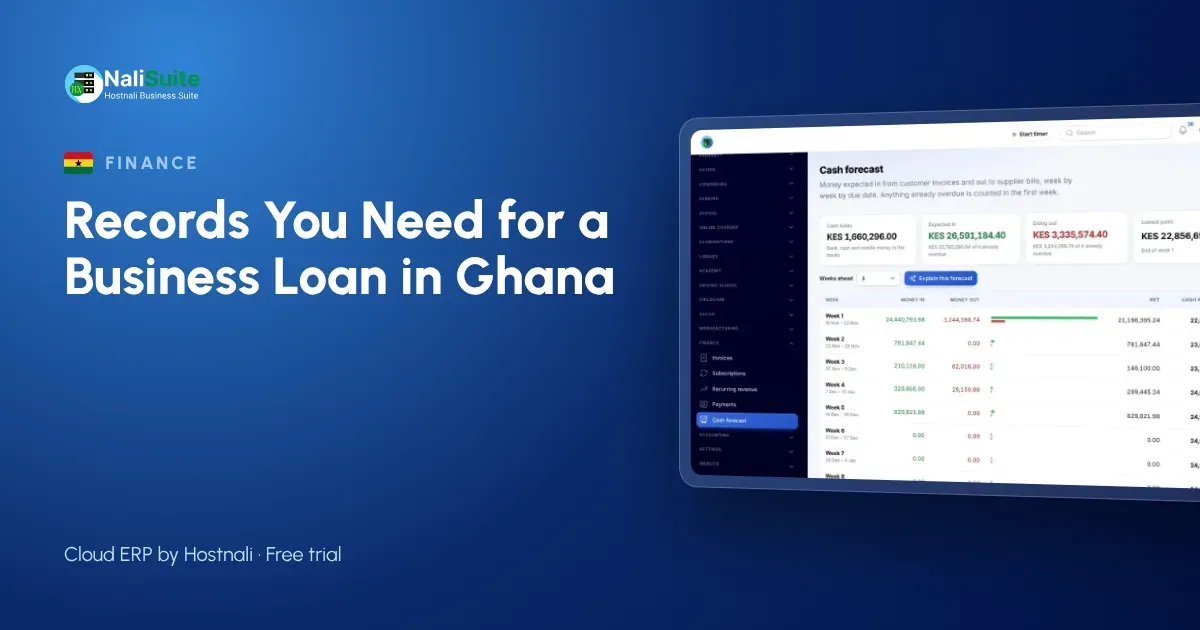
Show expected money in and out, month by month, over the loan period, with the repayments included. Our cash flow tips for Ghanaian businesses explain how to build a realistic forecast.
Collect supporting evidence
Contracts, purchase orders, letters of award or a list of regular customers support the forecast.
The week you apply
- Download the latest bank and MoMo statements for the period the lender asks for.
- Print or export the latest monthly accounts.
- Check that the figures in your accounts agree with your statements.
- Have documents for any collateral ready: land documents, vehicle papers or equipment invoices, and guarantor details if asked.
An example: Yaw’s water business in Tamale
Yaw runs a sachet water production business in Tamale, supplying shops and event organisers. He plans to finance a second production line before the dry season, when demand peaks.
| When | What Yaw did |
|---|---|
| Six months before | Opened a business account and MoMo merchant account; caught up on GRA returns; started monthly accounts |
| Three months before | Collected Ghana Cards, permits and his tenancy agreement; built a debtors list of his wholesale customers |
| One month before | Wrote a one-page purpose with machine quotations; built a twelve-month forecast |
| Application week | Exported statements and accounts; checked they agreed |
The lender’s questions were about the dry-season demand, not about missing papers.
Keeping records ready without the rush
NaliSuite Accounting posts every sale, supplier bill and payslip as it happens, so monthly profit and loss, balance sheet and cash flow statements are always ready. Invoicing keeps an aged debtors list, bank and mobile money reconciliation shows that the books agree with your statements, and Documents keeps registration papers, tax certificates and contracts in one place.
Frequently asked questions
Will lenders accept MoMo statements?
Many lenders consider mobile money statements alongside bank statements as evidence of sales. Ask the lender what it accepts.
Do I need audited accounts?
Smaller loans are often assessed on statements and management accounts; larger loans more often need accountant-prepared or audited accounts.
What if my tax returns are behind?
Catch up before applying. Many lenders ask for a GRA tax clearance certificate.
Will good records guarantee a loan?
No. They make your application easier and faster to assess.
Try NaliSuite
Keep your records loan-ready every month. NaliSuite starts at ₵25 a month with a free trial. See the plans.