USD
 KES - Kenya
 UGX - Uganda
 TZS - Tanzania
 RWF - Rwanda
 NGN - Nigeria
 ZAR - South Africa
 USD - Zimbabwe
 GHS - Ghana
 ETB - Ethiopia
 ZMW - Zambia

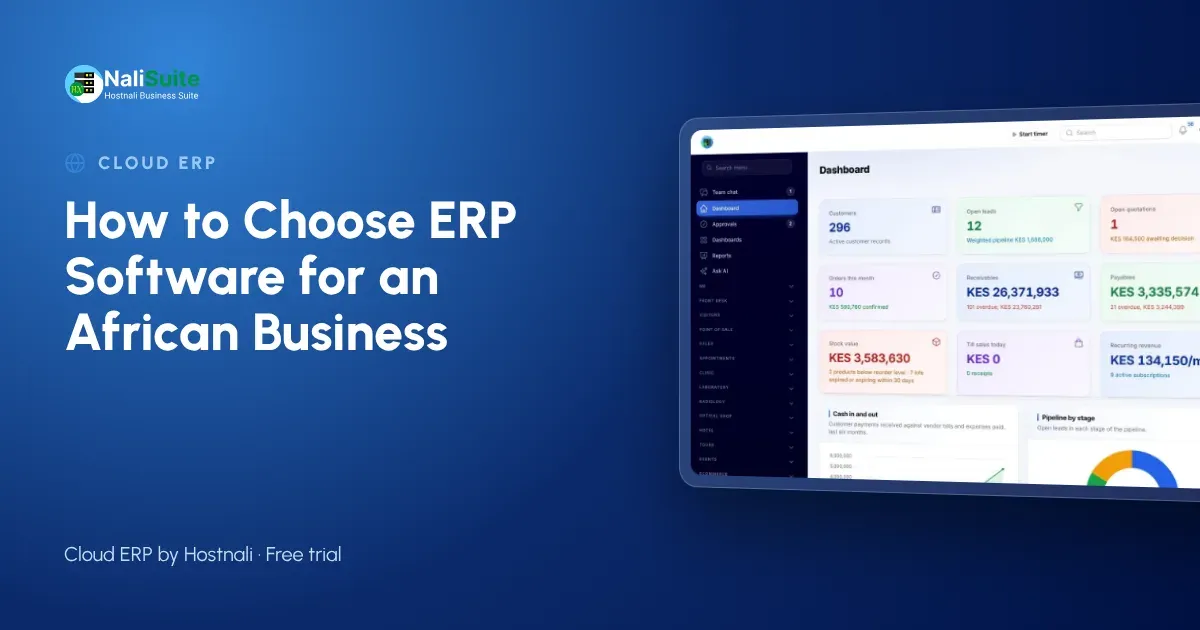
Across Africa, small businesses tend to start with a till, a mobile money or bank statement and a spreadsheet. The trouble starts when the business grows: more branches, more staff, more tax paperwork and more currencies. This guide explains what to look for in ERP software across Africa, using a logistics firm with offices in Lagos, Accra and Nairobi as a running example. The companies named here are examples, but their situations are common.
What ERP software actually is
ERP stands for enterprise resource planning, but the idea is simple: one system where sales, stock, purchases, payments, staff and accounts share the same records. A sale at the counter updates stock, the customer’s balance and the books at once. NaliSuite is a cloud ERP with 17 built-in apps, from CRM to payroll. For the logistics firm, that meant one customer list instead of four.
It must handle M-Pesa properly
Customers across Africa pay by M-Pesa, MTN MoMo, Airtel Money or Orange Money, card or bank transfer. Your ERP should send a payment prompt from the till, put a pay link on every invoice and match payments to invoices automatically. Ask how an M-Pesa payment reaches the books, and how long it takes. In NaliSuite, see mobile money payments. Amina at the logistics firm tested this first, before looking at any other feature.
Offline and mobile matter more than features lists
A beautiful dashboard is useless if the till freezes when the network goes down. Check that sales continue offline and sync later; NaliSuite’s offline POS does exactly that. For the logistics firm, a till that kept selling during an outage was worth more than any report.
Think about the second branch now
The logistics firm chose its ERP with the next branch in mind. Stock per location, transfers and reports for each branch matter far more after you open it than before. NaliSuite covers several branches and companies. Amina now sees each location of the logistics firm on one screen instead of in separate files.
Tax and invoicing rules
Tax rules differ from country to country. Your ERP should let you set your own rates per product and support e-invoicing where the law requires it, such as eTIMS in Kenya and the NRS system in Nigeria. The free VAT calculator is handy for checking sums. The logistics firm checked how the tax settings work before importing a single product.
Ask these five questions
Before the logistics firm signed up, Amina asked every supplier the same questions: how payments are matched, how tax is handled across Africa, what happens offline, how data is imported and whether there is a trial. Any vague answer was a warning sign. Suppliers who could not answer clearly were dropped from the logistics firm’s shortlist.
How to switch without chaos
Import your lists first, set opening balances, then run the old and new systems together for one month before you stop the old one. For QuickBooks, Xero, Sage or Tally users there is a step-by-step switching guide. The logistics firm moved its customer and product lists first and kept the old books for one more month.
A worked example: the logistics firm
Take a logistics firm with offices in Lagos, Accra and Nairobi. Before switching, Amina kept sales in one file, stock in another and payroll in a third, and the figures for Nairobi never agreed with the bank. The shortlist was simple: local payments, tax handled the way your tax authority expects, and a till that keeps going when the network drops in Accra. After a month of running both systems, the logistics firm moved fully across and closed its books in a day instead of a week.
What matters most across Africa
If you trade in more than one African country, check support for several currencies, local payment methods per country and payroll rules where you employ staff. NaliSuite covers statutory payroll for seven countries and lets you set your own deductions elsewhere.
Your checklist at a glance
| Question | Good answer |
|---|---|
| How do customers pay? | M-Pesa, MTN MoMo, Airtel Money or Orange Money, card or bank transfer, matched to invoices |
| Who sets tax rates? | you, in settings |
| Internet down? | the till keeps selling |
| More staff? | add users as you grow |
| Moving data? | import from Excel or CSV |
The logistics firm used a list like this to compare three options side by side.
Frequently asked questions
What is the difference between accounting software and an ERP?
Accounting software keeps the books. An ERP also runs sales, stock, purchases, payroll and support, and posts to the books automatically.
Does a cloud ERP work on phones?
Yes. NaliSuite runs in the browser on phones, tablets and computers, and the till keeps selling offline.
Will my data be safe?
Choose a provider that backs up your data and lets you export it. Ask about both before you sign up.
Which plan suits a small business across Africa?
Plans differ mainly by users and storage. Start small and move up as the team grows.
Try NaliSuite
See whether NaliSuite fits African businesses like yours: look through the 17 built-in apps, pick a plan from $2.10 a month and test it with your own data.