USD
 KES - Kenya
 UGX - Uganda
 TZS - Tanzania
 RWF - Rwanda
 NGN - Nigeria
 ZAR - South Africa
 USD - Zimbabwe
 GHS - Ghana
 ETB - Ethiopia
 ZMW - Zambia

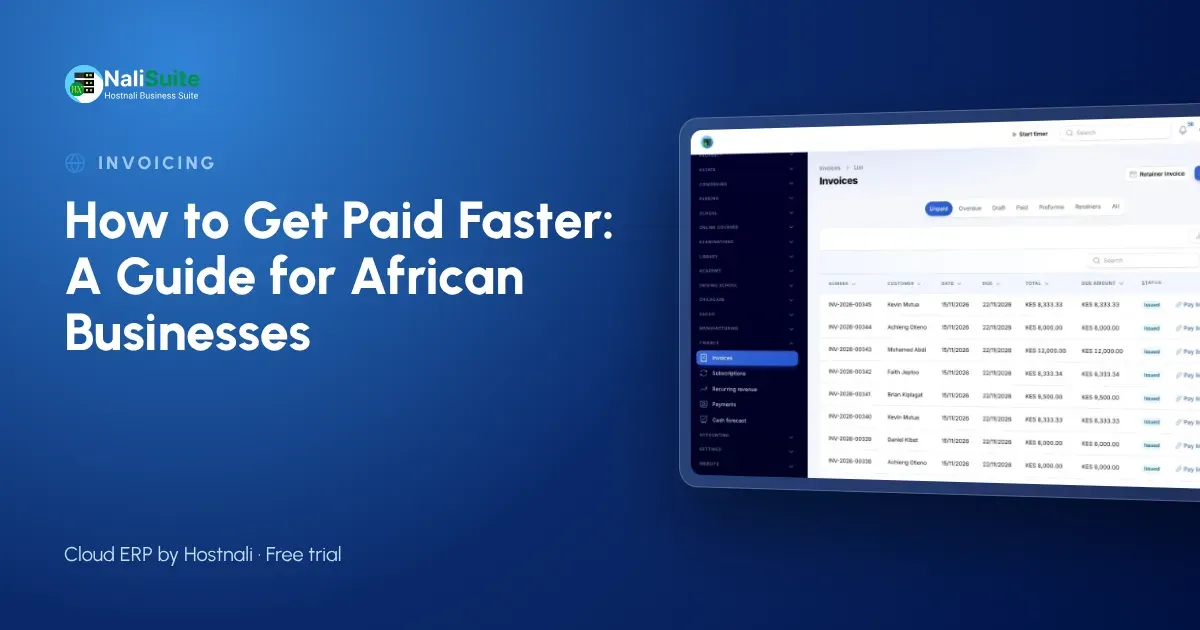
Cash in the bank pays salaries; invoices in a drawer do not. For a distributor in Nairobi that also ships to Kampala, the gap between delivery and payment once stretched to six weeks, which meant borrowing to restock. This guide walks through what changed, step by step, so other businesses across Africa can shorten the same gap without chasing customers every day. The businesses in this guide are examples, but the problems will be familiar.
Remove every reason to delay
The question “what is this invoice for?” can cost two weeks. Customers of a training company in Accra pay faster since every invoice includes:
- a due date, not just “payable on receipt”
- the order number the customer’s accounts team will look for
- your tax number, so their records are complete
- every way to pay, with the pay link at the top
- a named contact for questions
For occasional invoices, our free invoice generator covers the basics. After the change, the Nairobi distributor stopped getting calls from retailers in several countries asking what an invoice was for.
Invoice the day the work is done
At the Nairobi distributor, invoices used to be written up on Fridays from the delivery book, so some customers received them a week late and paid a week late. Now the invoice is raised when the goods leave. Nobody works harder; the clock simply starts sooner. If you deliver on Monday, the customer across Africa should have the invoice on Monday. The Accra trainer follows the same rule for deposits: the request goes out the day a booking is confirmed, not at the end of the week.
Write the terms on the quotation
The Nairobi distributor lost several weeks a year to customers who “thought it was 60 days”. Now the quotation states the terms and the customer accepts it online, so the order and invoice carry the same terms with no retyping. Regular customers of the Accra trainer now see the same terms on every quotation, so there is nothing to renegotiate when the invoice arrives.
Let customers pay by M-Pesa in one tap
Across Africa, customers pay fastest with the method they already use every day, whether that is M-Pesa, MTN MoMo, a card or a bank transfer, so the invoice should offer it. At the Nairobi distributor, adding a pay link to each invoice did more for collections than any reminder. The customer taps, approves and the invoice closes itself, with the receipt sent automatically. Read more about mobile money payments in NaliSuite. For the Nairobi distributor, the share of invoices paid within a week rose sharply once paying took a single step.
Give regular customers their own page
Regular customers of a distributor in Nairobi that also ships to Kampala can open the customer portal to check what they owe and pay it, at any hour. Fewer calls, fewer resent PDFs, faster payments. Customers of the Accra trainer now check balances themselves before calling, which saves Amina’s team hours each week.
Set a reminder schedule once
Choose when reminders go out, before and after the due date, and NaliSuite sends them by email or WhatsApp with the pay link. The tone stays friendly; the schedule stays consistent. For African customers who live on WhatsApp, a reminder there is hard to miss. The usual excuse at the Nairobi distributor, cross-border bank transfers, matters less when the reminder arrives with a link that takes ten seconds to use.
Match payments quickly
At the Accra trainer, payments sometimes arrive with no reference. Matching M-Pesa and bank statements to invoices every few days, using reconciliation with suggested matches, keeps the overdue list accurate and the reminders polite. Matching every few days means Amina never chases a customer of the Nairobi distributor who has already paid.
A note for businesses across Africa
Across Africa, the fastest way to pay differs by country: M-Pesa in Kenya and Tanzania, MTN MoMo in Ghana, Uganda and Rwanda, cards and bank transfers in Nigeria and South Africa. If you sell across borders, offer the local method your customer already uses.
Watch the total owed, not just single invoices
If the amount customers owe you keeps growing while sales stay flat, payment is slowing down. Amina checks the total owed each week alongside sales, and the accounting reports make it a two-minute job. For the Nairobi distributor, the weekly check is now the moment to decide which of the retailers in several countries get new deliveries.
Frequently asked questions
Which payment methods should I offer across Africa?
Offer what your customers already use: M-Pesa, MTN MoMo, Airtel Money or Orange Money, card or bank transfer. The more familiar the option, the faster they pay.
Do pay links cost my customers anything?
That depends on your payment provider’s fees and how you set them up. The money goes to your own account, not through Hostnali.
When should I stop supplying a late payer?
Decide a rule in advance, such as pausing new orders when an account is a set number of days overdue, and apply it to everyone.
Can invoices go out automatically every month?
Yes. Subscriptions in NaliSuite raise and send recurring invoices with their pay link on the schedule you set.
Try NaliSuite
NaliSuite, also known as Hostnali Business Suite, handles invoices, payments and reminders for African businesses, from $2.10 a month with a free trial. Compare the plans.