USD
 KES - Kenya
 UGX - Uganda
 TZS - Tanzania
 RWF - Rwanda
 NGN - Nigeria
 ZAR - South Africa
 USD - Zimbabwe
 GHS - Ghana
 ETB - Ethiopia
 ZMW - Zambia

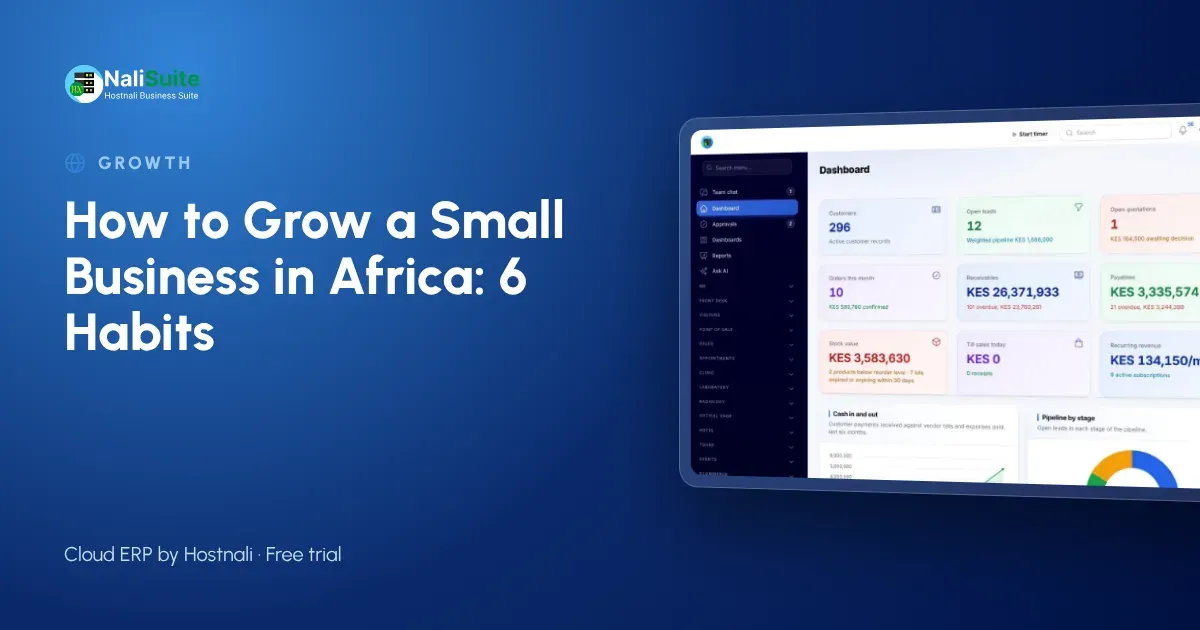
African small businesses grow in conditions that textbooks rarely describe: customers who pay by phone, currencies that move, power and internet that come and go, and markets where trust is personal. The businesses that grow anyway tend to share a handful of habits.
Here are six of them, with practical ways to build each one into your own business, wherever you are on the continent.
Habit 1: Formalise early
Many businesses start informally, and that is normal. But the ones that grow tend to formalise sooner than they strictly need to.
- Register the business with the relevant authority in your country, and get a tax number.
- Open a separate business account or mobile money line, so business and personal money do not mix.
- Issue proper invoices and receipts with your business details and tax number where required. The free invoice generator is an easy start.
- Keep records monthly, not at year end.
Formal records open doors: larger customers, supplier credit, loans and tenders all ask for them.
Habit 2: Build on mobile
Across Africa, the phone is the shop window, the till and the wallet.
- Let customers pay the way they already pay. M-Pesa, MTN MoMo, Airtel Money and other wallets are everyday tools in many markets. Mobile money payments link those payments to your invoices.
- Use WhatsApp for service, not just chat: order updates, quotations, receipts and reminders to customers who agreed to receive them.
- Make sure your website works on a phone. Most visitors will see it on a small screen with mobile data.
Habit 3: Earn trust deliberately
In many African markets, people buy from businesses they know or that someone they trust recommends.
- Deliver on promises, especially delivery dates. One broken promise travels fast.
- Ask for referrals and thank the people who give them.
- Show proof: real customer reviews, photos of completed work and clear contact details.
- Respect customer data. Most African countries now have a data protection law and a regulator. Only send marketing to people who agreed, and keep their details secure.
Habit 4: Manage cash for uncertain conditions
Volatile currencies, late-paying customers and sudden cost increases make cash the main constraint for many African businesses.
- Invoice on the day and follow up overdue payments every week.
- Ask for deposits on custom or large orders.
- Review prices regularly, especially when imported inputs change in cost.
- Keep a short cash forecast covering the next six to eight weeks.
- Watch stock. Money sitting in slow-moving stock is money you cannot use elsewhere. Inventory shows what is moving and what is not.
Habit 5: Systemise before you scale
Growth that depends on the owner’s memory stops when the owner is busy.
| Task | Systemised version |
|---|---|
| Quotations | Built from a price list, sent by email or WhatsApp |
| Sales follow-up | Every lead and quote in a CRM with reminders |
| Invoices | Created from accepted quotations |
| Books | Posted as you work in accounting |
| Selling during outages | A till that keeps working offline and syncs later |
Write down the steps for your most common tasks, then hand them to staff one at a time.
Habit 6: Expand across borders carefully
African trade is increasingly regional, and many businesses eventually serve customers in a neighbouring country. Do it in steps:
- Serve foreign customers from home first. Learn their needs, payment habits and paperwork before opening anything there.
- Understand local tax and registration rules with the relevant authorities before you sell regularly.
- Find a local partner who knows the market.
- Keep each entity’s books separate. Multi-company and branches lets one account hold several companies with their own figures.
A pan-African example
A small solar equipment supplier started selling to households in one city, taking payments by mobile money and keeping orders in a notebook. As demand grew, it registered formally, moved quotations and invoices into one system and wrote down its installation process. Customers from a neighbouring country began calling after seeing its installations. Rather than opening a branch, it shipped to a local installer partner and kept that partner’s orders in a separate company within the same account. The growth came from habits, not from one big decision.
A quick self-check
Ask yourself which of the six habits your business already has:
- Formal records every month?
- Payments and service built around mobile?
- Deliberate trust-building and referrals?
- Weekly cash discipline?
- Written processes for key tasks?
- A careful plan for new markets?
Pick the weakest one and work on it for the next three months.
Frequently asked questions
What is the most important habit for growth?
For most small African businesses, cash discipline. Many profitable businesses stall because money is stuck in unpaid invoices or stock.
Should I formalise if my business is very small?
Formal records and invoices help even small businesses win bigger customers and access credit. Check the rules in your country.
Does NaliSuite work in my country?
NaliSuite has country packs for many African markets and supports mobile money and card payments. Plans start from $2.10 a month.
Which industries does NaliSuite support?
See the industries hub.
Try NaliSuite
Choose the habit your business most needs, then start a free trial of NaliSuite to build it into your daily work.