USD
 KES - Kenya
 UGX - Uganda
 TZS - Tanzania
 RWF - Rwanda
 NGN - Nigeria
 ZAR - South Africa
 USD - Zimbabwe
 GHS - Ghana
 ETB - Ethiopia
 ZMW - Zambia

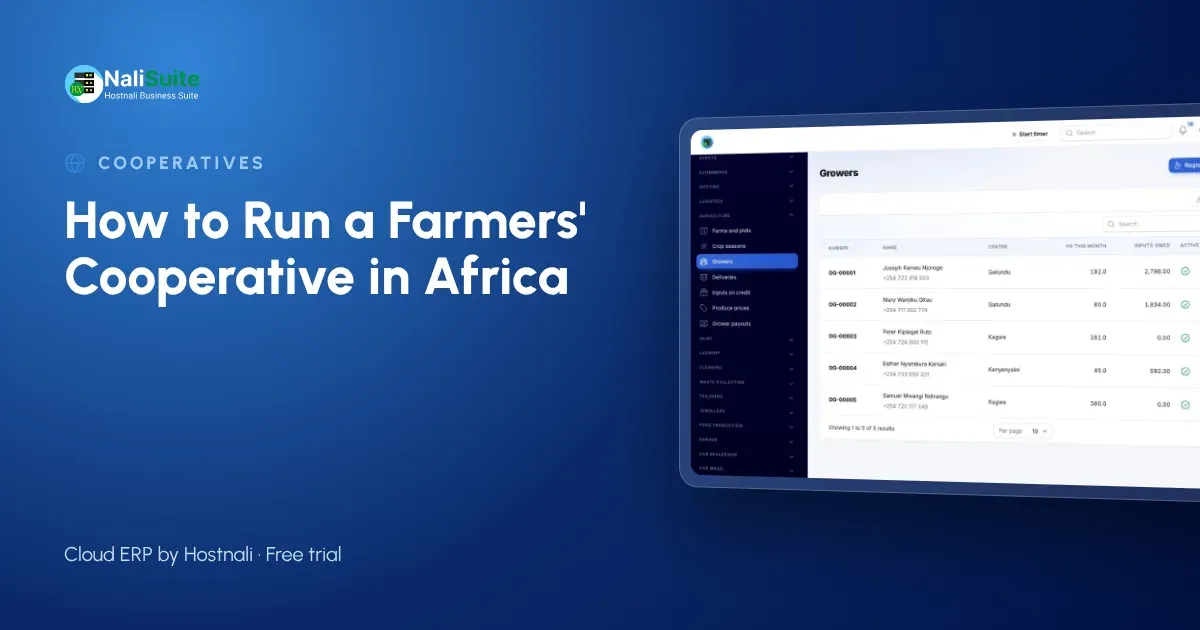
Across Africa, cooperatives help smallholders sell coffee, cocoa, milk, grain and vegetables together, at prices none of them could get alone. Whether you run a dairy society in East Africa or a cocoa group in West Africa, the same administration decides whether members trust you: accurate deliveries, fair deductions and payouts that arrive on time. This guide covers the routine.
Members first: a register you can rely on
Treat the member register as the cooperative’s most valuable document. Each entry needs the member number, full name, phone, payout details, route or centre, joining date and a contact person in the family.
Limit who can change payout details, and keep a note of every change and who made it. A changed phone number or bank account is the easiest way for money to go astray.
Make the collection point the source of truth
The collection point is where errors either start or stop. Capture each intake as it happens, with the member number, quantity, grade and the price that applies on that day, and give the member a receipt by text.
For milk, record morning and evening intake separately and reject deliveries that fail the quality check at the door, rather than arguing about them at month end.
Credit from the cooperative store
Run the cooperative store like a shop that sells on account. Goods leave stock, the member’s account is charged, and the balance is recovered from their next payout.
Because stock and member accounts are linked, the store manager knows what is left on the shelf and the treasurer knows what members owe, without comparing two notebooks.
Levies, shares and savings
Most cooperatives take something from each payout for the group itself: a levy, share contributions or savings. Set the rates in the system once, so they are applied the same way to every member.
Where members also save or borrow through the cooperative, keep those balances in the same place as their deliveries, so one statement tells the full story.
A worked example: a group with members in two countries
Imagine an organisation that supports cooperatives in two neighbouring countries, each with its own currency and payment habits. One group collects milk on routes and pays members by mobile money; the other bulks maize and pays by bank transfer after the harvest is sold. Running both on one system, with each cooperative kept as its own company with its own books, lets the head office see deliveries and payouts across the region without mixing the figures.
Running the payout
A good payout takes hours, not days. Earnings from deliveries, minus each member’s deductions, give the amount due. The committee reviews and approves the list, and members are paid by mobile money such as M-Pesa, MTN MoMo or Airtel Money, or by bank transfer.
Record every payment as it goes out and reconcile the account afterwards, so any failed payment is spotted and resent the same week.
Paying members across different countries
How members expect to be paid varies by country. In much of East Africa, M-Pesa, MTN MoMo and Airtel Money are normal; in other places bank transfer or cash at the depot still dominates. Agree the method with members, confirm their details and record every payout against the member.
If you work in several countries, keep each cooperative’s records separate, in its own currency, and respect the data protection law that applies to members in each one.
Statements and transparency
Send every member a statement each period: deliveries with dates and weights, the price applied, each deduction and the amount paid. Share it by text or WhatsApp, or let members log in to see it.
At the annual general meeting, show the totals: volume collected, what buyers paid, what was paid to members and what the cooperative kept. Openness is the best defence against rumours.
Putting it into practice with NaliSuite
The routine above maps directly onto NaliSuite. Deliveries, store credit and payouts for dairy groups run in the Dairy Cooperative Milk Collection add-on; crop collections, input credit and grower payouts in the Agriculture and Outgrowers add-on; savings and loans in the SACCO and Microfinance add-on.
All three share the same member records and post to the same Accounting books, and payouts go out through mobile money. The farms and cooperatives overview lists every app a cooperative typically uses.
A note on member data: the register holds names, phone numbers and payment details, so treat it carefully. In Africa that means following the data protection law of each country you operate in. Limit who can see member records and never share lists outside the cooperative.
Frequently asked questions
Can we run cooperatives in several countries?
Yes. Each cooperative can be set up as its own company with its own books, while head office sees reports across all of them.
Which payout methods are supported?
Members can be paid by mobile money where it is available, such as M-Pesa, MTN MoMo or Airtel Money, or by bank transfer, with each payout recorded on their statement.
Do the add-ons cost extra?
Yes. The cooperative add-ons are added to any NaliSuite plan and billed with the subscription; plans start from $2.10 a month.
Can we import our existing member list?
Yes. A member list kept in Excel can be imported in one go, with names, phones and payout details, so you do not retype anyone.
Try NaliSuite
The best way to judge it is to try it with your own members. A free trial lets you set up the register, record deliveries and run a test payout before committing. Compare the plans.