USD
 KES - Kenya
 UGX - Uganda
 TZS - Tanzania
 RWF - Rwanda
 NGN - Nigeria
 ZAR - South Africa
 USD - Zimbabwe
 GHS - Ghana
 ETB - Ethiopia
 ZMW - Zambia

As an African business grows, its spending spreads out. There is a second branch, a team on the road, a mobile money wallet for small payments, a bank account in another currency, perhaps an office in another country. Each new place money can leave from is another place an expense can be missed.
This guide is for growing businesses anywhere on the continent: how to keep expense tracking complete as you add branches, staff, wallets and currencies.
The goal: one complete picture
The aim of expense tracking is simple: every payment, from every account, wallet and cash box, recorded once, with a document behind it and a category that tells you what it was for. Everything below serves that goal.
Step 1: List every way money leaves the business
Write down every account and method:
- bank accounts, in each currency,
- mobile money wallets, such as M-Pesa, MTN MoMo, Airtel Money, Orange Money or Wave,
- business cards,
- petty cash boxes, one per branch,
- staff paying from their own pockets and claiming back.
Each one needs an owner who is responsible for its records and a monthly reconciliation.
Step 2: Agree one set of rules
A growing business needs written rules that apply everywhere:
| Rule | Example |
|---|---|
| Who can spend | Branch managers up to a set limit; above it, head office approves |
| How to pay | Business accounts or wallets only; personal money only by claim |
| What to keep | A receipt or tax invoice, or a signed voucher where none exists |
| When to record | On the day of the expense |
| When to claim | Within a set number of days |
Tax receipts differ by country: KRA eTIMS invoices in Kenya, EFD receipts in Tanzania, EFRIS e-receipts in Uganda, EBM receipts in Rwanda, and tax invoices elsewhere. Ask your local team to collect the receipt your tax authority expects, and check current rules with that authority.
Step 3: Use the same categories in every branch
If one branch calls it “transport” and another “logistics”, you cannot compare them. Set one list for the whole business – stock, transport and fuel, power and backup power, premises, staff, communication, bank and mobile money charges, marketing, professional fees, equipment – and use it everywhere.
Step 4: Track spending by branch, department or project
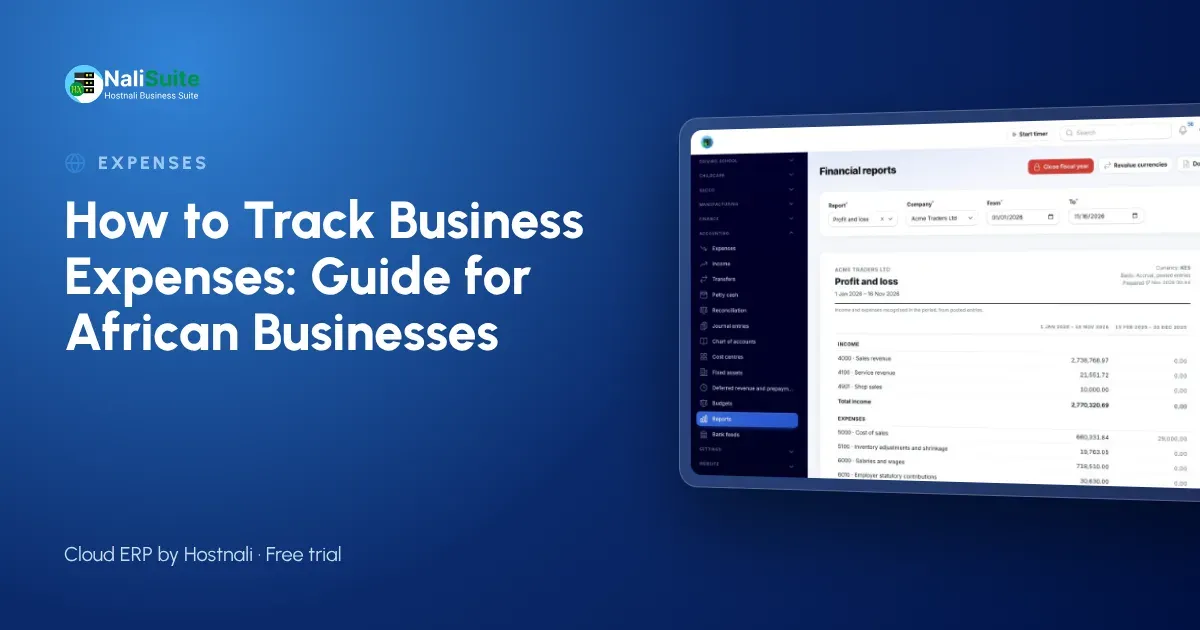
Group-level totals hide problems. Tag every expense with the branch, department or project it belongs to. NaliSuite accounting supports budgets and cost centres, so you can track each branch or project against its own budget. For separate companies, the multi-company setup keeps each one’s books and taxes apart, with reports for one company or all of them.
Step 5: Make approvals and claims fast
Slow approvals lead to workarounds. In NaliSuite purchases, purchase orders, bills and expenses above an amount you set wait for the right approver, and supplier bills are matched to what was ordered and received. Staff anywhere can photograph a receipt and submit a claim from their phone through employee self-service; managers approve from theirs.
For finance teams handling many supplier invoices, the Document AI add-on reads PDFs and receipt photos and drafts the bill or expense for review. It works with an Anthropic API key held by your business.
Step 6: Reconcile every account, every month
Reconciliation is what makes the picture complete. For each bank account, wallet and cash box, match every payment to a recorded expense and every expense to a payment. NaliSuite imports statements or connects bank feeds and suggests matches; bank and mobile money reconciliation shows what is still open, account by account.
Step 7: Report and act
A monthly one-page report is enough for most owners:
- total spending by category, this month and last,
- spending by branch or project against budget,
- the five largest individual expenses,
- anything unmatched or unexplained.
The report is where tracking pays off: a branch whose power costs doubled, a project running over budget, charges that could be cut by batching payments.
Examples from across the continent
These are sample scenarios, not real businesses:
- A retailer with shops in Nairobi and Nakuru found one branch spending far more on transport, because stock was collected daily instead of delivered weekly.
- A Lagos agency discovered that software subscriptions on staff cards had grown into one of its largest overheads.
- A Lusaka distributor cut mobile money charges by paying small suppliers in weekly batches.
Keep personal money separate
Owners who pay business costs personally, or personal costs from the business, blur the picture. Keep the two apart and use claims for exceptions.
Frequently asked questions
How do I handle expenses in several currencies?
Record each in its original currency, convert to one reporting currency with a consistent rule, and reconcile each account in its own currency.
Who should reconcile branch accounts?
The branch manager or bookkeeper first, then a check by head office. Two pairs of eyes catch more.
When is the right time to move from spreadsheets to software?
When you have more than one branch, several people spending, or reconciliation takes more than a day each month.
Try NaliSuite
NaliSuite keeps expenses, approvals, claims and reconciliation together for businesses across Africa. Plans start at $2.10 a month, shown in US dollars, with a free trial. View the plans.