USD
 KES - Kenya
 UGX - Uganda
 TZS - Tanzania
 RWF - Rwanda
 NGN - Nigeria
 ZAR - South Africa
 USD - Zimbabwe
 GHS - Ghana
 ETB - Ethiopia
 ZMW - Zambia

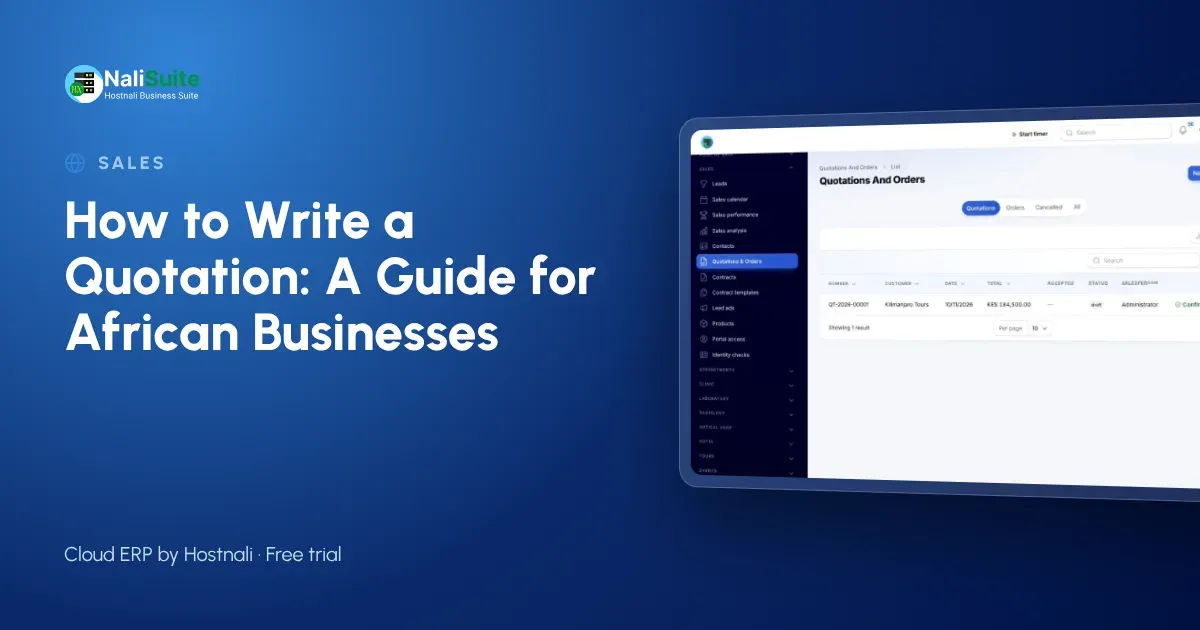
From a welder in Nairobi to a translation agency in Dakar, every business that sells to other businesses writes quotations. The rules for a good one are much the same across the continent, though tax, currency and payment habits differ from country to country.
This guide sets out seven rules that apply wherever you trade in Africa, with notes on quoting to customers in other countries.
Rule 1: Look like a registered business
The header of your quotation should answer the buyer’s first question: is this a real, registered supplier?
Include your business name, address, phone, email and tax identification number: the KRA PIN in Kenya, TIN in Nigeria, Ghana, Uganda, Tanzania and Rwanda, TPIN in Zambia, or your local equivalent. If you are registered for VAT, add the VAT number. Corporate, NGO and government buyers often cannot proceed without these.
Rule 2: Make the scope impossible to misread
Disputes rarely start with the price. They start with different ideas of what the price covered.
- Describe each item or service precisely, with quantities and specifications.
- Say where and when it will be delivered.
- List what is not included.
“Design and print 500 A5 flyers, full colour both sides, 150 g paper, delivered to your office within 5 working days; design revisions limited to two rounds” leaves little room for argument.
Rule 3: State the currency, then the price
On a continent of many currencies, never leave it to assumption. Write “All prices in Kenyan shillings” or “in US dollars” at the top of the price table.
For customers in another country, decide whether you quote in your currency, theirs or a third one, and who carries the exchange risk. Put that in the terms.
Rule 4: Show tax clearly
VAT rates differ widely across Africa and change from time to time. If you are VAT-registered, show the amount before tax, the VAT (and any levies) on separate lines and the total including tax. If you are not registered, do not add VAT.
For cross-border sales of goods or services, VAT treatment can be different from local sales. Ask your accountant before you quote. The free VAT calculator lets you set any rate when you need a quick figure.
Rule 5: Put a clock on it
State how long the quote is valid. Where supplier prices or exchange rates move quickly, 7 to 14 days is common; elsewhere 30 days is normal. Add that prices may be revised after the validity date.
Rule 6: Say how you want to be paid
Include:
- any deposit, as a percentage;
- when the balance is due;
- how to pay: mobile money (M-Pesa, MTN MoMo, Airtel Money, Orange Money or Wave, depending on the country), bank transfer or card.
Clear payment terms on the quote mean fewer awkward conversations later.
Rule 7: Make it easy to say yes
Send the quote as a PDF or link, not a typed message, so it can be forwarded to whoever approves it. Offer optional lines or two levels where that helps the buyer choose. And let them accept without printing anything.
NaliSuite Sales and Quotations does this in one place: it builds the quote from your product list with prices and taxes filled in, supports price lists by customer group, currency or quantity, adds optional lines and discounts, and sends a branded PDF by email or WhatsApp. The customer accepts through a secure link and you are notified immediately.
After you send it
Follow up
Call or message after two or three days. Ask if the quote is clear and when a decision will be made. Track each quote on a pipeline board in the CRM app, so you know what is waiting, won or lost.
Turn acceptance into an invoice
An accepted quote should flow straight into an order and an invoice, with no retyping. In NaliSuite it does, including deposits, milestone and partial invoices. NaliSuite Invoicing then adds a link to pay by mobile money or card; see the mobile money payments page. Where e-invoicing applies, such as eTIMS in Kenya or e-invoicing in Nigeria, the invoice can be submitted through NaliSuite with the business’s own credentials.
Quoting across borders: extra points
- Language. Reply in the language of the request: English, French, Portuguese or Arabic.
- Delivery terms. For goods, say who pays for shipping, insurance and import duties.
- Payment method. Mobile money wallets often do not work across borders; bank transfer or card may be needed.
- Documents. Cross-border buyers may ask for company registration and tax documents. Have them ready.
Frequently asked questions
What is the difference between a quotation and an estimate?
A quotation is a firm price for a defined job within a time limit. An estimate is an approximate figure that may change.
Should I quote in US dollars to customers in other African countries?
It is common for cross-border trade, but agree it with the customer and state it on the quote, along with who bears the exchange risk.
How many options should a quote offer?
One or two extra options are usually enough. More than that can make the decision harder.
Can I use one quotation system for several countries?
Yes. NaliSuite’s multi-company feature keeps each country’s company, currency and taxes separate under one login.
Try NaliSuite
NaliSuite helps African businesses quote, invoice and collect payment from one cloud system. Plans start at $2.10 a month with a free trial; see the plans or learn more about NaliSuite.