USD
 KES - Kenya
 UGX - Uganda
 TZS - Tanzania
 RWF - Rwanda
 NGN - Nigeria
 ZAR - South Africa
 USD - Zimbabwe
 GHS - Ghana
 ETB - Ethiopia
 ZMW - Zambia

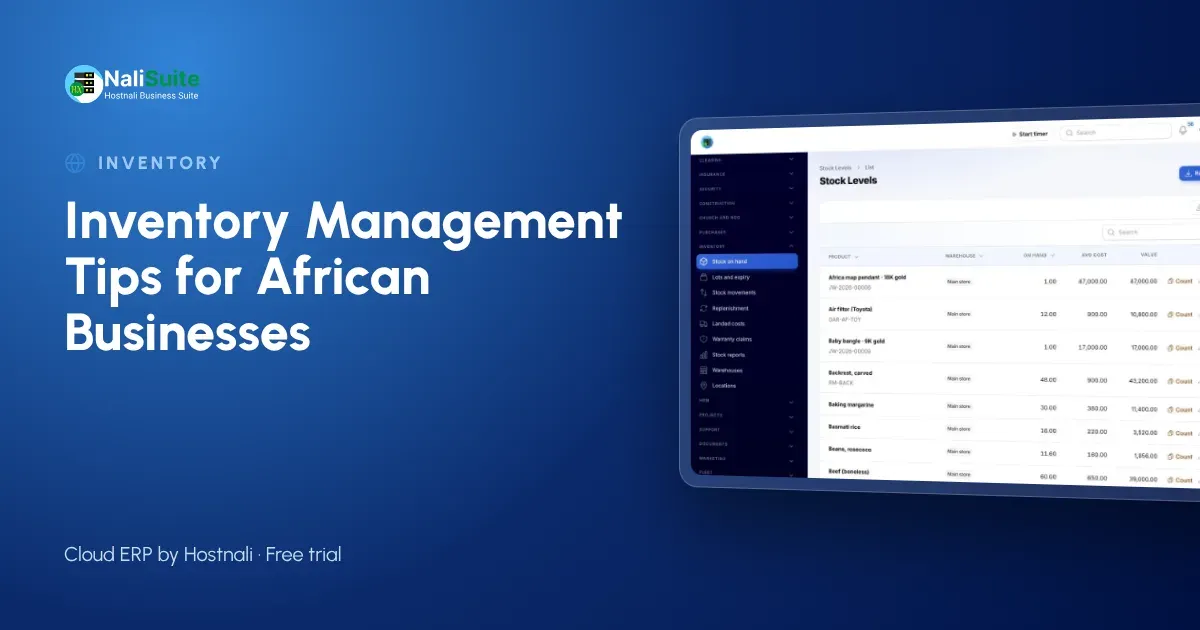
Across Africa, small and medium businesses face similar stock problems: long supply chains, cash tied up on shelves, losses that only appear at year-end and expiry dates that slip by. The details differ between Lagos and Lusaka, but the habits that fix them are the same. Here are the inventory tips that matter most.
Start with an accurate count
Before you can manage stock you need a true starting point. Close early one day or come in on a Sunday, count everything once and record it as opening stock. Barcode labels and a phone scanner make this much faster than a clipboard.
From then on, do not wait for the annual stock-take. Count one aisle or category each week. The aim is not to find every error at once but to find them while they are small.
What makes stock control harder in Africa
Many goods are imported, so lead times are long and sometimes unpredictable. Businesses often supply branches or customers in other towns by road. Credit sales to smaller shops are common, which means stock leaves before cash arrives.
At the same time, sales come in through cash, cards, mobile money such as M-Pesa and MTN MoMo, and bank transfers. When sales and stock live in different systems, the numbers drift apart.
Know when to reorder
Most stock-outs happen because nobody noticed a line running low until a customer asked for it. Fix that with reorder points: average daily sales times the supplier’s lead time, plus a buffer for delays. Sell 4 units a day with a 7-day lead time? Reorder at around 35.
In NaliSuite, inventory can apply reorder rules for you and list what is below its level each day, ready to turn into a purchase order.
Example: a distributor with depots in two cities
A cosmetics distributor runs depots in Nairobi and Kampala. Each depot is its own stock location with its own reorder points. Transfers between them are recorded, so head office always knows where stock is. Sales from each depot reduce that depot’s stock, and the weekly report shows which lines to move from one country to the other before buying more.
The same habits work for a single shop; you just start with one location.
Track batches and expiry dates
If a product has a shelf life, record its batch and expiry date when it arrives. That one habit lets you sell oldest first, spot near-expiry lines in time to discount or return them, and answer a recall without turning the store upside down.
For regulated products such as medicines, traceable batches are not just good practice; they are often expected by regulators and suppliers.
Mistakes African SMEs commonly make
- Trusting supplier lead times. Plan for how long deliveries really take, not how long they are promised.
- Separate systems for sales and stock. Every gap between them becomes a discrepancy at the count.
- No transfer records between branches. Stock moves; the records must move with it.
- Waiting for the annual count. Small, regular counts catch problems while they are cheap to fix.
Stop stock walking out of the door
Losses come from three places: receiving, selling and the stockroom. At receiving, check quantities against the purchase order before signing. At the till, make sure every sale goes through the point of sale rather than a notebook. In the stockroom, count small sections often and record write-offs for damage or expiry.
Track the shrinkage figure month by month. If it rises, you know which area to look at first.
Getting started, wherever you trade
Import your products with cost price, selling price and barcode, then count once to set opening stock in each location.
Set reorder points for your top sellers using real lead times, which in many African markets are longer than suppliers promise. Use purchase orders for every delivery. Record batches and expiry dates where products expire.
If you trade in several countries, set up each as its own company or branch with its own currency and stock, and review all of them together from head office.
Frequently asked questions
Can I manage stock in more than one country?
Yes. NaliSuite supports several companies and branches, each with its own stock locations, currency and settings. See multi-company and branches.
How does the till affect stock?
Every sale through the point of sale reduces stock in that shop automatically, so you do not have to update stock by hand.
How do purchase orders help with stock?
Deliveries are checked against the order before they are accepted, so shortages and wrong items are caught before you pay the supplier.
Try NaliSuite
Every NaliSuite plan, from $2.10 a month, includes inventory, purchases and an offline till, so stock and sales are always in one place. Try it free.