USD
 KES - Kenya
 UGX - Uganda
 TZS - Tanzania
 RWF - Rwanda
 NGN - Nigeria
 ZAR - South Africa
 USD - Zimbabwe
 GHS - Ghana
 ETB - Ethiopia
 ZMW - Zambia

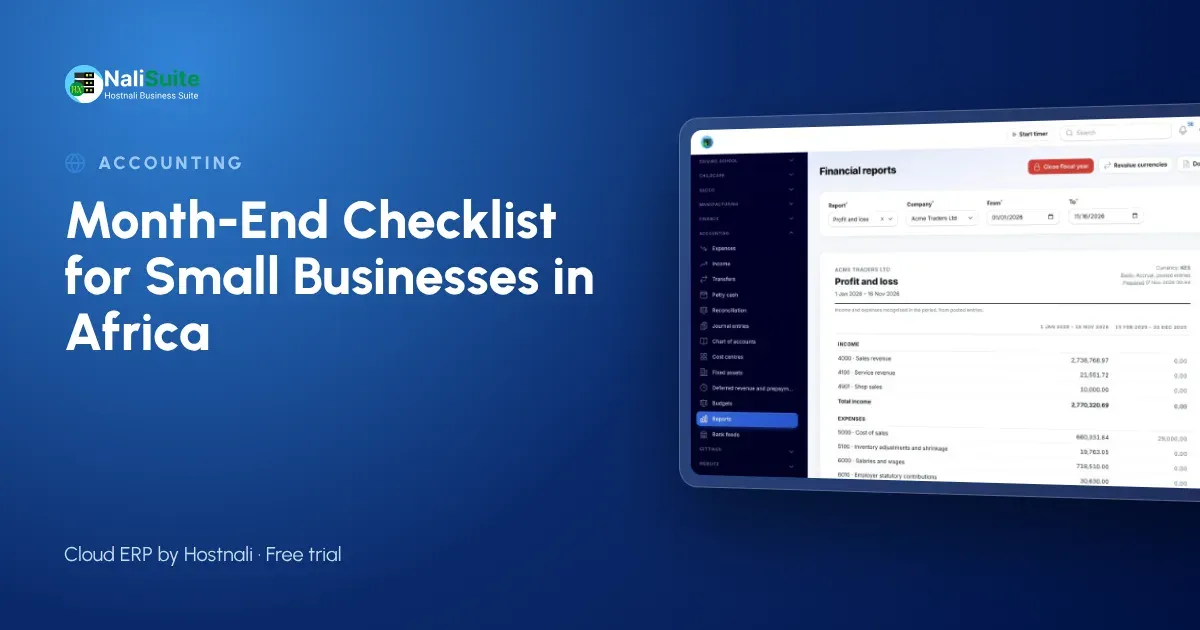
Whether you sell phones in Accra, run a clinic in Kampala or supply offices in Lusaka, the end of the month raises the same question: what really happened last month? The answer only exists if somebody closes the books.
This guide sets out a month-end routine that works for small African businesses that take money by mobile money, card, bank transfer and cash. It is split into what to do before the month ends, in the first days afterwards, and at the very end of the close.
The goal of a month-end close
You are trying to reach three agreements:
- Cash agrees. The balances in your books equal the balances on every bank and wallet statement.
- Activity is complete. Every sale, bill, wage and stock movement for the month is recorded in that month.
- The period is locked. Nobody can change the month by accident afterwards.
Once you have those three, the profit, VAT and payroll figures stop being guesses.
In the last week of the month
A good close starts before the month is over.
- Send statements to customers with open balances, so payments arrive before the cut-off.
- Ask suppliers for any bills not yet received.
- Remind staff to submit expense claims and receipts.
- Agree the date and time of the stock count, if you hold stock.
First two working days: cash
Collect every statement
Most African businesses now receive money through more channels than they pay out through. Gather statements for each M-Pesa, MTN MoMo, Airtel Money, Orange Money or Wave account the business uses, each bank account and each card provider settlement report.
Match line by line
Link each receipt to its invoice or till sale and each payment to its bill. Unmatched items go on a list to investigate. NaliSuite Accounting imports bank and mobile money statements and suggests a match for each line; the reconciliation feature shows how.
Count the cash
Count the physical cash and compare it with the cash sales recorded at the till. Small differences each day become large ones over a month.
Days three and four: activity
Bills and costs
Record all supplier bills dated in the month the goods arrived. Include transaction fees from wallets and banks: in a business that takes many small mobile payments, they can be a noticeable cost.
Debtors
List invoices still unpaid, oldest first. Send a reminder with a payment link for recent ones and call about the older ones. In NaliSuite Invoicing, each invoice includes a link to pay by mobile money or card, which tends to shorten the wait. The mobile money payments page lists how the payments are matched.
Stock
Count your most valuable and fastest-moving items. Record any difference as an adjustment with a reason. A full count can wait for the quarter or year end.
Payroll
Check that all payslips are approved and that income tax and social contributions are recorded as amounts owed to the authorities. NaliSuite runs statutory payroll for Kenya, Nigeria, Ghana, South Africa, Uganda, Tanzania and Rwanda; elsewhere you set up the deductions that apply to you.
Day five: tax, reports and lock
Tax
VAT rates and filing dates differ by country and change over time, so confirm the current rules with your revenue authority. Before you file, compare VAT charged on sales with VAT paid on purchases and look for invoices with a wrong rate. The free VAT calculator lets you set the rate yourself. Where electronic invoicing is required, such as eTIMS in Kenya or e-invoicing in Nigeria, check that each invoice was accepted.
Reports
Read the profit and loss, the balance sheet and the list of unpaid invoices. Compare each with the month before. Large swings usually point to a missing entry rather than a real change.
Lock
Lock the month. Corrections after that become deliberate decisions rather than accidents.
Running a close across several countries
Many growing businesses now sell into two or three African countries. If you do, close each company or branch separately with its own currency and tax rules, then look at the group figures. NaliSuite’s multi-company feature keeps each country’s books apart while giving you one login and combined reports.
Example: a distributor with two branches
Consider a small distributor with a head office in Nairobi and a branch in Kampala. Each branch takes mobile money in its own currency and pays its own staff. They agree a shared routine: statements matched by day two, bills and debtors by day four, and reports reviewed on a call on day five. The first close shows that the Kampala branch had been recording wallet fees as sales, which had inflated its profit for months.
Frequently asked questions
Is a month-end close necessary for a very small business?
Yes, in a short form. Even a one-person business benefits from matching its mobile money statement and listing who owes it money every month.
What is the most common month-end mistake?
Treating the mobile money or bank balance as profit. Cash in the account is not profit until the month’s costs and unpaid bills are taken into account.
How do I handle a currency change between months?
Record each transaction in the currency it happened in. Your accounting system then shows any exchange difference when foreign balances are revalued.
Can my accountant work remotely on the close?
Yes. With cloud accounting, your accountant can review the reports from anywhere once you invite them.
Try NaliSuite
NaliSuite gives African small businesses invoicing, mobile money reconciliation, payroll and accounting in one cloud system. Plans start at $2.10 a month with a free trial: see the plans or learn more about NaliSuite.