USD
 KES - Kenya
 UGX - Uganda
 TZS - Tanzania
 RWF - Rwanda
 NGN - Nigeria
 ZAR - South Africa
 USD - Zimbabwe
 GHS - Ghana
 ETB - Ethiopia
 ZMW - Zambia

Across Africa, rental property is one of the most popular investments, from apartment blocks in Nairobi and Lagos to houses in Accra and Kigali. Rent habits differ, from monthly mobile money payments to rent paid a year in advance, but the work is the same: invoice, collect, chase, repair and report. These tips work wherever you own property.
Keep leases and deposits on record
Store each lease against its unit with the start and end dates, rent, payment day, any agreed yearly increase and the deposit received. Attach the signed lease and the tenant’s ID.
When renewal comes round, you have the terms in front of you. When a tenant moves out, the deposit is already recorded and ready to settle.
Set up every property and unit once
Start by listing each building and every unit in it: flat, room, shop or office. Record the size, the rent, any service charge and whether it is let or empty.
With that in place you can see occupancy at a glance, and every invoice, payment and repair has a home. Empty units stand out immediately instead of hiding in a spreadsheet.
A worked example: a portfolio in two cities
Take an investor with apartments in Nairobi and Kampala, managed by local caretakers. Rent is collected by mobile money in both cities, in different currencies. Keeping each city’s properties with their own currency and tenants, and receiving one combined report, lets the investor compare occupancy and arrears without converting figures by hand.
Invoice rent automatically
Stop writing rent invoices by hand. Set each unit’s rent and charges once and let invoices go out every period, with part months worked out when a tenant moves in mid-month.
Every invoice carries a pay link, so tenants can pay by mobile money, card or bank transfer, and the payment is matched to their account.
Different countries, different rent habits
In East Africa, monthly rent by M-Pesa, MTN MoMo or Airtel Money is common; elsewhere, tenants may pay by bank transfer or a year in advance. Set up each property with the cycle and payment methods its tenants actually use.
Check the rent rules that apply in each country, and respect local data protection law for the tenant records you keep.
Arrears and late fees
Record every payment as it arrives so arrears are always current. Reminders go out on a schedule you choose, and any late fee in the lease is added automatically.
For tenants with a long history of late payment, the record of every reminder and payment is your evidence if the matter goes further.
Handle repairs properly
Give tenants one way to report problems and record each request against the unit. Note who was sent, what it cost and when it was fixed.
Over time you see which units cost the most to keep, which is useful when deciding on renovations or rent.
Getting changeovers right
The days between one tenant leaving and the next arriving are where money is lost. Inspect the unit, read the meters, return or settle the deposit, and list any repairs before advertising the unit again.
Keep the inspection notes and photos against the unit. They protect you if a former tenant disputes a deduction, and they show the next tenant the unit was handed over in good order.
How NaliSuite helps landlords
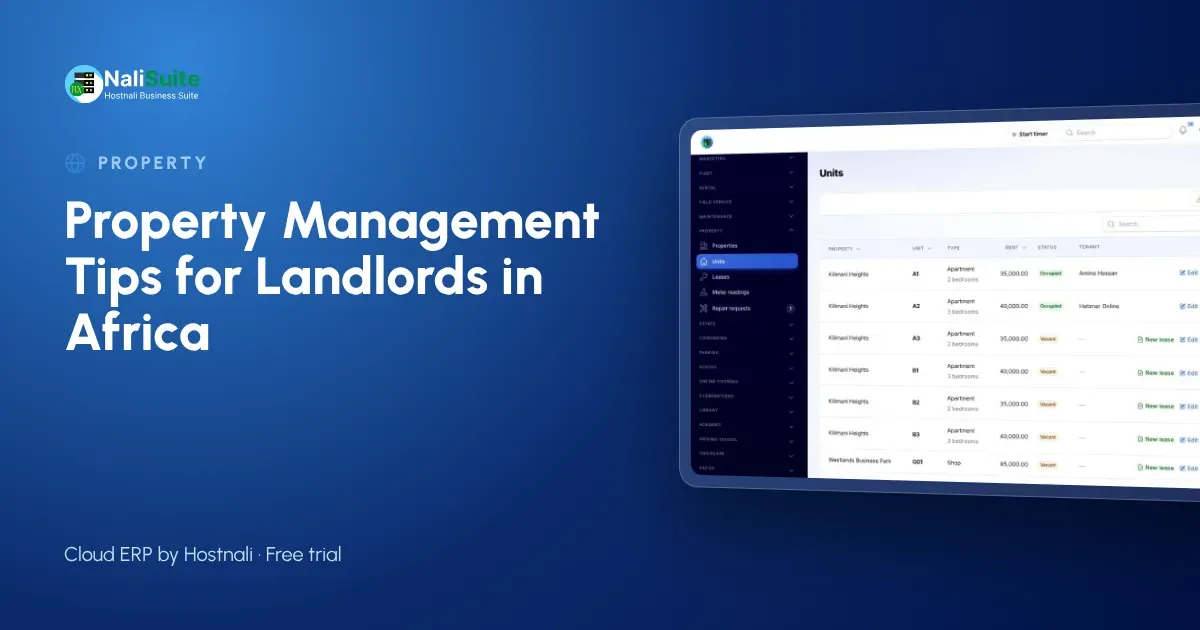
NaliSuite’s Property Management add-on is built for this: properties and units with occupancy, leases with deposits and yearly increases, rent and service charge invoiced every period with part months worked out, utility billing from meter readings, arrears and late fees, repair requests from tenants and statements for the owners you manage for.
It uses the same billing engine as Subscriptions, tenants pay through mobile money and other payments, and they can see invoices and report issues in the customer portal. Estates and gated communities can add the Residents’ Associations add-on for service charges, levies, gate passes and AGM votes.
Statements for owners and for yourself
If you manage property for others, send each owner a monthly statement: rent invoiced, rent collected, expenses paid and the balance due to them.
If you are the owner, the same report tells you which properties earn their keep and which need attention.
You also hold tenants’ IDs, phone numbers and payment records. Keep them secure and use them only to manage the tenancy, in line with the data protection law of each country you operate in.
Frequently asked questions
Can I manage properties in several countries?
Yes. Properties can be grouped by country or company, each with its own currency and tenants, with reports across all of them.
Which payment methods can tenants use?
Tenants can pay by mobile money where available, such as M-Pesa, MTN MoMo or Airtel Money, or by card or bank transfer.
Is there an extra cost for the property add-on?
Yes. The Property Management add-on is added to any NaliSuite plan and billed with the subscription; plans start from $2.10 a month.
Can I import my existing tenants?
Yes. Tenants, units and current balances can be imported from Excel, so you start with your real figures.
Try NaliSuite
Start a free trial, add one building and its tenants, and let the next month’s invoices go out automatically. See the plans.