USD
 KES - Kenya
 UGX - Uganda
 TZS - Tanzania
 RWF - Rwanda
 NGN - Nigeria
 ZAR - South Africa
 USD - Zimbabwe
 GHS - Ghana
 ETB - Ethiopia
 ZMW - Zambia

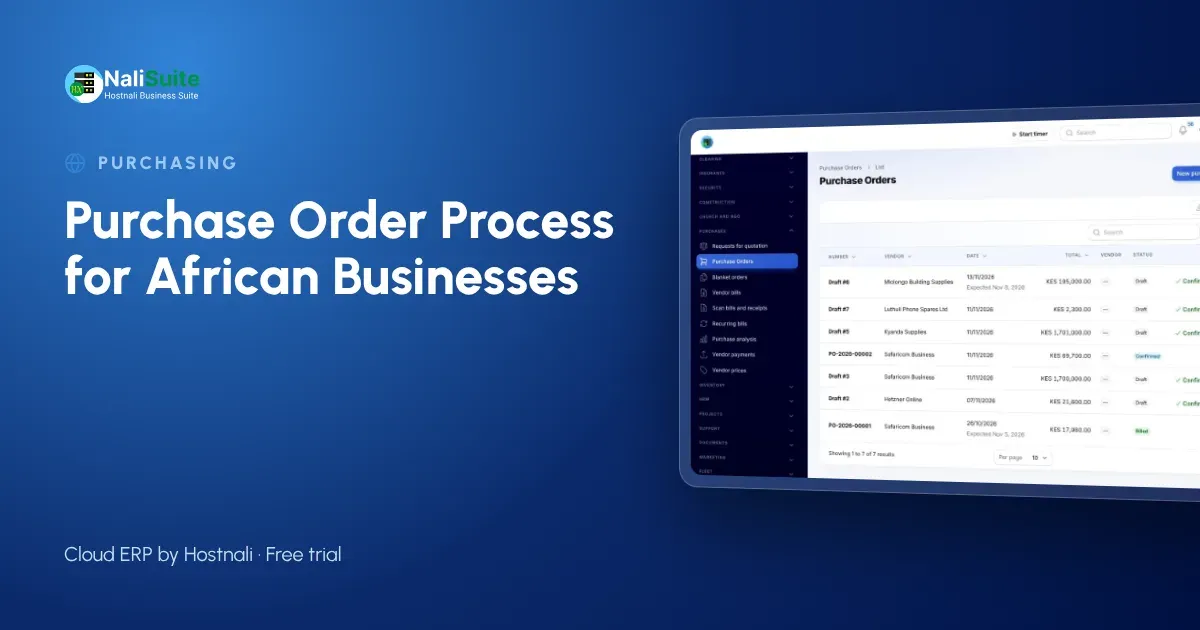
From a distributor in Lagos to a lodge in Arusha, African businesses lose money in the same place: buying that nobody controls. Orders go out by phone, deliveries are signed by whoever is around, and bills are paid without a check.
This guide sets out a purchase order process that works whichever country you trade in.
Why buying needs a process
Buying is where a business commits cash before it sees a return. If that step is loose, you find out at month end, when the money is already gone and the supplier has already been paid.
The purchase order process, step by step
1. Ask for it
The person who needs the goods records a request with the item, the quantity, the reason and a preferred supplier.
2. Get it approved
The right manager says yes or no. Small amounts can be approved by a supervisor; bigger ones go up to the owner.
3. Order from the supplier
The supplier receives a purchase order, not a phone call. It carries a PO number they quote on their delivery note and bill.
4. Receive
When the goods arrive, someone counts and checks them against the PO and records what was actually received, including short or damaged items.
5. Pay what you received
Pay the supplier for what was delivered at the price on the PO, and record the payment against that bill.
Three-way matching
Three-way matching sounds technical, but it simply means comparing three documents before you pay:
| Question | Answered by |
|---|---|
| Did we order this, at this price? | The purchase order |
| Did it arrive, and in good condition? | The delivery record |
| Is the supplier charging only for that? | The bill |
A bill that matches goes into the payment run. A bill that does not goes back to the supplier with a question, and is paid once it is corrected or a credit note arrives.
Example: a distributor with branches in two countries
Consider an example distributor of household goods with branches in Accra and Lusaka. Each branch bought from its own suppliers in its own currency, and head office only saw the total at month end.
After introducing purchase orders, branch managers raise requests, head office approves anything above the branch limit, and suppliers receive POs in the agreed currency. Each branch records its deliveries. Bills are matched before payment by bank transfer or mobile money, and head office sees spending per branch, supplier and currency.
Tax records across countries
Every country has its own rules for supplier invoices and tax. In Kenya, expenses generally need an eTIMS invoice from the supplier; Uganda uses EFRIS, Tanzania EFDs and Rwanda EBM invoices; Nigeria is moving businesses onto e-invoicing in phases. Check what your tax authority requires and keep the supplier’s invoice with the matched bill.
NaliSuite lets each company set its own tax rates and currency, which helps when you trade in more than one country. See multi-company and branches.
Common mistakes to avoid
- Bills paid on the day they arrive. Pay on the due date, after matching.
- Deliveries left unchecked overnight. Count goods when they arrive, while the driver is still there.
- Suppliers without records. Keep each supplier’s contact, tax number and agreed prices in one place.
- No review. Look at spending by supplier every quarter.
Approvals for teams in several places
When branches sit in different countries or towns, approvals cannot depend on someone being in the office. Approvals on a phone keep orders moving: the branch manager approves within their limit, and head office sees only what is above it.
Keep agreed prices per supplier and per currency, so every new PO starts from the right figure. Review suppliers every quarter on price, delivery time and accuracy.
Head office or each branch then pays matched bills by bank transfer or mobile money, quoting the bill number, and reconciles every account once a month. See bank and mobile money reconciliation.
Doing it in software
Software turns the process into a few taps. NaliSuite Purchases takes a request through approval to a PO, records what is received into inventory, and sends matched supplier bills to accounting, ready to pay.
Frequently asked questions
Can I run purchase orders in several currencies?
Yes. NaliSuite handles several currencies, so each PO, bill and payment uses the currency agreed with the supplier.
Do supplier invoice rules differ by country?
Yes. Check with your tax authority what a valid supplier invoice must show, and keep it with the matched bill.
Is a purchase order legally binding?
Once a supplier accepts a PO, it usually forms the basis of the agreement on price, quantity and delivery. Keep the accepted PO with the bill.
Do small businesses really need purchase orders?
If more than one person buys on behalf of the business, yes. Even a simple request-and-approve step stops most mistakes.
Try NaliSuite
NaliSuite brings purchase orders, inventory and supplier bills into one cloud system. Plans start at $2.10 a month. See what is included.