USD
 KES - Kenya
 UGX - Uganda
 TZS - Tanzania
 RWF - Rwanda
 NGN - Nigeria
 ZAR - South Africa
 USD - Zimbabwe
 GHS - Ghana
 ETB - Ethiopia
 ZMW - Zambia

Subscription businesses are growing fast across Africa: software firms in Lagos and Nairobi, internet providers in Kampala and Lusaka, co-working spaces in Accra and Kigali, and thousands of traditional businesses that have always billed monthly, such as landlords, schools and security firms.
All of them need the same thing: invoices that go out on time and payments that arrive on time. This guide covers the signs that your billing needs to be automated, and how to do it well.
Six signs you have outgrown manual billing
- Invoices go out on different days every month. The date depends on when someone has time.
- Your team spends the first week of the month chasing payments.
- You cannot say, quickly, how much is owed and by whom.
- Price changes take days to apply. Each invoice is edited by hand.
- Customers ask for statements you have to put together manually.
- You do not know your churn. You see the bank balance but not who has left.
If three or more apply, recurring billing software will save you time and money.
The core idea: a subscription
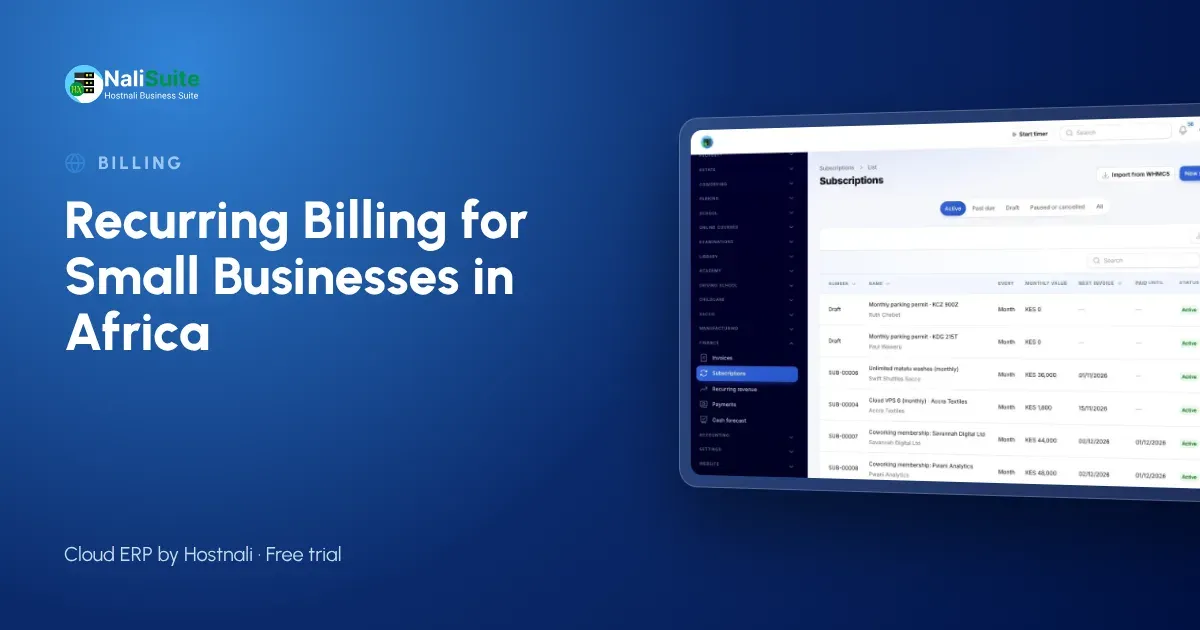
A subscription is a record that says: this customer pays this amount, for this service, every period, from this date (and perhaps until that date). Once it exists, the system does the rest.
NaliSuite Subscriptions supports weekly, monthly, quarterly and yearly periods with start and end dates. It creates invoices on schedule, sends them by email or WhatsApp, and records the payment when it arrives.
Getting paid on the continent
How customers pay varies by country: M-Pesa in Kenya and Tanzania, MTN MoMo in Ghana, Uganda, Rwanda and Zambia, Airtel Money in several countries, Orange Money and Wave in francophone West Africa, and cards and bank transfers everywhere.
The simplest way to get paid on time is to put a pay link on every invoice. NaliSuite invoices can carry a link to pay by mobile money or card through the providers you connect; see the mobile money payments page. Payments made through the link are matched to the invoice automatically. Bank transfers can be matched from your statement in NaliSuite Accounting.
Setting it up well
Design your plans
Plans are the packages customers buy: “Basic hosting, monthly”, “Co-working hot desk”, “Grade 4 fees, termly”. Put customers on plans rather than giving each a custom price. Price changes then take one edit.
Choose your billing rhythm
- Fixed date: everyone billed on the 1st. Simple for rent and contracts.
- Anniversary: each customer billed on the day they joined. Common for software and memberships.
- Annual with a discount: many subscription businesses offer a lower price for a year paid upfront, which improves cash flow.
Handle changes fairly
Customers upgrade, downgrade and pause. NaliSuite works out the difference when a plan changes mid-period and lets you pause and resume with clear dates.
Automate reminders
NaliSuite Invoicing sends reminders before and after the due date and statements showing each customer’s balance. Polite, regular reminders work better than an occasional angry call.
Offer self-service
In the customer portal, customers can see and pay invoices and, if you allow it, upgrade, pause or cancel their own subscription. For software and internet businesses, that is now expected.
Tax and e-invoicing
Every recurring invoice must follow the tax rules of the country where you bill. VAT rates differ across Africa and change over time, so set the right tax on each plan and update it when rates change. Where e-invoicing is required, such as eTIMS in Kenya or e-invoicing in Nigeria, each automatic invoice has to be submitted too; NaliSuite provides those connections and the business uses its own credentials.
If you bill customers in several countries, consider a separate company for each. NaliSuite’s multi-company feature keeps each company’s currency and taxes apart under one login.
The numbers to watch
- Monthly recurring revenue (MRR): the predictable income from your subscriptions.
- New subscribers: how many joined this month.
- Lost subscribers and churn: how many left, as a share of the total.
NaliSuite shows these on a subscription dashboard. A business with growing MRR and low churn can plan hiring and investment with confidence.
Moving from WHMCS
Many African hosting and IT companies bill through WHMCS. NaliSuite imports clients and services from WHMCS, so you can move your billing without a gap and bring it together with accounting, support and sales.
Frequently asked questions
What kinds of businesses can use recurring billing?
Any business that bills the same customer on a schedule: rent, school fees, memberships, service contracts, retainers, software and internet subscriptions.
Can customers pay with mobile money?
Yes. Invoices can carry a link to pay by mobile money or card through the providers you connect.
What if a customer wants to pay yearly?
Create a yearly plan, often with a discount, and the invoice is created once a year.
How do I reduce churn?
Watch who pauses or downgrades, contact them early and make it easy to stay, for example by offering a smaller plan instead of cancelling.
Try NaliSuite
NaliSuite gives African subscription businesses automatic billing, mobile money pay links, a customer portal and churn reports in one system. Plans start at $2.10 a month with a free trial; see the plans or learn more about NaliSuite.