 ZMW
 KES - Kenya
 UGX - Uganda
 TZS - Tanzania
 RWF - Rwanda
 NGN - Nigeria
 ZAR - South Africa
 USD - Zimbabwe
 GHS - Ghana
 ETB - Ethiopia
 USD - International

For many Zambian businesses the year has a rhythm. An agro-dealer in Chipata sells seed and fertiliser in a rush from October to December and then waits for the harvest. A school uniform shop in Ndola is packed in January and quiet in June. A lodge near Livingstone fills up in the dry season. Looking at one month’s profit in isolation tells you very little in businesses like these.
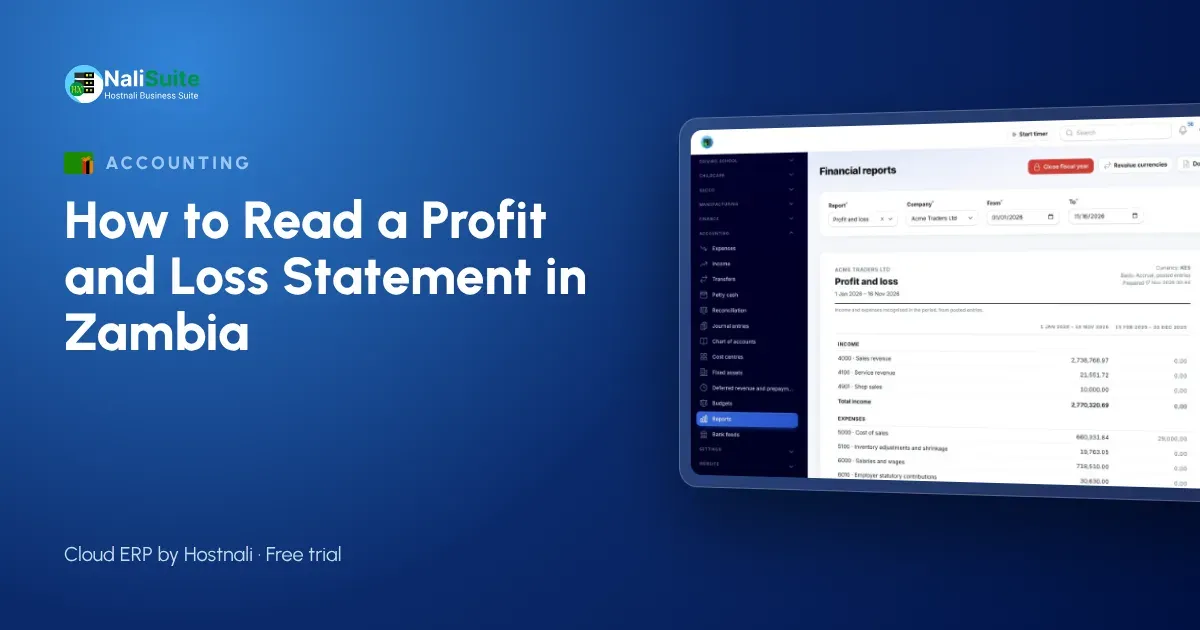
This guide explains how to read a profit and loss statement (P&L), and how to read it in a way that respects the seasons your business lives by.
The P&L in one paragraph
A profit and loss statement shows the income earned and the costs incurred over a period. Income is counted when you sell, even if the customer pays later. Costs are counted when they are used, even if you pay the supplier later. The difference is profit. It is not the kwacha in your bank account or MTN MoMo wallet, which also moves with loans, stock purchases and money the owner puts in or takes out. For the cash side of the story, read our cash flow tips for Zambian businesses.
The lines, and what they mean for a seasonal business
Revenue. Sales for the period, excluding VAT if you are registered. In a seasonal trade, revenue swings widely. That is expected.
Cost of sales. The cost of the goods you actually sold. Stock bought in September for the planting season is not a cost until it is sold. If you count it as a cost when you buy it, September looks like a disaster and November looks like a goldmine, and neither is true.
Gross profit and gross margin. Gross profit is revenue minus cost of sales; gross margin is that figure as a percentage of revenue. Unlike revenue, margin should be fairly steady through the year. If it is not, something other than the season is going on.
Operating expenses. Rent, wages, transport, electricity and backup power during load management, phone and data, mobile money and bank charges. Many of these are fixed: you pay rent in the quiet months too. That is why quiet months often show a loss.
Operating profit. What trading earned after running costs.
Finance costs and tax. Interest on loans (often taken to buy stock ahead of the season) and income tax. Check current tax rules with ZRA or your accountant.
Net profit. What remains for the owners.
Reading it the seasonal way
Compare with the same period last year
October against October, not October against September. That comparison removes the season and shows whether the business itself is improving.
Look at the full cycle
Add up the twelve months of a full season. A lodge that loses money for four months and makes good profits for eight may be perfectly healthy. The question is whether the good months cover the quiet ones with something left over.
Watch fixed costs in the quiet months
Fixed costs are the ones that decide whether you survive the off-season. If they creep up, the quiet months get longer and deeper.
A worked example: Mutale’s agro-dealership
Mutale sells seed, fertiliser and chemicals near Chipata. His P&L for the season compared with the season before shows:
| Line | Change | What it tells him |
|---|---|---|
| Revenue for the season | Up 18% | More farmers came, partly due to a new cooperative account |
| Gross margin | 22% → 17% | The cooperative was given a large discount |
| Transport | Up 30% | Deliveries to the cooperative’s collection point |
| Off-season losses | Deeper | Rent and two permanent staff unchanged, more interest on a stock loan |
| Net profit for the season | Down | The new account added sales but not profit |
His decision for next season: keep the cooperative, but on a smaller discount with delivery charged separately, and borrow less for stock by ordering in two rounds.
Mistakes to avoid
- Treating a loan as income. A stock loan increases cash, not revenue.
- Skipping the stock count. At the end of each period, count what is left. Without it, cost of sales and profit are unreliable.
- Mixing household and business money. School fees or family shopping paid from the till make the business look less profitable. Our guide to separating business and personal money in Zambia shows how to stop it.
- Reading only once a year. By the time the annual accounts are ready, the next season has started.
Getting the figures each month
Producing a monthly P&L by hand is the reason most owners give up. In NaliSuite Accounting, sales, supplier bills, stock movements and wages post to the books as they happen, so the profit and loss statement, balance sheet and cash flow statement are always current, with comparisons against earlier periods. Budgets let you plan the season and compare actual results month by month. Inventory keeps stock costs right, so cost of sales reflects what was actually sold, and customers can pay by MTN MoMo or Airtel Money with the receipt matched to the invoice.
Frequently asked questions
Why does my business show a loss in some months?
In seasonal trades, fixed costs continue in quiet months while sales fall. Judge the business on the full season and on comparisons with the same months last year.
Should I record stock as an expense when I buy it?
No. Stock becomes a cost when it is sold. Until then it is an asset on the balance sheet.
Does ZRA use my profit and loss statement?
Income tax is based on profit, so your records must support your figures. Ask ZRA or your accountant what your business must file.
How do I compare two branches?
Track each branch separately as a cost centre, then compare their margins and expenses.
Try NaliSuite
Plan the season and see your profit month by month. NaliSuite starts at ₵25 a month with a free trial. Compare the plans.