 ZMW
 KES - Kenya
 UGX - Uganda
 TZS - Tanzania
 RWF - Rwanda
 NGN - Nigeria
 ZAR - South Africa
 USD - Zimbabwe
 GHS - Ghana
 ETB - Ethiopia
 USD - International

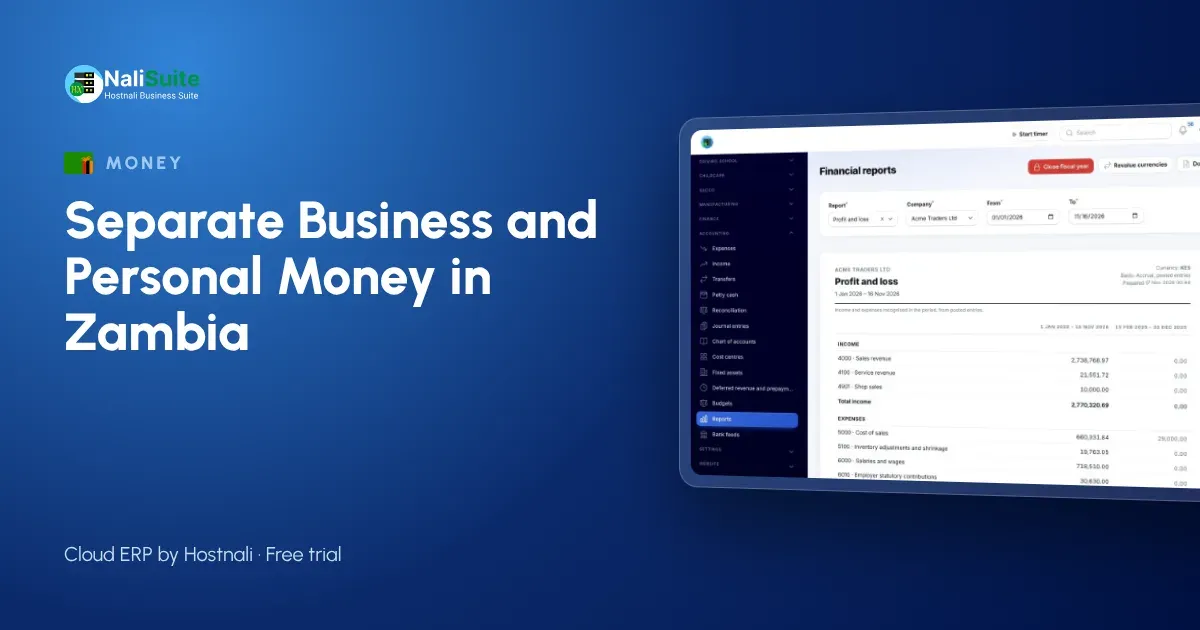
Most Zambian business owners know, in principle, that business money and personal money should be kept apart. Yet very few actually do it, and when you ask why, the same handful of reasons come up. This guide takes those reasons one by one, explains why they do not hold up, and then sets out a simple arrangement that works for a small business with mobile money, a bank account and some cash.
Myth 1: “It is all my money anyway”
For a sole trader, it is legally true that the business and the owner are the same person. But the question is not whose money it is; it is whether you can tell what the business earns. Without that, you cannot price properly, plan for the season or know whether the business is worth the effort. When you register a company with PACRA, the business becomes a separate legal person, and the company’s money is no longer yours to spend freely.
Myth 2: “My business is too small to need this”
The smaller the business, the more a few mistakes matter. A poultry farmer in Kabwe selling a few hundred birds a month cannot afford to discover at the end of the year that feed prices ate the whole margin. Small businesses benefit most from seeing their numbers clearly.
Myth 3: “I keep it all in my head”
You may remember the big transactions, but nobody remembers every mobile money charge, every small cash purchase or every bag of feed taken for the house. Our guide to reading a profit and loss statement in Zambia shows how much detail a useful report needs.
Myth 4: “Separate accounts cost too much”
A second SIM and mobile money wallet costs little. A bank account used only for the business is affordable for most traders. Compare that with what mixing costs: lost profit you never noticed, tax costs you cannot support with records, and loans you do not get because your statements look messy.
Myth 5: “I will sort it out at the end of the year”
Untangling twelve months of mixed transactions is slow, expensive if an accountant does it, and full of guesses. Keeping them apart from the start takes minutes a week.
The simple arrangement
Two wallets, two purposes
Use one MTN MoMo or Airtel Money line, or a merchant account, only for the business: customers pay into it and you pay suppliers from it. Keep your personal wallet for home. A dual-SIM phone makes this easy.
A business bank account
Open an account used only for the business, and move the business wallet balance into it on a set day each week. If you are registered with PACRA and have a TPIN from ZRA, the bank will usually ask for them.
Cash goes to the bank
Bank cash takings regularly instead of spending them on the way home. Every sale then appears on a statement.
The owner is paid on a schedule
Choose a fixed amount and a fixed day. Sole traders transfer it as drawings, which are not a business expense. Company owners can take a salary through payroll with the deductions you set up; ask your accountant which suits you. NaliSuite’s Payroll app produces payslips and records the cost.
Household costs go through the personal account
School fees, rent at home, family support and church contributions are paid from your personal account, funded by your pay. If the business lends you money one month, record it and pay it back.
Receipts for everything
Keep the receipt or invoice for every business payment. In NaliSuite Purchases, you can photograph a supplier bill and Document AI fills in the supplier, lines and tax for you to check.
Chanda’s poultry business, before and after
| Before | After | |
|---|---|---|
| Customer payments | Personal Airtel Money and cash | Business MoMo line and bank account |
| Feed and chicks | Bought with whatever was available | Paid from the business account, receipts kept |
| Birds for the family | Not recorded | Recorded at cost as drawings |
| Chanda’s pay | Taken when needed | Fixed transfer on the last Friday of the month |
| Knowing profit | Guesswork | Monthly report per batch |
The first clean report shows that her profit per batch is good when she buys feed in bulk before prices rise, and poor when she buys bag by bag. She now saves part of each batch’s profit in the business account to buy the next batch’s feed in one go.
A weekly check that keeps it working
Once a week, go through the business wallet and bank statement and explain every line: a sale, a supplier payment, an expense, a transfer between your own accounts or your drawings. Bank and mobile money reconciliation in NaliSuite imports the statements and suggests matches against your invoices and bills, so the check takes minutes. Customers can also pay invoices by MTN MoMo or Airtel Money from a link, with the payment matched for you.
Frequently asked questions
Do I need to register with PACRA first?
No. You can start with a dedicated wallet and account. Registration helps when you open a business bank account or apply for credit.
Are drawings a business expense?
No. They are profit taken out by the owner and do not reduce taxable profit.
What if a customer still pays my personal number?
Transfer the amount to the business wallet the same day, note it, and remind the customer of the business number.
Will this help me borrow?
Yes. Clean statements show what the business really earns. See our guide to records for a business loan in Zambia.
Try NaliSuite
Keep your business on its own books with NaliSuite Accounting, from ₵25 a month with a free trial. See the plans.